
Needs transcription from Original Scan Images DN2023-05-28B-02

240 ByWays DoncasterMirror
21 Pettys Lane
Doncaster 3108.
December 18th 1982
Mrs Joan Seppings Webster.
With reference to your articles on the history of Doncaster which I have been following with great interest.
I would like to know if you would have or could arrange a complete set of the articles which have appeared in the Doncaster Mirror.
My grandmother was one of the early Clay family that you have written about. and my mother is most interested in what you have written, but unfortunately I have not keep all of the sections.
Would you please advise me if this would possible.
Yours faithfully
(signature)
Yvonne C Robbins.
Answered
24.2.83

241 ByWays DoncasterMirror
1853 Thomas Petty
1855 son
Tom Petty (his name was Tom not Thomas)
son
Thomas Henry Petty
son
Henry Royden Petty (my late husband)
son
D.G & RY Petty
This does not include all the descendants of Thomas Petty.
We still have an orchard on the river but not for long.
KYP
Answered
26.6.62
----
Homestead Rd
Templestowe
Dear Mrs Webster,
I have read with great interest your articles in the Doncaster Mirror about the people and history of Doncaster and Templestowe.
May I point out that it was Thomas Henry Petty—my late father-in-law—who settled in Peter St. Templestowe in 1900.
Thomas Petty was his grandfather. Albert Petty another son of Tom Petty also was an orchardist in the area.
Thomas Henry Petty and his brother-in-law Jack Russell tested the spray pump in the Peter St Orchard.
Yours faithfully,
K. Y. Petty
(wife)

242 ByWays DoncasterMirror
Letter 1 (left)
"TIRLEY"
30 Dellas Avenue
Templestowe 3106
2 July 1984
Joan Seppings Webster
c/o Doncaster Mirror
Dear Madam,
My name is Peter Ramsay and I am in Form 10 attending Carey Grammar. For our history option this term we have to outline the history of any building, place or subject. I was considering doing my option on the history of Westerfolds Park (Porter St Templestowe), on who its previous owners were, what the land was used for in the past and how the surrounding it developed. I was wondering whether you might be able to help me find the information by recommending books or sources of information. Any help would be greatly appreciated.
Yours sincerely
(signature)
Peter Ramsay
Answered 6.7.84
---
Letter 2 (right)
35 Thiele St
Doncaster
3108
22-9-81
Answered
31-9-81
To Joan Seppings Webster,
I am a 15 yr old student attending C.L.C. in Eltham.
After reading your articles in the Doncaster Mirror I thought you might be able to help me in a school assignment I'm now involved in. It is on the early history of my suburb.
It would be much appreciated if you could send me any basic information on the history of Doncaster.
I'm especially interested in the early pioneers and the reason for settlement. Also any further information on the Thiele family.
Yours sincerely
Amanda Harris
P.S. I have enclosed a stamped, self-addressed envelope for easy return.

243 ByWays DoncasterMirror
To: JOAN WEBSTER
From: SAVAS MIRIKELIS
Ph. 857-6452
Dear Joan,
I read with great interest your "Curealls (Part II)" article in the March 30 (1982) edition of the Mirror. I am currently studying Australian History in my second year Arts Course at Monash University; a research essay I am writing for that subject is on Melbourne's sanitary condition in the 1880's.
If it is possible I would appreciate discovering your source of information for your March 30 "Curealls" column. This would be of great help when I am citing extracts from that article. I hope you can help me (and shall continue to read your column in the future!)
Yours Sincerely,
(signature)
Savas Mirikelis

244 ByWays DoncasterMirror
LETTERS
1978
Tracing ancestors
Sir,—Joan Sepping Webster's article "Abroad a Convict Ship" was most interesting. In it she averred that the TV serial "Against The Wind" set her searching for ancestors and anecdotes.
Tracing ones ancestors has become one of the fastest growing hobbies in recent years.
The said serial plus the recent book and film 'Roots', have given even greater stimulus to amateur genealogists.
People are taking a greater interest in their forebears and beginning to realise that they were real people and not just names.
They like to know from whence they came, what their relatives did and how they lived.
Formerly, Australians were reluctant to delve too deeply into the past in case they discovered that they were descended from convicts.
There was a stigma attached to them.
Now people seem proud to admit that their forebears were convicts; for many were convicted for such trivial offences as stealing a handkerchief.
Many people even committed offences with the deliberate intention of being caught and transported.
Conditions in England at the time were so bad that they reasoned it would be worth doing seven years to get away and then become free men and women in a new land . . .
The genealogical society of Victoria is a non profit organisation of people who wish to trace their ancestors, compile a family tree or a history of their family.
Members often take on a certain project which will be of benefit to themselves and other members.
Such as, indexing cemetery records, inscriptions from tombstones and similar functions.
A complete list of all convicts who arrived in Australia has already been compiled.
Another such list of all assisted and unassisted passengers is well under way.
Names of all ships is readily available with a complete list of passengers, giving dates, ages, occupation, religion, whether able to read and write, where from and destination.
The society is always willing to accept new members.
The office and library is staffed daily by voluntary helpers who are most obliging to anyone making enquiries.
Information regarding The G.S.V. may be obtained by writing to the secretary, genealogical society of Victoria, or calling at the office and library, Room 4, First Floor, Block Arcade, 98 Elizabeth St., Melbourne. 3000. Or phoning 63 2138.
— Joseph P. Morton,
Lower Templestowe.
245 ByWays DoncasterMirror
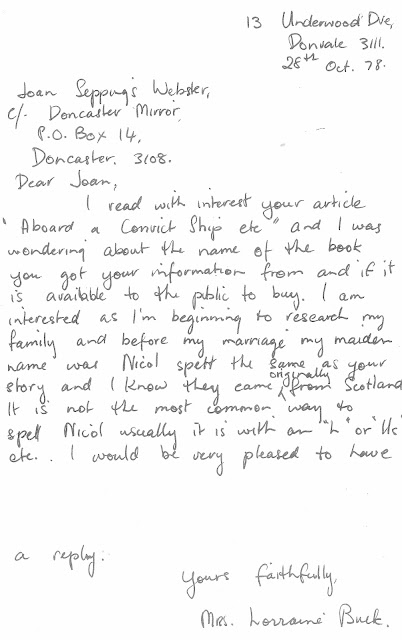
13 Underwood Drive,
Donvale 3111.
28th Oct. 78.
Joan Seppings Webster,
c/- Doncaster Mirror,
P.O. Box 14,
Doncaster, 3108.
Dear Joan,
I read with interest your article “Aboard a Convict Ship etc” and I was wondering about the name of the book you got your information from and if it is available to the public to buy. I am interested as I’m beginning to research my family and before my marriage my maiden name was Nicol spelt the same as your story and I know they came originally from Scotland. It is not the most common way to spell Nicol usually it is with an “h” or “ll” etc. I would be very pleased to have a reply.
Yours faithfully,
Mrs. Lorraine Buck.

246 ByWays DoncasterMirror
Page 40—The Herald, Sat., April 15, 1967
People saved a relic
Pastor Schramm’s cottage, soon to be the venue of a historical reconstruction and exhibition at Doncaster as part of the newly proclaimed city’s Festival of Arts, was all but doomed to demolition seven years ago.
The only chance that it would remain to remind Doncaster’s newer generations of the past rested on the odd hope that its attractive local stone work would one day adorn the foundations of some municipal building, perhaps a bowling club.
But the voice of the people—and the readiness of the council to hear it—saved the day and the house.
In the cottage, most of Doncaster’s forefathers (and mothers) received their early schooling. For many, it was the only school they knew, and was the forerunner of the present Doncaster State School.
Max von Schramm first came to Doncaster to teach the children of Lutheran settlers, but soon his classes grew to include those from all nations and faiths.
HALL USED
He taught first in the Lutheran Church hall and later, from about 1864, in a detached room behind the cottage.
When the State system of compulsory, non-secular education became law in 1876 and the present primary school building was constructed, Schramm continued to give German lessons in his home.
It has been declared “C” worthy of preservation by the National Trust.
But in November, 1960, hopes that the cottage could be renovated for use as a municipal library or museum were dashed by a report that reconstruction would cost between $3600 and $4400.
Led by Mrs Phyllis Whitten, a descendant of one of the earliest pioneers of Doncaster and the orcharding industry, a petition of 754 signatures was collected and presented to council, praying its preservation and restoration.
UNANIMOUS
Council’s reprieve for the condemned cottage was unanimous.
It even asked that all correspondence on the matter be recorded in the minutes for the guidance of future councils faced with a similar decision.
The Doncaster-Templestowe Historical Society—two months old—hopes to fully restore the cottage.
From April 21 to 30 four rooms of the cottage will be on show, completely furnished in the fashion of the pioneer families of the district.
They can be seen from 7.30–10 p.m. week days, and 2 p.m.–5 p.m. weekends for the Display Week.
The cottage is in front of the municipal offices, Doncaster Road.
—JOAN SEPPINGS
---------------
Handwritten note: “Doncaster East Yarra News, Jan 11, 1967”
THEY NEED THE EVIDENCE
A Doncaster Historical Society could be formed, following moves for a Festival of Arts as part of the proposed “City” celebrations.
The prospect of incorporating a tour of historical areas of the district and an exhibition of period furniture and other articles in Schramm’s Cottage, was raised at the inaugural meeting for the promotion of the festival.
But no evidence of a Doncaster Historical Society can be found, the Shire Secretary, Mr J. W. Thomson, has reported.
Persons interested in Shire history, or who may be able to lend photographs or articles connected with the history and growth of the district are asked to contact the festival secretary, Mrs D. A. Smith, 848-1824.
Residents with special interests or talents in the fields of art, ballet, theatre, music, literature and public relations publicity who are willing to serve on an activity committee are needed urgently.
At a meeting on January 9, committee chairmen presented their first reports on organisation of the Festival, to be held from April 14 to 30.
It is hoped to make the festival an annual event.
Handwritten note: “The article that instigated formation of the Doncaster-Templestowe Historical Society.”

247 ByWays DoncasterMirror
DONCASTER AND TEMPLESTOWE NEWS, January 6, 1993
YESTERyear
Templestowe is believed to be unique as a suburb-name.
There seems to be no other place outside of fiction called Templestowe.
It was a name which 19th century author Sir Walter Scott gave to the Preceptory of the English Knights Templars in his novel *Ivanhoe*.
A scene in Scott’s book has hero and villains meet at “Templestowe”.
Some say that our Templestowe was so named because of its proximity to the suburb Ivanhoe.
Scott’s *Ivanhoe*, published in 1819, would still have been popular in 1846 when Templestowe township was being gazetted.
But why was our Ivanhoe so called in the first place?
And from where did Scott derive the name Templestowe?
In England there is a boys’ school called Stowe, set in 300 hectares of beautiful gardens, which came into existence in 1923.
Before that, this place was renowned as “the most influential garden in Europe, the finest example of landscape gardening in the traditional English style”.
It was the haunt of poets and writers, and it was the home of Earl Temple of Stowe.
This fact was revealed to me in 1974 by a visitor to the district, Mr Robert Drayton, who at the time had for ten years been principal of Stowe School.
Mr Drayton felt that Scott would certainly, like so many other writers, have visited and loved the Earl of Temple’s “Stowe”, and that he “quite possibly” derived the name Templestowe from it for his book.
Templestowe had settlers from 1837, but the first maps—by Nutt and Darke 1841 and Hoddle 1844—bestowe no names on the area except those of cattle station owners.
In 1846 its street between what is now Finn’s Reserve and the Templestowe Hotel were designed, drawn up and gazetted as Templestowe township, the first appearance of the area’s name as such.
So, could the early town planners have been fans of Scott and readers of his *Ivanhoe*?
Could they have been reminded by this part of the Yarra Valley—which was by then metamorphosing into a beautiful agricultural area—of the sparsely populated agricultural area of the English midlands which surround Temple’s beautiful Stowe, through which also flows a river?
The English Stowe, incidentally, is not only connected with temples by the name of its Earl.
Actual temples abound there—38 of them.
Stowe was originally built in the early 1600s, being developed to its splendor over some centuries by the Temple family who bought it circa 1700, one of Marleborough’s generals providing money for extensions and improvements later in the 18th century.
Another link of Templestowe with Temple’s Stowe, though obscure, is interesting: a member of the family of Temple of Stowe married a Newman from Melbourne in 1913.
Major Charles Newman was Templestowe first permanent settler.
The Temple’s Stowe house was sold in 1921 for 40,000 pounds, after which it became the boys’ school.
Is it co-incidental that for long battles have raged over conserving the landscape of our Templestowe for its special peace and beauty?
—JOAN WEBSTER

248 ByWays DoncasterMirror
TULLAMORE in the 1930s … now a golf clubhouse.
A doctor’s delight
The imposing white mansion half-way up the north side of Doncaster Hill was built in 1887 for Melbourne’s then leading surgeon, Sir Thomas Fitzgerald.
“Tullamore”, named after his birthplace in Ireland, is now the Eastern golf clubhouse.
The red brick 12-roomed mansion, is richly decorated with stained-glass windows in the stairwell and gothic windows.
Fitzgerald was a colorful character and at times the ringleader of controversy.
Probably the most prosperous surgeon in the colony, he once told a friend that he had earned a million pounds ($2 million) in professional fees.
He owned the famous nude portrait *Chloe*, later to become a famous feature of Melbourne’s Young & Jackson’s Hotel, and said he liked Chloe “because she was anatomically correct”.
In his book *Hospital and Community*, K. S. Inglis tells how Fitzgerald was the only senior surgeon of the Melbourne Hospital who visited wards regularly to instruct medical students.
No colleague or student who watched him at work ever forgot “the beauty and brilliance of his performance”. Up to 100 students would watch him, seated on raised tiers inside the operating room.
Fitzgerald was the only surgeon who could successfully operate for club foot and cleft palate.
Back in his home country, before Lister “discovered” antisepsis, Fitzgerald devised his own methods of surgery which lessened the chances of infection.
But he was never a convert to the then new aseptic method, pioneered in German operating rooms in 1885, of using carbolic.
Although washing his hands before operating, he was known to step back during surgery, pull a handkerchief from his pocket and blow his nose.
He never entirely accepted the germ theory.
Fitzgerald promulgated hospital reformer Florence Nightingale’s 1859 theories of ventilation and cleanliness, although these had produced a “furore in the (British) medical world”.
Yet when he operated, a crowd of doctors and others stood around the operating bench, wearing street suits and no masks, gowns or gloves.
Insight
Despite this and his nose-blowing, Doncaster’s Dr Fitzgerald had more insight into post-operative infections than most of his colleagues, who dismissed as natural and necessary a certain amount of what they called “laudable pus”.
In 1885 there was a severe wave of blood poisoning at the Melbourne Hospital.
Noticing that his private patients, who were nursed at home, survived twice as well as his hospital patients, he refused to operate in it.
The climax came when three of his patients became infected there in the same week. He told the management to burn the hospital down.
Out of this came a Royal Commission recommending a new hospital at Parkville on a site then known as the Pig Market.
But it wasn’t until 1942 that the Royal Melbourne Hospital open there.
—JOAN WEBSTER

249 ByWays DoncasterMirror
DONCASTER AND TEMPLESTOWE NEWS, December 16, 1992
YESTERyear
Council’s part to save a piece of city’s history
Schramm’s cottage, just named “Victorian tourist attraction of the year”, was saved from demolition twice.
The voice of the people—and the readiness of Doncaster-Templestowe councillors to listen—saved it.
Originally it was just west of the Municipal Offices.
In 1960 its only hope was to be renovated and used as a library, which Doncaster-Templestowe lacked at the time.
Demolishers suggested its attractive Ruffey’s Creek stone be commemorated by adorning the foundations of some future municipal building one day, or decorating the bowling club.
Costs for the proposed cottage-library of $3600–$4400 and Shire President Mr Percy Whithers’ opinion that its atmosphere would be lost if modern windows and doors were installed and a tiled roof added, caused the idea to be abandoned.
Then a thought that chilled preservationists was put by Cr A. E. Ireland: the cottage would be in the way when Doncaster Rd, then a narrow two-laned road, was widened.
As council’s Christmas recess approached, a demolition order was hovering over the heads of the historically-minded.
But council’s decision—specifically in order to allow time for full expression of public opinion—to defer any order until the new year, brought a temporary reprieve.
It also gave councillors time to assess their voter strength.
Cr Ron McKenzie (after whom Doncaster’s first library in Churchill St was named) had warned his colleagues that Progress Association members, activists all, were strongly preservationist.
The Progress Association was the biggest, if not the only, pressure group at the time, the Historical Society being another seven years away from formation.
The preservation push was led by Mrs Phyllis Whitten, descendant of Doncaster pioneers Thomas and Jane Petty.
Mrs Whitten organised the collection of 754 signatures on a petition: “For the restoration of Schramm’s historic home, which”, it stated, “will probably be the last link with early Doncaster-Templestowe.”
So keen was local interest that extra chairs had to be brought into council chambers’ public gallery for the petition hearing, presented by Cr Les Cameron whose family had been in the district for 100 years.
In an unusual procedure, Shire Secretary Mr Jack Thomson included in the minutes the people’s viewpoint and all correspondence on the subject, “for guidance of any future council faced with a similar decision.”
Council carried unanimously the motion to preserve the cottage. However, rumblings of “inevitable” demolition for road widening persisted.
A small group of people, linked by caring interest alone, with as yet no formal organisation, worked quietly for years repairing the cottage and collecting memorabilia.
In April 1967 more than 1000 people flocked through the cottage in the first 10 years of an historical display organised by Mrs Whitten, Mrs Loris Webster and Mrs Hazal Poulter (descendant of Templestowe pioneers Thomas and Emily Chivers) for the newly formed Historical Society.
In 1968 the forecast widening of Doncaster Road happened, and precipitated another demolition crisis. An ingenious design to route it so the cottage would stay as an island was put by local architect Mr Horace Tribe.
After much heart-burning and public discussion stimulated by publicity in *Leader’s East Yarra News*, the decision was made to allow volunteers to move the cottage, brick by numbered brick, to its present position.
The shift in 1971 to the site of the first Lutheran church, of which Schramm was first resident Pastor, was almost like completing an historic circle.

250 ByWays DoncasterMirror
DONCASTER AND TEMPLESTOWE NEWS, December 9, 1992
A transport service to suit the community
By JOAN WEBSTER
After Doncaster’s famous electric tram service closed in 1896, Mr Victor Sonenberg operated a horse-drawn coach service from Box Hill to the Doncaster Hotel.
By 1912 his run took only 45 minutes with a four-horse coach and Mr Sonenberg was so pleased he extended the line to East Doncaster, with five trips on weekdays and two on Sundays.
At the far eastern end of the municipality a horse-drawn coach ran daily between Warrandyte and Ringwood.
A quaint aspect of Doncaster’s early public transport was 20-passenger touring cars, used for a short while around the time of World War 1.
These were very wide motor cars which could seat four or five passengers across each seat and each seat had its own door.
These early versions of the mini bus were instigated by the Doncaster Progress Association and run by a company known as the British Motor Service.
The Progress Association also, in an effort to have buses on the roads as far as East Doncaster Post Office, paid six pounds a week to another bus company, (the General Motor Bus Company), which ran in Toorak, through Kew, to St Paul’s Cathedral opposite Flinders Street Station.
To cover cost, three trips a day with fares of two shillings to Melbourne, or threepence from East Doncaster to Doncaster, and carrying forty passengers daily had been planned. But it was the start of the same old story—high running costs and lack of patronage—and it lasted only a few months.
Before World War 1, Mr Sonenberg had also turned to motor with a 26-passenger bus for his Box Hill to Doncaster run. But scarcity of petrol and replacement parts due to the war forced him to return to horses.
In 1919, Kew traders and Doncaster people co-operated to start up a solid-tyre bus service between their districts.
Then a medley of operators hopped on the bus bandwagon and four or five services ran simultaneously in the district. Bus operators touted for passengers, some even sending cars ahead along the routes to pick up passengers for transfer to their bus for the run to the city.
Because of this fierce competition between bus companies, in the 1920s the area enjoyed better public transport services pro rata population than it has ever had since.
Percy Withers, a councillor of Warrandyte Riding from 1957–61, Shire President in 1960 and a long-time member of local progress associations, became a name synonymous with Doncaster bus services.
His father, A. C. Withers, had made a jerky start for Warrandyte passengers in 1911 but the service did not pay and it stalled in 1913. The family bus company later became Pioneer Motors. Withers’ bus drivers were always known for their helpfulness and courtesy.
From 1925 the P. C. Withers company ran well and after World War 2 provided the only public transport until the Melbourne and Metropolitan Tramways Board took over in 1961.
With the MMTB, passengers looked forward to an improvement on the Withers’ one and two hourly off-peak buses, and to more at evenings and weekends. Instead, the service deteriorated. Buses did not connect with each other nor with trains. Drivers did not keep to timetables and often did not know the routes.
In 1965, fifty years after its first public transport venture, the East Doncaster Progress Association initiated a survey of residents’ public transport needs which in fact I, with the help of my former husband Edgar Seppings, carried out, both of us long-time active members of that Association.
By door-to-door discussion with a detailed questionnaire on local needs, and through investigations of the complaints and suggestions of more than 300 residents, I compiled 30,000 word report with which I pestered the MMTB, politicians and the press.
One jerky public transport service has so often needed a push.'

251 ByWays DoncasterMirror
YESTERYEAR
Medical mayhem
By JOAN WEBSTER
Would-be life-savers of old didn’t know much about surf boards, mouth-to-mouth resuscitation or even neck-to-knees.
But they did read Mrs Isabella Beeton’s reference, *The Doctor*, which spelt out what to do in the event of an accident including everything from drowning to lightning strikes.
For drowning, she warns: “Never hang a person up by the heels. Hanging a person up by the heels would be quite as bad as hanging him (sic) up by the neck.”
“It is an error to suppose that water gets into the lungs,” she proclaims.
The “proper treatment”, according to Mrs Beeton, is for the victim to be wiped dry and then, wrapped in blankets or the clothes of bystanders, taken to the nearest house and put in the bath.
It could be a good idea to wrap up the denuded bystanders also, she says.
The bath should be as hot as the hand can stand then: “artificial breathing should be had recourse to while he (sic) is in it.”
Three persons are required for this operation. (High button boots, crinolines, all in together, I guess.)
Reading her description of this resuscitation method, the procedure will soon fall into place—some place—probably the bath.
“The first person should put the nozzle of a common pair of bellows into one of the patient’s nostrils; the second should push down and then thrust back that part of the throat called the Adam’s Apple, and the third should raise and depress the chest.
“The three actions are performed in the following order: first of all, the throat is drawn down and thrust back; then the chest is raised and the bellows gently blown into the nostril.
“Directly this is done the chest should be depressed. The mouth and other nostril should be closed while the bellows is being blown.”
The whole process is repeated 18 times a minute until “absolute signs of death are visible”. Whether this means the death of the patient or of the resuscitators Mrs Beeton does not make clear.
Victims of sufficient stamina to survive the bath and bellows treatment should be: “taken out after 10 minutes of water treatment, placed flat on their back in a warm bed, wiped perfectly dry and rubbed with a warm flannel.”
Mustard poultices and warm bricks are now applied; poultices to the soles of the feet, bricks to armpits and thighs.
A patient who now stirs is probably trying to escape. However, regard it as a sign of life, tickle under the nose with a feather and pass the smelling salts.
Further on Mrs Beeton adds: “The bath is not really necessary, Sir B. Brodie saying that warm air is quite as good as warm water.”
About 24 hours after the victim has been revived it may be necessary, Mrs Beeton points out, to bleed the convalescent and administer an aperient draught: “…for the peculiar head symptoms which occur now and then.”
The same rigmarole is advised for “a touch of lightning” and for anyone affected by poor ventilation or bad smells.
Except Mrs Beeton admits for lightning it is not much use: “when death takes place at all, it is generally instantaneous.”

252 ByWays DoncasterMirror
DONCASTER AND TEMPLESTOWE NEWS, November 11, 1992
YESTERYEAR
Horsemen, pass by
The aura surrounding the Melbourne Cup evokes a mystique almost equal to that of another cup followed with fervor in days of old—the Holy Grail.
And I’ll lay odds that more workers down tools for three minutes on the first Tuesday in November, than for two minutes homage to Australia’s official ideals just one week later.
The first Melbourne Cup was run on Tuesday, November 7, 1861, the traditional Tuesday not beginning until 1875.
But horses had been racing in Melbourne from 1838, three years after the town’s foundation.
The first race track stretched from near the site of the North Melbourne railway station to where Spencer Street Station is now.
The grandstand was a row of bullock carts, jockeys dressed in ordinary workmen’s clothes and horses were weighed in with a butcher’s steelyard.
The Australian reputation for betting on anything may have stemmed from then.
Bets were laid and paid in rum.
Alas!
And whereas today many a punter drowns his losses in drink, one racegoer after that first meeting was drowned by his winnings. He drank them there and then, staggered off, and fell into the Yarra.
The track was moved to the present Flemington site in 1840.
The Cup itself, a piece of plate valued at 100 sovereigns, was added to the prize money in 1865, the year of the birth of two other Cup Day rites—the fashion parade and the public holiday.
The stretch of grass inside the course had been landscaped into a gentle slope dotted with seats, making an ideal stage for the ladies to display their form. Some have always managed to provoke a traditional protest.
In contrast to the bowls, back in 1965, over model Jean Shrimpton’s mini skirt, complaints in 1868 were on too much coverage.
“The ladies are now wearing such long trains that, if fashion demands they be any longer, Mr Bagot (VRC Secretary) had better look for an extension of the parading ground,” commented one writer.
These protests were disallowed, and by 1881 the lady who attracted most attention wore a peacock train some yards in length which, it was said, “flowed like a glittering rivulet along the sward”.
During World War II, when the Cup prizes were reduced to a £200 Austerity Bond and the race itself held on a Saturday, the holiday was still held on the first Tuesday in November.
First gazetted in 1865 as a half holiday for public servants and bank officials, it became a day for family outings.
From soon after breakfast, drays and furniture vans loaded with happy families filled the roads to Flemington while, ironically, church denominations which abhorred betting (such as Methodists) used the race day to set off in other directions for their traditional Sunday School picnic.
Ah, well, it is an Australian heresy to consider “a flutter on the Cup sweep” as ordinary gambling.
—KATE GREEN
Image caption: Melbourne artists have been painting race horses since 1838, but are a horse’s four hooves ever off the ground at the same time, as depicted here?

253 ByWays DoncasterMirror
YESTERYEAR
Pioneer’s lucky strike
By JOAN WEBSTER
Pound Bend, Warrandyte, a favorite picnic spot for families from all over Melbourne, is part of the heritage of Australia. Its tunnel is believed to be unique in the history of gold mining in Victoria.
The man behind the creation of Pound Bend Tunnel, David Mitchell, was also famous as the father of Dame Nellie Melba.
The name Pound Bend came from an animal pound which used to be in the area.
Near Pound Bend, the Yarra River winds back a horseshoe arch.
Mitchell realised that by diverting the river through a tunnel in the neck of the bend the water could be dammed, leaving about three miles of river bed exposed for dredging for gold.
He formed the Evelyn Tunnel Gold Mining Company and on June 3, 1870, blasted what was then the Evelyn Tunnel.
Three months and 2100 pounds later, the 634 ft tunnel (18 ft wide and 14 ft high) was completed.
With 1100 sandbags holding the river back, 1500 gallons a second of water raced through the tunnel.
At this well-known beauty spot the river now ripples pleasantly over pebbles, trees trail their branches in the water and swallows swoop through the echoing tunnel.
About 8000 pounds of gold were taken from this part of the river bed in 12 months but dredging costs greatly overtook returns and the company was liquidated.
The land around Pound Bend is probably one of the few former Aboriginal tribal lands near a metropolis which is still in a bush-like state.
When Warrandyte was surveyed in 1841, 1103 acres of Yarra Tribe land, which included Pound Bend, were set aside for a reserve and from the Aboriginals living there in 1843, native police were recruited.
They wore a uniform of green jackets with possum skin facings, black trousers with red stripes, and green caps with red bands.
The name Warrandyte is said to come from the words “warran”, to throw, and “dyte”, the object thrown at, echoing the boomerang throwing and corroborees of that time.
Under its original name of Anderson’s Creek, Warrandyte was the site of Victoria’s official first gold discovery in June 1851; it was the first officially declared gold field; the first area to have a Gold Commissioner and the first issue of a gold licence was made there.
The remains of many mining tunnels can still be seen in the nearby timber mining reserve.
Image caption: WORKING at Pound Bend Tunnel.

254 ByWays DoncasterMirror
DONCASTER AND TEMPLESTOWE NEWS, October 21, 1992
YESTERYEAR
School a post office
Image caption: THE East Doncaster School and Post Office in 1900.
East Doncaster Primary School on the corner of George St and Blackburn Rd once doubled as a post office.
The first tiny government school, known as Deep Creek, appeared on a two-acre hill-top site above St Phillips Church of England, and, near the creek crossing on Anderson’s Creek Rd in 1875.
The education of children in East Doncaster in the 1870s was by night classes in the Methodist Church at the corner of Doncaster and Blackburn roads, conducted by the Misses Faulkner.
The opening of State Primary School No. 2096 supplemented their work.
In 1877 it was rebuilt as a 24ft x 16ft (8m x 5m) timber schoolroom with an adjoining three-roomed residence, on a five-acre block which the Education Department owned at the corner of Andersons Creek and Reynolds roads.
Average pupil attendance during the first year of the new state school was 28, dropping in the years following to 16.
Maybe the steep hills discouraged the children, who had to walk up and down them and from their learning, after and again before, orchard chores.
Many times, epidemics of fatal infectious diseases such as diphtheria, scarlet and typhoid fevers closed Deep Creek Primary, and it became known as an “unhealthy” school.
The habits of householders were unhealthy in that era. It was normal housekeeping practice to empty “bedroom receptacles” outside the door each morning and city people dumped their so-called “night-soil” on the districts’ vacant land.
Children had to walk to school along muddy roads and overflowing gutters—often overflowing with effluent—and parents complained to the shire council that this caused the also fatal whooping cough.
By 1885 the then head teacher, Mr Kelso, was writing “…if the school is left in its present position for a year or two more I will have but seven or eight pupils to teach…” and urging its removal to higher, drier and more thickly populated Germantown. That year there was a typhoid outbreak.
Next year the school—one big classroom and teacher’s residence combined—was moved to the corner of Blackburn Rd and George St (then German Rd) its present site.
In 1877 the big classroom doubled as a post office. A slot in the front wall facing Blackburn Rd received mail and above it the signs: “VR Post Office” and “State School No. 2096” shared honors.
The people of Deep Creek were very community minded and assertive. They kept their children home because they were so concerned about the way it was being conducted.
One new head teacher in 1891, Thomas Rutter, died of typhoid only six weeks after he had come there from Warragul, and that year the name was changed from Deep Creek to East Doncaster.
As the years rolled into the 20th century, troubles continued to beset the school. One teacher was dismissed by the Education Department, another burned the school records, and there was community turmoil after the burning of an effigy of a member of the school committee.
In 1920 the attached teacher’s residence was replaced by a weatherboard house on the east side of Blackburn Rd.
From then until the baby boom of the 1960s, the big “post office” room—the original school room—held infants, first, second, third and fourth grades, with fifth, sixth, seventh and eighth in a new room added that year.
The 1960s brought big changes and more additions, but the “post office” room continued to be used by the sixth grade for over a decade more.
In the 1920–60s era the school continued in a placid way. A small shop built opposite in 1913, was run by a Mrs Sykes and for many years by the legendary and indomitable Miss Jamieson, servicing the needs of the growing numbers of students, staff and nearby residents until the building boom of the 1970s brought about its demolition, too, and created traffic lights and a bustling shopping centre.
—By JOAN WEBSTER
No comments:
Post a Comment