
A local history book, "The Life and Times of Ron Douglas: Reminiscences of a Raconteur or The Ravings of a Ratbag", has been added to the Ballarat Mechanics Institute (BMI) collection.
The term "ravings" as used throughout, is the author's humorous self-depreciation.
Authored by historian Kate Elliott, the book follows Ron Douglas’s multifaceted life—from his days as a rower and captain of the Ballarat Rowing Club during the 1956 Olympic era to his time as a "Nasho" and his career in higher education.
As at Mar2025, the book can be purchased for $50 (postage included). Contact DTHS for details.
Employment And further education

Hollways workshop circa 1910
These are Ron’s memories of his working days at Hollways as he wrote them.
It is perhaps appropriate that I take a closer look at my years working in the trade. At the end of Form 3 (Year9) I left school a few weeks before the official end of the school year with the principal’s permission. I then spent several weeks working with Dad, who was a plumber with the firm of Fargher and Roff. They were a long established and well respected firm. Mr. Bill Roff was a Ballarat City Councillor who served at least one term as Mayor. He was also Chairman of the Ballarat Water Commission (now Central Highlands Water) and President of the Ballarat RSL. Mr. Roff provided me with an excellent reference when I later applied to join the Education Department, stating he had known our family for over 30 years.
During this time, I worked on several jobs with Dad mainly doing spouting and roofing, both new spouting and roofs and repairs to these. The biggest job was at Dana Street Primary School in Doveton Street. This involved replacing a gutter between two gable slate roofs and replacing most of the slates. This roof has long been refurbished and when we pass the school, I still reminisce. It was hard work and quite exciting, working some thirty feet up, access by ladder only and no lifting machinery or safety equipment available on this job. I recall “knocking off” early one day to attend an interview with the Foreman at John Holloway and Sons, Mr. Harold Pearson. I must have impressed him enough that I was told to report for work on January 3rd, 1949. My wages were 30 shillings a week with an extra 5 shillings overtime for Saturday mornings.
The trade certainly changed over the years, the firm was established in 1856, which was two years after the Eureka Stockade Rebellion, and originally catered for the requirements of miners and the mining industry. It would be fair to say the firm did everything from tin-smithing to air-conditioning. We apprentices learned to be experts at soldering, as literally thousands of milk billies and buckets were manufactured, and the Crown Brand tinware was dispatched and sold far and wide. Those days the milkman delivered milk to homes, not in bottles or cartons, but scooped out of large milk cans carried on his horse-drawn cart. Households would leave a billy out overnight, usually with the money in it. It was the milkman’s job to stop at each house and fetch the billy, collect the money then ladle the required amount into it and return it to the doorstep.
The manufacture of billies and buckets was largely done by machines whereas the milk strainers and scoops were largely handmade. This was good work with skill and accuracy required. Milk scoops were made to different measures. Imperial measures were used as it was before the use of metric measures. There was a half pint scoop, pint, quart etc. These were all individually tested and stamped by the weights and measures Department at the Town Hall.
Spirit measures of varying sizes were also tested and stamped as accurate. Brass Fireman’s torches were another example of the intricate and skilled work we did. These torches were carried by fireman in torchlight processions that were regularly held. These torches still survive today and are used on special occasions such as the 150th Anniversary of the Ballarat Fire Brigade which was held in 2006.
As juniors at Holloways, we were required to clean the factory each Friday afternoon, including the toilets. There were no cleaners employed to do it in those days! Friday was also the main day that farmers came to town, to repair milk cans and have name plates fixed to new ones. Names and addresses were stamped on tinplate and soldered to the can and the lid. Each farmer had his name plate on his cans of milk so that when they were sent to the dairy, the dairy would know how much to pay him for. We were often very busy with customers waiting until their name plates could be affixed.
Wool and potato farmers would often require stencils to brand their bales and bags. These were usually cut in zinc sheet. The stencil would be placed on the bale or bag and black stencil ink applied. Wool bags had a 4-inch stencil, and the smaller potato bags had a 2-inch stencil. (2 inches is approximately 5 centimetres)
Other items produced in my time were galvanised baths and bath heaters (chip heaters). I also remember making old fashioned meat safes which were made with perforated metal sides and a door and a hook for hanging at the top. Jobbing work for builders and plumbers included canopies, flues, gutters. Indeed, we made almost anything in metal from tinplate to 10-gauge metal (1/8th of an inch thick.) Metals used included mild steel sheet (black iron), copper, brass, aluminium, stainless steel and of course galvanised iron. Rods, angles and flat sections were the types of profiles used depending on the job requirements. Duct work of all shapes and sizes for air-conditioning and exhaust systems were made and installed. Often control cabinets and cyclone separators of various sizes were made as part of these systems as well.
The largest job undertaken at the time was at Selkirk Bricks, another large and well-known Ballarat business. A major change in their production methods was the installation of a “Tunnel kiln”. This was a building inside a building, where pallets of formed bricks travelled through the kiln on rail trucks to be fired and emerge as the finished product. The work took many months with teams working in the factory and on site. This must have been about 1960, as I remember having to take a day off to take my daughter Kerryn to Melbourne for one of our regular trips to Mr. Brotchie for treatment.
Unfortunately, on this occasion I was replaced as Leading Hand on site and returned to the factory to continue manufacturing components for the job. This was unfortunate at the time as it meant I also missed out on the “Site Allowance”, the princely sum of sixpence and hour! It certainly indicates how much tradesmen’s wages have changed over the years.
Rainwater tanks and silos were also manufactured by Hollways at another factory they had in Ballarat. In fact, if a job could be made in metal, it could be made by Holloways.
It is a truism to say that if you learnt your trade at John Holloway and Sons you could rightly claim to be well trained, experienced, and versatile. I am sure that my 20 years with the firm enabled me to be successful in teaching trade subjects to both apprentices and secondary students.
Ron also worked a second part time job at Franklin Caravans from 1959. He worked at Franklins full time for six months before joining the Education Department Technical Schools Division in 1969. The skills he gained at Hollways and Franklins over 20 years were invaluable when teaching both Metal and Woodworking skills.

In his time at Hollways, Ron remembers this model of a poppet head being made by Harold Pearson who was foreman at Hollways in the 1950’s. It was made of sheet copper and Ron can remember watching him make it and thinking what a great job he was doing. It is mounted on top of the Discovery of Gold Memorial erected in Sturt Street at the end of Albert Street, in 1951. It is a fine example of the skilled craftsmen and artisans who worked for Hollways over many years. It can still be seen on there to this day and although his name does not appear on the monument it is a testament to the skilled artisan who produced it.
When I commenced employment at Hollwyas, my Employer had discontinued the signing of Apprenticeship Indentures, and we were employed as "Improvers"
Despite our best endeavours, I was unable to be signed as up as an Apprentice although I attended all classes and completed the same training as those employed by rival firms, who were able to sign up as Apprentices.
The lack of Indentures was not a problem when joining the Education Department Technical Division, a Statutory Declaration was sufficient; but I experienced some problems years later when I applied for Secondary as well as Technical Registration. The problem was the academic snobbery (for want of a better term) of the Secondary Registration Board. Those days High Schools and Tech. Schools had separate Associations / Unions and my case became somewhat of a 'Cause Celebre'.
Countless letters, phone calls and meetings between all parties finally resolved the issue. The Principal of the School of Mines was particularly helpful and one of his letters to the Secondary Board was particularly scathing, citing my academic records and the fact that I had been accepted as qualified by my current employer, who was after all, the same Education Department.
The final outcome was that I was interviewed by a Local Trades Committee and was issued a "Tradesman's Certificate" by the Commonwealth of Australia under the Tradesman's Rights Regulation. The wording –“This Certificate was Granted to Ronald George Douglas on the Classification of Sheet Metal Worker First Class, 7th. December, 1984.”
So, thirty-Five Years after I started my Apprenticeship, I was officially recognised as a First Class Sheet Metal Worker.
Now days there are no Technical or High Schools just Secondary Colleges, although as many of us predicted, Technical Education is making a comeback because there is a shortage of skilled tradesmen. New Technical Colleges are being built and Tech. wings are being added to Secondary schools. The adding of Tech. Wings to High Schools was Government Policy in the 1960s. As the saying goes "The more things change the more they stay the same".


Letter of recommendation written by Hollways in 1967 when Ron started his further education and began the move to a second career in teaching.
Hollways - Some History

John Hollway and Sons established 1859 at 40 Armstrong Street North, Ballarat. The second building they built is still there today and occupied by a law firm.


Cover and excerpts from a 1910 Hollways price list and pictures of some of the products made by Hollways. The buckets and dippers were still manufactured by Hollways when Ron started there. From the online archive collection of Sydney Living Museums.
Nashos
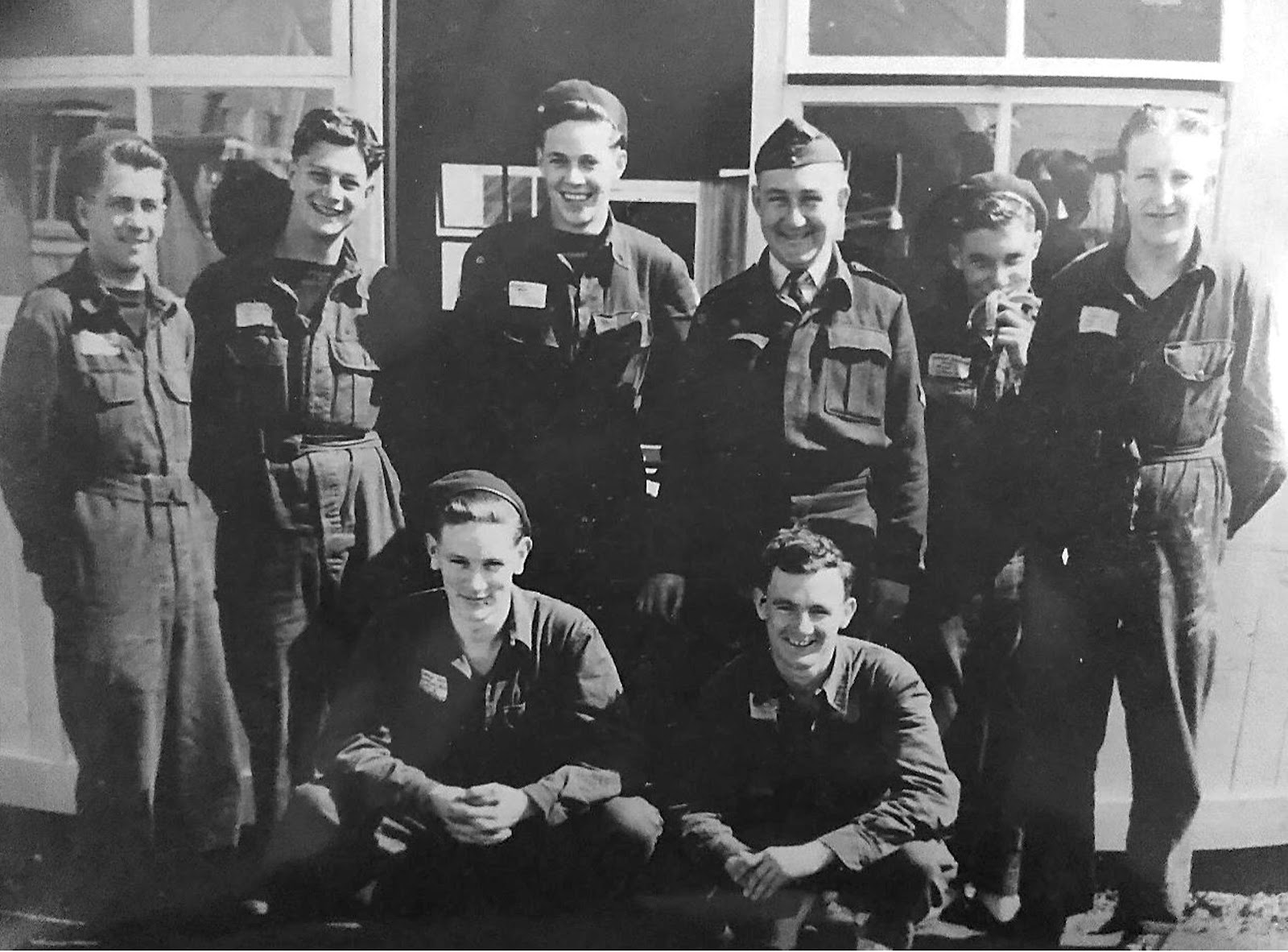
Ron Douglas pictured at far left.
Ron was enlisted for National Service on the 15th of June 1953 for five months National Service Training.
Ron recalled,
“During 1953 I was called up or “conscripted” for National Service Training and served at RAAF Laverton from June until December of that year. I was then posted to RAAF Reserve until 1960.
National Service was a great experience and would be valuable for young people today. Having registered, I was keen to start training. The greater number of trainees were inducted into the Army, and I recall many of my acquaintances being called whilst I waited for my call-up.
I even made enquires as to the delay but was assured that my turn would come! I did feel good about being selected for the Airforce.”
Eventually Ron’s call-up did come and from the considerable eligible population of young men in Ballarat only 12 were called up by the RAAF. Six of these went to Point Cook RAAF base and six, including Ron, went to Laverton. The group travelled by train to Melbourne and were formally organised at Footscray Drill Hall, then travelled by truck to Laverton.
There was an initial welcome and issue of uniform and gear and allocation of quarters. Ron was allocated to Flight 3 and assigned to a Nissan hut in which recruits were housed. He and seven others shared the hut and Ron was the only recruit from Ballarat. Four recruits came from Melbourne, one from Adelaide, one from Euroa and one from Hamilton. There were a large number of South Australians and Tasmanians in Ron’s Flight.
The lads from interstate revelled in their newfound freedoms. In all states except Victoria, the legal drinking age, the age at which you could be served a beer in a pub, was 21. In Victoria the legal age was 18! So, these young recruits, away from home with newfound buddies exercised their drinking rights diligently. It is ironic that they could legally drink, drive, be conscripted and sent to war but they could not vote, as the legal voting age was 21. Another point of interest was that they were still regarded as British subjects.
Training started immediately, marching, and physical training exercises were a daily occurrence. Later in the first week, they were issued with rifles with bayonets and training continued with the use of weapons added in. Most recruits were fairly fit having been involved in sporting activities, but some of the “City boys” did it hard for a little while.
Ron said the recruits referred to them as “getting rid of their bar-room pallor,” but they all learned to look after each other. The Airforce call-up time was six months, as opposed to just three months in the Army. The time was divided up with “Army” type training and time spent in the RAAF workshops alongside permanent personnel.
“The time spent in the workshops was great and I gained experience that helped me in the trade later. We had lectures and theory classes as well as practical training. At these times we felt like permanent members, not just Nasho’s. The jobs we worked on were many and varied.
The one I remember very well was manufacturing new window frames for the aircraft to be used by Queen Elizabeth 2nd when she visited Australia during 1954. Records subsequently obtained showed this job to be Order No.97.
This was exacting, high quality work and as is the case with all aircraft sheet metal work, the degree of accuracy is critical.”
As was mentioned in Ron’s rowing story, he competed at the Ballarat Regatta held during the Queen’s visit to Ballarat so there is a nice synchronicity that he helped her get here safely by contributing in a small but significant way to making part of the royal aircraft!
One of the Officers in Charge (a warrant officer) was a great help to the young Nasho’s, as he was to all the personnel under him. He almost convinced Ron to join up permanently. However, Ron did not feel ready to take what would have been a very big step at that time of his life.
Guard Duty
Guard Duty included overnight patrols of the Workshop Area (3AD) and the area adjacent to the airstrip. We spent the night in the Service Police Headquarters until our allocated patrol time. Bundy clocks were installed at intervals throughout the patrol area, and we had to “Punch the Bundy” each within an allocated time. If the signals were not received back at base in the reasonable time, then the Guard was called out.
“It was a little eerie wandering, on your own, around the workshops and parked planes at 0300 hours with rifle and fixed bayonet. We had been given a cursory tour to pinpoint the location of each Bundy in daylight, so there was a worry that we may miss one and cause the Guard to be called out. However, all went well and we able to have a leisurely breakfast and excused from duties until after lunch.”
Parade And Social Occasions
Every Tuesday morning was the CO’s Parade when the whole base, Regulars and NASHOS, paraded on the main Parade Ground. We marched to the accompaniment of the RAAF Central Band which was based at Laverton and directed by Squadron leader Hicks, a musician of renown. Besides being a Military Band, members also played in dance bands and various ensembles. These parades were a lead up to our passing out Parade, a most memorable occasion.
Each month a Station Dance was held and to ensure there was adequate female representation, RAAF buses were stationed in Swanston Street in the City to transport any ladies who wished to attend. An interesting array of talent took up this opportunity.
I remember celebrating my 19th birthday at a dance in a small hall in Laverton.
Melbourne Cup Day 1953 was declared a holiday and many of us attended the cup, in uniform of course. A horse called WODALLA ridden by Jack Purtell won. I still have the Official program. There was a large crowd in attendance. The American fleet was docked in Melbourne and I can recall viewing the race alongside some American sailers.
That evening, I went ice-skating at the old Glacierium Rink, located where the Arts Centre is today in St. Kilda Road.

Kitchen Duty
All the recruits had a turn working in the Airman’s Mess and a few worked in the Officers or Sargeant’s Mess. Duty commenced immediately after breakfast when all breakfast dishes were washed and placed in drying racks, and they helped the cooks prepare lunch. Lunch dishes were washed, and tables cleaned, and the evening meal prepared. After tea/dinner, it was dishwashing time again and a general clean-up for the next day.
The Airmen’s Mess was for all enlisted personnel, Nasho’s and permanent Airforce members including the WAAF’s, so it was a busy place. The food was good, and they all ate well, probably due to the constant daily activity. Often, after hours, some of us would “sneak out” to the Drome Café just outside the main gate for a late-night feed. I recall purchasing a tin milk Billy, from Hollways while on leave, which we would fill with milkshakes and malt shakes and take them back to our Nissan Hut.
Entertainment
On several occasions Ron and his fellow recruits were able to “escape” from camp and ventured a couple of times to Luna Park and several times to Werribee. Werribee was a very different suburb in those days, much quieter and semi-rural, rather than the urban jungle it is today. They referred to their visits as the “The Bitter and Bloody Battle of Werribee” with the Bitter being Melbourne Bitter beer which was consumed by the recruits on these visits! Our mode of transport to the “Battle” which catered for eight hut members was a Morris Minor and a BSA Bantam motorbike. Ron recalled despite the somewhat dodgy and overcrowded transport, “We had some great outings!”
Bivouac
“The only time I volunteered for a job was to be part of an advance party to set-up camp for a two-week Bivouac at Point Addis, near Anglesea. This was a large RAAF controlled area with a permanent Obstacle course and a Firing Range and was sometimes used as a bombing range. We travelled to Point Addis in two trucks and stopped at Geelong for “Refreshments”. Fortuitously we pulled up outside two hotels situated opposite one another on either side of the road. The Officers and NCOs in charge informed us that Nasho’s were not permitted to drink while on duty, but they were going for a drink at the hotel opposite, and we were to report back to the truck in 45 minutes. We took the hint and spent an enjoyable 45 minutes in the other pub. We then continued to our destination where we set up camp in preparation for the arrival of the remainder of the squadron.
I remember marches along the beach and through the town. The Obstacle Course was quite demanding and one of our group broke his leg and subsequently missed our Passing Out Parade. While at Pt. Addis, we trained with Bren Guns, handguns, Hand Grenades and of course Bayonet practice.
The only bad memory I have is having to shave with cold water! I did grow a moustache during this time to reduce the amount of shaving required. The only time we had access to the luxury of hot water was if we scored Mess duty.”
Besides the arms training on Bivouac the recruits also spent time at the Rifle Range located at Laverton RAAF Base and on occasion travelled by truck to the renowned Williamstown Riffle Range for further training. It was a great experience for them to shoot at such an elite venue which hosted the Queen’s Cup. The Williamstown Range no longer exists having been replace by “up-market” housing development.

RAAF National Service 8th Intake, 1953. Bivouac Point Addis. Ron second from left, standing.
Flying
One of our hut members worked in Aircraft Research and Development Unit (ARDU) and was able to get us on a flight to Ballarat RAAF Base on a Douglas DC3. This was the first time I had ever flown! The interior of the plane was set up with wooden benches! It was a very basic configuration that added to the experience. We circled Ballarat and flew over landmarks including my home in Magpie Street, Golden Point.
On our arrival at the Ballarat airfield, as we were on our landing approach, the Pilot suddenly put the plane into a steep climb, circled and then lined up to land again. On this second approach, again the landing was aborted, and the pilot circled around for a third approach. It was then that we learned the pilot was practising instrument landings. Quite an exciting experience on a first flight!
We spent the day touring the base and then returned to Laverton in time for tea.
Hitch Hiking
Another memory Ron has is hitch-hiking home on leave from Laverton.
This involved travelling from Laverton by bus or train to Footscray Station, then by tram to the tram terminus on the corner of Rosamond and Ballarat Roads, Footscray. Then we had to catch another bus or walk to the Albion railway gates on Ballarat Road. There was no difficulty hitching a ride from the Albion gates as cars banked up when the gates were closed to allow the trains through. Dozens of servicemen in uniform would be waiting for a ride at any one time.
On one occasion Ron was given a lift home on a motor bike by a regular RAAF member with whom he worked in the trade section. Travel back to camp from Ballarat was either by train or again hitch a ride. The gates at the Albion rail crossing were replaced by an over-pass many years ago and the tram service was also replaced by a bus service.
National Service Record & Flag

Name: Ronald George Douglas
Number: A35464
Rank: Aircraftman-recruit
Enlisted: 15th June 1953 for a period of five months of National Training. Transferred to RAAF Reserve: 9th December 1953 (Under the provisions of the National Service Act 1951) Section 33/4
“Having completed the prescribed period of continuous training.”
Honours and Awards - Anniversary of National Service 1951-1972 Medal Australian Defence Medal
Discharged with effect 30th June 1960. National Service (Discharge of Trainees Act 1960.)

Douglas DC3 from the 1960’s. This is similar to the plane that flew Ron and his mates to Ballarat.
Summary Of My Nashos Service
There is no doubt many more interesting aspects of National Service which have faded from memory, but all experiences were positive.
I do believe the aims of National Service were, and still are important in terms of defence preparedness and physical fitness. This is not only for males but females too. The results of the training are as visible today, as they were then, in terms of developing the whole person.
A form of National Service, not necessarily military, would be valuable today to both the participants and the country as well. The fact that the National Servicemen’s Association of Australia was formed was due to former NASHOS wishing to keep alive many of the ideals and the notion of “Esprit de Corps” that was developed during their service and show that we are proud to be NASHOS.
The Ballarat Sub-branch of NSAA was formed in 1996, just after we returned to Ballarat, and I was one of 140 former NASHOS who came together to form the sub-branch. Dot was an Associate member as were many of the wives. I served as Sub-Branch Welfare Officer and later Secretary. It was a demanding job but one that provided great satisfaction.
National Service Overview
The First Scheme 1951-1959
In the first National Service scheme between 1951 and 1959, all young men in Australia aged 18 were called up for training in the Navy, Army and Air Force. A total of 227,000 served in 52 intakes.
Air Force: About 23,500 National Servicemen undertook their training in National Service Training Units and were allocated to Flights, corresponding to platoons, at the major air bases and depots throughout Australia including Laverton, Victoria.

Ron’s pennant from NASHO’s and the names of his intake.
THE NASHO FLAG
On a field of white,
The colour blue comes brightly to the fore;
In memory of the young men, Trained to protect Australia's shore.
Lads from town and country, Called to serve their states;
Then returning to their homes, Now men with many mates.
The white, that pure colour, That glows within the forge;
Denotes that change has taken place, That keens the edge on sword.
The blue of sincerity, With self and comrade too;
Of making changes in the lad, And entering manhood true.
Like drops of blood there splashed, The red upon this field;
Giving time to pause and remember, The ones whose lives did yield.
Look upon this banner, In white and red and blue;
Remembering those proud men, To their nation proud and true.

Ron’s certificate of National Service, 1951-72.
Life After Nasho’s
After National Service I returned to Civvy Life, perhaps reluctantly because the incentive and opportunity to join up was very strong. How different my life would have been can only be imagined. However, I returned to Ballarat and my place of employment. Social and sporting activities soon overtook any thoughts of “What might have been.” As previously mentioned, Baseball, Rowing and Badminton took up a great amount of time. And what great times they were.
In my early twenties I met Dot. And after going together for some 12 months, we became engaged and about 8 months later were married at St. Paul’s Cathedral, Ballarat, on March 2 ,1957 with the Rev. George Mutton officiating.
The Wedding was unfortunately not the happy occasion it should have been. Mum passed away three weeks before on February 20. We considered postponing the wedding but after discussion with Dad, logic dictated that we should continue with our plans.
Our first home was in Landsborough Street, Ballarat North, but the house was not completed on schedule, we lived for several months with Dot’s parents, Dorrie and Roy (later known as Nan and Pop). They were always great to us and adored each of the children. Unfortunately, Mum’s passing left a large gap in all our lives and our kids never got to develop the same rapport with Grandpa as they did with Nan and Pop.
Kerryn was born June 19, 1958, and we moved into our new home soon after. Lindy was born October 23, 1961.We lived in Landsborough Street for many years. We sold this home and built another in Magpie Street, Golden Point, and Ian was born February 28, 1965, completing our family.
For several years, as well as working at John Hollway and Sons, I worked part time at Franklin Caravans. This was a cash payment arrangement with the owner Mr. Geoff. Robbie who was a very good employer and I valued his friendship. Without appearing to be pretentious, I claim to have become a very good Tradesman.
The Sheet Metal Trade, like most trades, underwent considerable changes during my Apprenticeship and Journeyman periods. Perhaps I mentioned elsewhere in this narrative that John Hollway and Sons was established in 1856 specialising in requirements of the Gold Mining Industry and later developing a reputation as Tinsmiths. Crown Brand Tinware was well known and widely distributed. Over the years an ever-increasing range of Sheet metal products was produced for Home and Industry. Because of this wide range of metal products our training and skills were of a high calibre. For a number of years, I was employed as a Leading Hand and on occasion Acting Forman.
My employment (part- time) at Franklin Caravans commenced about 1959. At Hollways we manufactured Caravan components for Franklins such as Water Tanks, Mudguards, Roof –Hatches, Ice Chest Linings (this was before caravan refrigerators) and various beadings used inside and outside the caravans.
As the demand for caravans grew, Geoff Robertson set up a Sheetmetal section and employed a longtime Hollways employee to manufacture his requirements on site. Business boomed and I was offered a job part-time. I worked evenings and weekends and was on several occasions asked to become a full- time employee but was reluctant to leave my position at Hollways. Although Franklins was a thriving business, ingrained attitudes to employment prevailed, and so out of loyalty to Hollways, I remained a part-time employee at Franklins.
That is until 1968, when a recession caused Hollways to cut back on staff and a couple of us were asked to take Long-service leave to ease the situation. This did not suit me as I had already taken one
month’s leave to work on our Coffield Street home. So, I finally accepted the offer of Geoff Robinson to join his firm.
Geoff was aware of my aim to join the Education Department but was happy to employ me on above award wages and also offer a Superannuation package. As mentioned elsewhere, Geoff was a good boss, and we shared a mutual respect.
It was quite a decision to leave Hollways, but I was intending to leave anyway subject of course to being accepted by the Education Department. Also of course, I had to pass the various courses in which I enrolled.
Returning to Night School in 1966, I enrolled at Ballarat S.M.B. to complete my formal apprenticeship qualifications, Practice, Theory and Drawing. My aim was to become a Trade Teacher with the Technical Schools Division of the Victorian Education Department.
I undertook Grades 1,2,3 and 4; also Trade Maths Grade 4. Examinations were externally set, 3 hours Theory / Drawing and 6 hours Practical. Although successfully completing each subject, I could not apply for a position until the following year. I also enrolled in an Intermediate English class (Form 4 / Year 10) as previously I had only completed Form 3 / Year 9 Junior Technical Certificate.

Ballarat North Technical School, Norman Street, Ballarat, 1967, where Ron attended night school.


Franklin Caravans factory in the 1960’s. This is where Ron worked part-time and then full time after he finished at Hollways in 1968. In the 1960s the company had great success with simple and affordable lightweight aluminium caravans.
Teaching - A Career Change - Sunshine North Footscray Tech - Templestowe Tech

It was about the time of my re-enrolment in further education towards my goal of becoming a Trade teacher, that things got a bit tricky. Unfortunately, at this time I entered hospital for surgery, a haemorrhoidectomy which is quite literally a pain in the arse and was laid up for a while. Running out of Sick Leave and with no pay coming in, we decided to sell our house to clear debts and build again. We moved to Coffield St. Brown Hill.
Once again Nan and Pop came to our rescue. We stayed with them for a short time whilst the house was completed. As with all our homes to this time, we did a good deal of the construction from plumbing, painting, staining floors and of course landscaping and the building of garages and sheds. This was a traumatic time for us all as I was still recovering from my operation, and it was difficult for Dot. The children were a bit cramped for room at Nan and Pop’s. Kerryn and Lindy also transferred Schools at this time and to add to the trauma I chose this time to quit smoking!
I had enrolled in the Intermediate English Night Class at Ballarat North Technical School, as mentioned previously I had only completed Junior Tech. (Form 3/ Year 9). The Principal was Mr. Bobby Watson who had taught me English and Social Studies at Junior Technical School from 1946 to 1948. He remembered me and provided an excellent reference to add to my Resume.
Quitting smoking is of course difficult and was made more so by the decision of the class teacher to allow smoking in class, remember this was 1967! Many of my classmates were 16-year-olds who were repeating. Imagine sitting at a desk with a smoker whilst quitting – however I did win out and I am quite proud of my achievement. (Note: Imagine also a class of 16- and 17-year-olds being permitted to smoke! As Ron said, it certainly was a very different time and Ron was ahead of his time in making the decision to quit smoking.)
On successful completion of Intermediate English, an application was lodged with the Education Department, and I gained an interview at Collingwood Technical School. I was not successful but was placed on a reserve list.
The following year I enrolled in a Leaving English class, completing it successfully in 1968 and lodged another application with the Department. This time I was successful and was appointed to Sunshine North Technical School, commencing February 1969. This was the year Man landed on the Moon – The whole School stopped and crowded in classrooms to watch the event on Television.
So as not to disrupt schooling too much, especially the older two children, Kerryn and Lindy, the decision was made for me to board in Melbourne for 12 months, returning home at weekends and holidays. Dot did a marvellous job at this time managing as she did.
During the May School Holidays at the end of Term 1 (the school year had 3 Terms at that time) I also returned to work at Franklin Caravans to oversee the Sheetmetal section while Ken Pattie took holidays. It was Ken who asked me to join him at Franklins when he left Hollways, we always got on well together, I believe I learned more from Ken, trade wise, than any other single person.
Teacher Training, at that time in the Technical Division, consisted of 3 days teaching in school and 2 days per week at Teachers College over 2 years. Teachers College was 2 houses in Toorak, Melbourne, one in Glenbervie Road and the other in Lansell Road,Toorak. Hawthorn Teachers College, Stage One, was completed late 1970. Our group spent only a month or so in these magnificent facilities. However, I did study there later. Subjects included General and Special Teaching Methods, English, Maths, Psychology and Instrumental Drawing (Solid Geometry).
A great learning experience albeit somewhat of a culture shock! I went from working as a Tradesman one day to standing in front of a class teaching the next. The second year of Teacher Training included similar subjects and we graduated with a Trained Trade Instructors Certificate or T.Tr.I.C.
After the first year of teaching I was appointed to Footscray Technical School, or Footscray Tech. as it was known, before it became a Tertiary Institution. We sold our home in Brown Hill and moved to a rented house in Footscray. Kerryn commenced High School at Maribyrnong High School. Lindy attended Rosamond Road Primary School, and Ian also started his schooling there.
At Footscray Tech. I taught both secondary students and apprentices in Third year Sheetmetal work. This was 1970, the year the Westgate Bridge collapsed, I remember the day well with all the emergency vehicle traffic that was on the roads around Footscray heading to the bridge site in Williamstown. Unfortunately, the father of one of my year 9 students was killed.
When we moved from Ballarat to Footscray. I contacted the local Electoral Office to enrol. When the officer saw “Teacher” on my employment description, he offered me a job at the upcoming election. The fact that I had no experience was irrelevant as he was short staffed. This was another valuable learning experience and the money I was paid for working for the election was good too. Later when we moved to Templestowe I was again contacted by the Electoral Office and worked at many State and Federal elections. When the polls closed at each election, we also counted the first preference votes at the Polling venue. This was to predict early trends, I suppose.
I did feel guilty about moving Dot and the kids from a new house in Coffield Street, Brown Hill, which was only 3 years old, to the cramped and rather primitive living conditions at Footscray. They left behind friends and family of course, especially Nan and Pop, and had to change schools again. Our home in Coffield Street was a rather complete house – a good design with more than adequate cupboard space.
A highlight was a large Drying Cabinet built above a Slow Combustion Space Heater. We had the space constructed by the builder and I lined it with galvanised iron and made wire mesh shelves. The flue was encased in perforated metal. It looked good and worked to perfection. I am sure Dot missed the convenience the set up provided.
We built a garage, woodshed, and Kids Playhouse, which was large and set up with benches, sliding window and well ventilated. I made table and chairs to a similar pattern to our kitchen setting. This was later refurbished and as far as I know Ian still has them along with the swing that I made for Kerryn when she was about two years of age. Also built was a dog shed, and run, built for Terry, our Aussie Terrier. Terry stayed with Nan and Pop when we moved to Footscray and lived for many years with them.
Mention of the Table and Swing etc. reminds me of the Rocking horse that dad bought for Kerryn at Christmas the same year she got the Swing and a trike from Nan and Pop. We still have that horse, named Madge, in as new condition – we have always looked after things. When you consider that Kerryn’s horse is approximately 50 years old, we have done a good job of preserving it.

The swing Ron made for Kerryn when she was two years old. Still swinging many years on!

The table and chairs that Ron made for his children are still in service today. Wooden seats and backs have been replaced but the metal frames are as sturdy as the day he made them.
Living In Footscray
The Footscray house was in the school grounds of Rosamond Road Primary School and was formerly the Caretaker’s Residence. The Caretaker / Cleaner when we lived there was Mr. Claude Wilson
who lived next to the school. Claude and his family made us most welcome.
Some refurbishments had taken place, new hot water service, etc. but heating consisted of a very ancient wood heater. We purchased a couple of kerosene heaters to keep the place warm. They were effective but prolonged use would not be advisable. We lived with bare boards throughout much of the house for quite some time, eventually having Linoleum laid in some rooms. The house was quite small, only two bedrooms, therefore Kerryn, Lindy and Ian had to share a room. However, it was only for 10 – 11 months and I guess it was a learning experience for us all!
As with all busy times in a life, a couple of additional traumas occurred while we were there. I burnt my arm rather badly when extinguishing burning fat on the gas cooker, requiring several visits to Footscray Hospital just down the road. Lindy broke her arm on the school monkey bars and also attended the hospital.
As I mentioned previously there was a feeling of guilt about disrupting our lives, but I do believe that "the end justified the means."
Templestowe Tech 1971-1991
Whilst at Footscray Tech. I took the advantage of studying a couple of levels of Instrumental Drawing (Descriptive Geometry) at Technician and Intermediate levels. These courses added to my drawing knowledge and improved my ability to communicate with my apprenticeship group, and secondary students. Finishing the course our group members were appointed to schools throughout Victoria.
I was sent to Templestowe Technical School in 1971, which was a brand-new school then. It was so new in fact, that the buildings had not been commenced at that time. My appointment notice read – “Appointed to Templestowe Technical School C /- The Vice Principal, Altona North Tech.” Dave Donaldson was the newly appointed first Principal of Templestowe Technical School.
We commenced operation in February 1971 in temporary accommodation with building works taking place around us and with an enrolment of 80 students- boys only. We became Co- Ed. Some 3 years later. I taught Sheetmetal, Solid Geometry, and Woodwork, due to the unfortunate passing of our Woodwork teacher. Being the only "Tradie" on staff was a challenging but rewarding time.
We rented a house in Rosanna, Kerryn transferred to Banyule High School Lindy and Ian to Banyule Primary School and Dot accepted a position at the Austin Hospital. We rented for 3 years and then built a home in Templestowe. Lindy and Ian transferred to Templestowe Heights P.S., which was adjacent to Templestowe Tech. Kerryn later transferred to Whitehorse Technical College, Box Hill, completing a Business Course. Lindy and Ian both moved to Templestowe High School on completion of Year 6.
Setting up the combined Sheetmetal / Woodwork room was both demanding and rewarding. Planning was required for the next few years when a new Trade Block was built. Solid Geometry was taught and my two assistants, Rosemary and Dale who were Art Students and who required some instruction to keep them in front of their students! These were interesting times. Dale Marsh went on to become a well-known Artist.
During 1971-72, I studied my H.S.C. and a Student Instructor was appointed. I was responsible for Training and Crit. Lessons. Crit. Lessons were required of us all whilst training. This was about 30- 32 lessons per year. For Crit. lessons we were required to prepare a lesson plan with drawings, etc. These lessons were supervised, either by staff colleagues or visiting college Lecturers who made comments on a Green Sheet for assessment purposes. I still have my Crit. Lessons assessments. Too much work went into them for me to part with them.
The school population grew rapidly, student and staff numbers increased as did parental involvement, these were great times and many parents, and students, became friends. Many students were friends of Kerryn, Lindy, and Ian. By this time permanent buildings, as opposed to portable classrooms, were completed and the school became Co- Ed., catering for some 1200 students.
For several years I worked in the Trade Block teaching mainly Junior Sheet metal. Technical Schools operated in a very business like manner. This meant the Education Department, Technical Schools Division, allocated a budget to each school based on the planning, and budget, presented by the individual school. Each Department within the school was required to submit to School.
Administration a budget for the following financial year. Expected expenditure was itemised and considerable time and expertise was required.
Whilst working in the Trade required certain planning skills, the actual pricing etc. was the responsibility of Foremen and Managers, therefore I had little experience in actually running a Section or Department. Until that is, I was on the Staff of Sunshine North Technical School which was my first School as a qualified Trade Teacher.
The Junior Sheetmetal section was a two-man Department, Ivan Gellie was Head of Department and I was a first Year Student Instructor. Ivan was good to work with, he was most supportive, and I learned a lot from him. When Ivan unfortunately became quite seriously ill and was off work for some time, I needed to take over many of his duties, quite often running two classes at a time, and also some administrative duties. Whilst being very demanding, I was attending Teachers College two days each week, the experience gained was invaluable.
Addendum: December 2008.
Reading the December Issue of the Wanganalla Banner, the official Newsletter of the Wangaratta – Benalla Sub-Branch of The National Servicemen's Association of Australia; I read "Sick Bay" report and saw the name, Ivan Gellie and reckoned that there could be only one Ivan Gellie.
I worked with Ivan at Sunshine North Technical School in 1969, my first year in teaching. Ivan and his wife Bev, also on staff as a Librarian, were very supportive of me and Ivan in particular, was great to work teach with and a help with College requirements.
Templestowe Tech
After a few phone calls to Wanganalla Branch Executives, I obtain Ivan's Phone number and called him. It was indeed the Ivan Gellie I knew, and I spoke to both he and Bev for some time. They had both been seriously unwell and were looking forward to better times. They had settled in Bright after extensive travels and hope to resume some travel in the near future. Ivan's sister Judy was married to John Mead who was on course with me, and we were both on the Staff of Templestowe Technical School at one stage.
Sadly, Judy passed away in the early 90's and whilst attending her funeral, was the last time I had spoken to Ivan and Bev, until our phone conversation. Hopefully we can catch up in the near future.
At Footscray Tech. responsibility was required of course, but to a lesser degree. Perhaps my experiences contributed to my appointment to Templestowe Tech. A number of experienced Trade Teachers were a little "Put- out" at the time. However, all were supportive when required.
As mentioned elsewhere, there were originally two Trade Teachers appointed to Templestowe Tech., me and Harold Jones. Harold was a Woodwork Teacher of many years’ experience, he was appointed as Senior Master being second in command to the Principal, Dave Donaldson. Early in the school year Harold was taken seriously ill and unfortunately passed away. This resulted in a re-shuffling of his duties. As well as Sheetmetal, I also taught Woodwork classes and Solid Geometry.
I was the only Tradie, and assumed practical person, on staff now. I also became responsible for setting up a Student Locker system. This was very demanding, students being students. Initially, I was able to get Locker keys, and others, cut at the local Hardware store which was owned by a parent of the school. It soon became obvious that to purchase our own Key Cutting Machine was the more practical option. Therefore, I gained another worthwhile experience / skill that of key cutting and I was able to pass on the job after three years to another Tradie.
About this time, I remember breaking my arm one Saturday morning, an altercation with a motor mower which I had repaired the starter winder to save money. Unfortunately, the lever caught and struck my wrist. The pain was bloody excruciating! X-rays at the local clinic were inconclusive and I had to wait until Monday for results. I remember receiving a phone call from the doctor, at school, asking me to call in as soon as possible to have the arm put in a cast.
This was not the only trauma I experienced over a period of several years at Tempy. Tech. I seemed to attract injury!
Over time I had a few knee operations resulting in two cartilages being removed which led to heel problems and having spurs removed from each heel. Another time I received an electric shock from a faulty urn whilst fitting a metal tray that I had made. This was quite serious as our doctor indicated that a shock of this nature affected the nervous system and sometimes takes up to a couple of years to get back to normal. It did take some time as I remember.
Perhaps the most alarming incident occurred at school, when a fitting on an oxygen cylinder malfunctioned. The design of the new Trade Block included a "Manifold System" to deliver Acetylene and Oxygen to several Trade Rooms. Instead of having cylinders in each room, they were grouped in a "Manifold Room" which was accessed externally. This was the latest technology, cylinders were grouped with Oxygen on one wall and Acetylene on another, connected to the main line by short leads made from a new woven material. Usually either Laurie or I, whoever was in first, opened up and turned on the system ready for the start of lessons.
This particular morning, I turned on all cylinders and was about to leave when there was a loud "Bang”. My initial thought was that a cylinder had exploded, and I had better get out. Not sure how I did get out but the next thing I knew, I was lying on the concrete pathway somewhat dazed. I got to my feet and could hear a loud hissing sound, my next thought was, “I had better turn off the cylinders”. I went back into the room and did so. On inspection, it was ascertained that one of the new leads, on an oxygen cylinder, had given way under pressure. A medical examination of myself, revealed a couple of cracked ribs and shock, I was perhaps a little fortunate there were no other injuries.
Of course, there was a Departmental enquiry which resulted in specification changes for all installations. The woven fittings were replaced with a copper "Pig – Tail" fitting. The heavy wooden door was replaced by an open mesh roller door, I often wondered at the outcome if the door had been closed at the time. Concrete garden edging was removed and replaced with a concrete apron; this edging was what I landed on and had caused the rib fractures. Not a lot of publicity was given to the incident. I was asked to write an account for “The Ventilator" our subject Association Newsletter, the Plumbing, Sheetmetal & Coppersmiths Association (PSCIA). From all accounts the powers that be were not too pleased but at least many necessary changes were made in future constructions / installations.
The PSCIA was a strong association and I served on the committee for several years. The committee reflected the Member numbers of the Association. There were more Plumbers than Sheetmetal Workers or Coppersmiths in the Association. Therefore, Committee membership was pro rata. Because of the many changes associated with the demise of the Technical Schools Division and the move to Secondary Colleges, the PSCIA was eventually replaced by the Technology Association.
Later TAFE members also formed their own Association and other subjects became attached to "Technology". It was no longer a group of Tradies and it became, I believe, somewhat irrelevant.
The mention of injury / traumas brings other incidents to mind. Lindy attended a gym group, I’m not sure if she was at Primary or Secondary School, at a local hall. One evening we received a phone call alerting us that she had been injured. When we got to the hall Lindy was lying on the floor with bindings around her arms, shoulder and upper body. The situation looked very serious indeed, very worrying. After a while it was decided to move her and transport her to hospital for X-rays etc. which showed a badly dislocated shoulder and bruising.
Much later, both Lindy and Kerryn have had knee operations. The standing joke in our family is that the kids inherited their mother’s brains and my knees.
I guess though the greatest trauma that we, as a family experienced was when Ian had his Motor Bike accident. He was seriously injured and there were times when the outcome was uncertain. Initially in intensive care, he spent several months in hospital. After a long convalescence, he recovered sufficiently to return to school. We were quite proud of his decision to repeat Year 10 rather than simply be promoted to be with his mates. I must admit that I have had a love / hate relationship with motor bikes since that time.
Great Musician and a Good Friend
But let me return to the narrative.
During this time work was quite demanding but I still found time to study my HSC, over two years, and set up the new Trade Block at Templestowe Tech. These were productive years and marvellous experience. After two years the school had grown quickly and several positions were upgraded to Senior Teacher and Head of Departments, including my role in Sheetmetal and Drawing. I of course applied for the position but was unsuccessful and a senior / experienced teacher was appointed. Lawrie Safstrom commenced duties at the start of the school year.
As imagined it could have been a difficult time, but Lawrie and I got on very well and the Trade areas continued to prosper under our combined efforts. When I later moved into Career Education, Laurie's support was invaluable and contributed to the success of the Program.
When I was appointed to Templestowe Tech. we rented a house in Rosanna – a three-bedroom new home which we enquired about buying. However, the owner, a bank clerk, was transferring back from Bendigo, and did not want to sell. After three years we built at Templestowe and made up for the previously cramped living, moving in during 1974.
We altered the house plan eliminating the ensuite to enable the addition of another bedroom, so that each of the kids had their own room, something neither Dot nor I had when growing up. Therefore, each of the kids had their own room complete with desk / table that I made, thus providing private study conditions. Hopefully these conditions that we provided made up for the inconveniences experienced during the preceding years.
1970’s Career Education
During the mid-1970's the concept of Career Education and Work Experience was recognised by the Government and Education Department. Technical Schools had traditionally, if informally, offered Work Experience to some students over several years; and we at Templestowe Technical School were among the first schools to introduce an official program. I was appointed Careers Officer.
We were very innovative. With the involvement of a couple of staff a professional looking Work Experience Arrangement form was developed. Printed in triplicate, different colours, one each for, Employer, School and Student/ Parent. This system was later copied and issued to all schools by the Education Dept. as the official format.
The Education Department arranged short courses in Career Education and then a Graduate Diploma in Career Education was introduced at R.M.I.T. I applied and after interviews was offered a place. The course of 2 years duration with lecture / class time about 8 hours per week (2 x 4 hours at night). I was able to gain a place in the course because of my involvement in the field. All the other participants were graduates and for a while I felt I may have been out of my depth. However, by applying myself to the task, I coped quite well while some of the other younger graduates dropped out.
During the second year, Study Leave was available, and my application was successful. Whist time off from school certainly eased the workload it was difficult to juggle study and work. However, I was able to graduate and was awarded The Graduate Diploma in Careers Education. (Grad. Dip. Ca. Ed.). At this time the Education Department decided to make Teaching Qualifications comply with National U 2 Diplomas. We former Tradies were required to undertake further training to upgrade to this level. Credits were given for existing subjects, but another 2 years part time study was required, and we Graduated with a Diploma of Technical Teaching. (Dip. Tech. Teach.).
During this time our Work Experience Program grew and we at Templestowe Technical School were in the forefront of innovation and called upon by the Education Department to assist other schools with their Programs.
I became full- time in Careers Education / Work Experience moving from the Trade / Drawing areas to administration to Coordinate the Program. Due to the support of Administration and Staff, our Work Experience Program, and therefore Templestowe Tech. became well regarded throughout the State. Many employers both Government and Private, became involved and our reputation grew. Several companies very often contacted the school directly, seeking prospective employees.
Because the program ran for many years, several students who gained their start through the program in turn became employers themselves and relied on our judgement when recruiting. My involvement in the Program, particularly the Work Experience / Job Placement component, was a very rewarding period of my Teaching career.
Templestowe Technical School from the outset developed a practical partnership with the local and wider Community long before the Government introduced the concept of School Councils at Primary and Secondary levels. Councils had long been part of the old School of Mines structures at Ballarat and Bendigo and no doubt RMIT. Templestowe Tech. in many ways pioneered the structure which was to become the norm.
Parent involvement, not just the formation of a Mothers Club, was necessary, as the school commenced operation in unfinished buildings consisting of a "Terrapin" Building and one Portable classroom, later called relocatable classrooms. The Terrapin was a modern structure with 3 classrooms, Humanities / Science room, Art and a combined Sheetmetal / Woodwork room, and also the Principal’s Office, General Office and Staffroom. The portable was used mainly for Instrumental drawing (Solid Geometry) and Music. During the second and subsequent years, room usage changed, and some 25 Portable occupied the site.
Construction of permanent School buildings commenced, the first being the Trade Block for Plumbing / Sheetmetal, Woodwork, Electrical & Automotive and there was also a Gymnasium. This was closely followed by Business Studies, Maths / Science, Instrumental Drawing, Humanities, Art and Library, Staffroom and Offices, Administration and Conference Room. The majority of the buildings were connected by corridors or walkways, except -wouldn't you know - the Trade Block. However, the whole complex was a great educational facility.
The Library which was a School and Community Library, set the tone, with Doncaster and Templestowe Council and School Library staff working side by side. It was great to see the interaction of students and general public. Other community use saw a local church, Templestowe Church of Christ, use a large open area for Church Services until the building of their permanent Church. The Gymnasium / Basketball Courts were also used by the public. Community Open Days were conducted on a regular basis and various groups were encouraged use School buildings to hold meetings. Night Classes, in Academic, Art and Trade / Hobby Classes were conducted, and all were well attended particularly in the early years.
Because of my involvement in Career Education, it was considered that I should be responsible for the co-ordination of these activities: Therefore I gained another guernsey, that of Community Education Co-ordinator, which was a very time consuming but immensely interesting and rewarding.
This was also the era of the "Life Be In It" Campaign of the Victorian Government and considerable monies were available to Schools to be involved. Templestowe Tech. had a Regional Co-ordinator based at the school. Robyn Ellis shared my Careers Office for quite some time, and we worked together on many community projects.
The Third International Community Conference was held in Melbourne, August 19 and 20, 1972. Culminating in a lavish Dinner at a City Hotel. I still have a couple of Conference Satchels. Ian remembers Robyn, as she taught him at Templestowe Heights Primary School. Also, she was the producer of "Oliver" in which Ian had a role, the production was held in the theatre at LaTrobe University.
Doncaster and Templestowe Municipal Band
At about this time the Music Department, under the direction of Mike Hughes, developed an outstanding reputation and an instrumental section of renown. Discussions with local Council led
to the formation of the Doncaster and Templestowe Municipal Band. Because Mike was held in such high esteem by the Staff, many of us joined him to establish the Band. Until we met at Templestowe Tech.
I did not know Mike; however, I did know his family as the Hughes family were old “Pointies”. Also interesting to note, is that Mike also had Chinese heritage, yet another Chinese descendant from Golden Point who made a great contribution to Aussie community and culture.
Dot also knew some of his sisters and a brother. Coincidently our current postman, Peter Hughes, is a nephew of Mike. Mike and Dawn (Doreen) moved to Queensland when they retired. Mike passed away some years ago, Dawn and I kept in touch at Christmas time for many years.
I was Treasurer of the band for a couple of years, which was another learning experience, during which time we received grants from the Council Doncaster and Templestowe, later renamed Manningham Council. The delivery of our telephone books recently reminded me that one year, to enable the purchase of new Band Uniforms, we successfully tendered to win the contract to deliver Phone Books throughout the Municipality. I cannot remember the number of books involved but it was a worthwhile exercise and boosted our bank balance.
The Band performed at many civic functions and helped to further the reputation of Templestowe Technical School. It was unfortunate that when Mike retired as Bandmaster, and the Registrar of Templestowe Tech., Elaine Carter, Band Secretary, also resigned to accept an administrative position at Latrobe University. At about this time I also resigned as Treasurer, as I had gained a place in the recently established “Graduate Diploma in Careers” Education Course at R.M.I.T.
Other staff members who also gave support to Mike and the Band were: from the Music Department, Julia Hayes, Frank Robertson – Smith and Derrick Link. Derrick was a Former British Army Music Apprentice (Bugle / Trumpet) short of stature with Military bearing. Also about this time Julia left to get married and Derrick transferred to another school which required an instrumental teacher.
Another staff member very much involved was Kathryn Reiter, Head of Business Studies. Kathy took on the role of Band Publicity Officer and between us all we developed valuable contacts in the Media. Those days there were two Community Newspapers plus a Community Newsletter. They all gave the Band and the School generally, great coverage. All were more than happy to cover the Careers / Work Experience Program and regularly published stories, photos and statistics.
All publications, Doncaster Mirror, Doncaster News and Templestowe Newsletter no longer exist. This is a great pity as they were all a valuable part of the close – knit community that existed in those days.
At about this time, Kathy also left Templestowe Tech. to work in the Computer Industry on a School / Industry exchange scheme. She later returned to teaching at a new College in the South Eastern suburbs. So, with all these "defections" there was little incentive for the band to remain at the school.
The band moved from the school and the structure changed, which was most unfortunate for both the school and the community, as potential Student recruits were lost to the band, and probably to music as well.
The band continued to be an asset to the community for many years several members formed individual groups that performed and recorded one Jazz Band "The All Stars" was very successful. I don't know if the Municipal Band is still a viable concern, but I do hope so, not only as an asset to the City of Manningham, but also as a Legacy to the memory of Lawrence Michael Hughes, a Good man, a Great Musician and a Good Friend.

Article regarding the formation of the band with Ron and Michael Hughes both pictured.
NOTE: Templestowe Technical School (1971) later merged with Templestowe High School. Today it is known as Templestowe College. In 1994, a decline in enrolments led to the ‘merging’ of Templestowe High School with Templestowe Technical to form the new Templestowe College. Templestowe High School was closed and the site was sold to make way for the David Road housing estate. Ron’s tenure at Tempy Tech. lasted until 1991 just 3 years before the amalgamation.
Mining Matters
During the 1970’s several mining companies offered the opportunity to be part of a promotional exercise to publicise the importance of mining to Australia’s economy called “Mining Matters”. When the advertising material came to Templestowe Tech, I was immediately interested. The planned itinerary was to reside in the student accommodation at Ballarat University (now Federation University) attend lectures on mining and then fly to Tasmania and visit working mines including underground tours. Sovereign Hill also figured prominently, as a home base.
I applied for and was accepted for the Mining experience. Unfortunately, an industrial dispute at the time, meant our flights to tassie were cancelled. To compensate we were provided with underground tours of Sovereign Hill and Stawell mines and the Maldon processing plant. Whilst not on the original itinerary, the food and the company was good and the curriculum interesting.
The following year the invitation was extended, and I again applied and was accepted. I have misplaced my notes from the time so I may not recall accurately the timing of events. However, this time we did fly to Tassie. We took off from Essendon and landed in Burnie and then were bussed to our motel accommodation. I can ‘t remember the mine we visited this year but I also went the following year and toured mines at Roseberry and Hellyer. The Beaconsfield Mine is nearby and there were three miners trapped underground with two being rescued after more than a week. It would be a terrifying experience.
The mine at Hellyer was one that tunnelled into the mountain I think and had a narrow-gauge rail track that ran a quarter mile to the bank of elevators which descended to several levels. The area underground was cavernous, with excavating machinery working on two levels.
During the tour, I got stuck in the mud and walked out of my gumboot, but quickly retrieved the situation and caught back up with the group. As the narrow-gauge train was not available, we walked out on the track. After a physically demanding day we were all quite exhausted when we emerged. We saw a fair bit of Tassie including the Zeehan Mining Museum which was very interesting. We also spent time in Launceston and my wife Dot and I visited many times after this.
My reference to gumboots reminded me of the miner’s safety gear we were required to wear-helmets, overalls, boots etc. We were required to strip off to our underwear and put on combination overalls. My issued overalls were a slightly tight fit and unfortunately a couple of press studs snapped open revealing a “tantalising” glimpse of the aforementioned underwear.
A couple of members of the group designed a Merit Award which was presented to me at a formal dinner. Since that time I have always purchased clothes one size larger to avoid a recurrence of that particular mining disaster!

Ron, second from left, looking resplendent in his red overalls, outside the mine.
The Mining Matters program allowed him to explore some of this heritage.

Ron’s certificate for his unique personal mining “disaster”, the ultimate failure of safety overalls. Ron has always been interested in his mining heritage with both grandfathers involved in mining in England and Australia.


Group photo of Mining Matters study group. Ron is in the second back row, third from left.
I seem to have devoted more words to my years with the Education Department than time spent working in the trade. Indeed, I was with the Department 24 years and 20 years in the trade. However, without my Trade experience I would not have had the option to change direction. My change of employment provided Career opportunities and an improved lifestyle for us all.
The desire to “Improve one’s lot” was the catalyst and I believe we all gained from the decisions made in the 1960’s. Although I did feel guilty initially that I had taken Dot and the kids away from family and friends, moving from a new house and changing schools must have been upsetting.
Of course, our improved lifestyle would not have been possible if Dot had not gone back to work. It was probably difficult for her at first, being out of the workforce for so long. Because we were a two-income family, it was easier to provide the means whereby Kerryn, Lindy and Ian were able to experience stability both Educationally and Socially.
The time that I spent with the Education Department particularly the 22 years at Templestowe Tech., was the most rewarding of my working life. As previously mentioned, the 1970’s ushered in many changes to education. Community / School initiatives, Library and Band, along with many Sporting and social activities.
To facilitate these activities, it was of course crucial that we tapped into all community resources, individuals, local government, sporting and Service Clubs such as Rotary, etc and also Educational Institutions both public and private. The people that I met during this whole time and the experiences would not have been available to me in the trade as they were in a profession.
During Teacher Training the lecturers were “Academics”, many of them Tradies and a different perspective of life was gained. There was also contact with parents from widely diverse backgrounds. Also, at this time Dot. was working fulltime, either in “The Rag – Trade” or Aged Care and we both enjoyed a variety of social contacts, particularly with one of her employers, Jack and Connie Piero. They certainly enjoyed a party. When Templestowe Technical School commenced operation the whole Municipality was experiencing a dramatic expansion.
The City of Doncaster and Templestowe was long established, having been settled in the early to mid-1800’s Doncaster and Templestowe Primary Schools were established about the same time as Golden Point Primary School. The area was famous for its Orchards, many of which were operating during our residency. The land on which we built our home, corner of James and Mahoney Streets, was formally Mahoney’s Orchard.
Doncaster and Templestowe Historical Society celebrated “Hundred Years of Music” in the mid 1970’s. The Doncaster and Templestowe Municipal Band played at the concert. Mike Hughes was Musical Director; Convenor was Cr. Muriel Green. I think Muriel was later Mayor. Bruce Mansfield, of Radio and T.V. fame, was Compere. Tickets, which I still have, featured the Tram which ran from Box Hill to Doncaster from 1888 to 1896. The terminus was the corner of Tram Road and Doncaster Road known as White’s Corner. This now the site of Doncaster shopping Town.
The Federal Seat of Templestowe was newly created, and the first Member for Templestowe was Neil Brown. Neil displayed a “certain ambiguity” but was a great supporter of an also newly created Templestowe Technical School. Neil was a Liberal and lost and reclaimed the seat from Labor politician, David Mc Kenzie, who also gave great support. Templestowe Tech’s Work Experience Program was supported by Neil Brown and his Secretary was always helpful in placing students.
Other politicians (State) both Liberal of course given the conservative nature of the populace, were also valuable contacts. Morrie Williams (Doncaster) and David Perrin (Bulleen) were able to assist on many occasions. David was a Parent of a Tempy. Tech. Student and was of particular help.
I was a member of a couple of Committees with David, and he was also with our Neighbourhood Watch group which we formed in the area. I did serve on the committee for some time and was involved with the Monthly Newsletter which was often printed at David’s Electoral Office. While I think of it, David Perrin officiated at the burying of a Time Capsule at Tempy. Tech., sometime in the mid 80’s. All staff were asked to contribute material to be included in the capsule. I submitted material re the history and development of the school. I am not sure how much was actually included with the claim that I would be present at the exhumation to answer any queries, after all I will only about 100 years of age.
David was a “Good Member of Parliament” but was unfortunately (allegedly) shafted by The Premier at the time, Jeff. Kennett during a Branch stacking exercise within the Greek Community. Contact with Council was always possible to some extent as three Staff Members were Councillors, and all served terms as Mayor. Because of the Work Experience Program and Community activities, liaison with Council was on- going.
There was constant contact with Mayor and Councillors but also with Council Officers, City Engineer (student parent), Depot Manager, Electricity Dept. Manager – Council was the Electricity supplier. Coincidently, our previous residences, Footscray & Heidelberg, Councils were also suppliers. This system resulted in better service and when necessary, speedy repairs. Many Council employees were either parents of students or acquaintances; several were members of Templestowe RSL.
Over the years a large number of Students were employed in Council Departments, several as a direct result of participation in the Work Experience Program.

Ron’s 1985 contribution to the Time capsule. The exhumation of the capsule will be in 2035! 137
I should mention that for many years the Templestowe Hotel was like a Club, a great meeting place, but a change of management resulted in many patrons joining the RSL. Up until this time I had not considered joining although as NASHOS, several of us were entitled to do so. Templestowe in particular was close knit Community. Many families had lived in the area for generations, descendants of early orchardists. Many streets bore the names of these early settlers. There are too many to list but Fitzsimmons Lane, a major thoroughfare, is worth a mention.
The late Brendan Fitzsimmon was active in the community, and we met on many occasions, often at The Pub or RSL, also at his workplace at the Doncaster and Templestowe Electricity Supply and Templestowe Football Club. The Templestowe Football Club who was part of the Diamond Valley League at that time, was very strong. Ian played in successful junior teams.
Cricket, Tennis and Basketball were also popular sports which enjoyed success. The recent anniversary of the hanging of Ronald Ryan, a criminal convicted of the shooting of Prison Warder, George Hodgson whilst escaping from Pentridge Prison, brought to mind my meeting with Phillip Opas who defended Ryan. Phillip was for a time the CEO of Doncaster and Templestowe and I met with him in his office on several occasions.
He spoke of his feelings of disappointment over the hanging and his inability to prevent it. Phillip was a keen horseman, and he had a large photo on the office wall of him mounted on his quite large horse. Also, I remember his office (desk) chair, a large uncomfortable looking wooden one which came from some Law Institute or other, but like the man himself had an interesting persona.
Templestowe and Doncaster Rotary Clubs both offered invaluable support to the School’s Career and Work Experience Programs. At some stage a Principal and a Vice- Principal were members of each club as were some Parents and Local Businessmen. Through these contacts many Students were placed in various work situations, some in regional areas through reciprocal arrangements between Rotary Clubs. Of course, many were placed in State and Local government Departments and with a wide range of Trade, Commerce and Retail Employers.
Career Information Days and Evenings were arranged each year. Guest Speakers from all relevant Careers options attended and provided the students with up to the minute information. The Armed Services, the Army, Navy and Airforce, were always ready to be involved as were Victoria Police. Students of course were given advice on job applications, Letter and Resume writing, and Interview Techniques. Practice Interview Evenings were one of our success stories. Initially a Templestowe Tech. innovation, the concept broadened to include other Schools in the district. Templestowe Technical School at various times combined with: Templestowe, Doncaster and Doncaster East High schools as well as Marcellin College to conduct these evenings.
Organisation and administration of these evenings was a very demanding task. Students were surveyed to ascertain their interests and a timetable was prepared for each to enable them to experience interviews in their areas of interest. Experienced Interviewers, many of them Rotarians, conducted the interview and completed a comment sheet that I had prepared. Students were then Counselled individually on the Report and advised on strategies etc.
Another one of our success stories was our involvement with Bulleen Special School. Both Schools benefited with Tempy Tech. Students on Work Experience as Teacher Aides learning a degree of tolerance and an appreciation of the difficulties experienced by people less fortunate than themselves. This concept was further enhanced when Students from Bulleen attended classes, mainly in the Trade Work Shops and Art rooms. Three or four students at a time integrated into “normal” classes and were accepted and readily given assistance by our students. The students from Bulleen were wonderfully well mannered and a pleasure to have in class.
Probably our biggest venture was the organisation of a Careers Expo at Doncaster Shopping Town. All the previously mentioned Schools were involved, and the support of Centre Management and Retailers was magnificent. The Expo ran from Monday to Friday and required a great deal of organisation. A floor plan of the Shopping Centre was drawn up and the Sunday prior was spent setting up the exhibits. Students from each School displayed their skills, Templestowe Tech. Students demonstrated their skills in several areas: especially trade, Sheetmetal, Woodwork, Engineering, Electrical and Automotive, Maths / Science, Humanities and Business
Studies classes were also involved. I of course made sure that our very successful Work Experience Program was publicised. We were able to recruit several Celebrities: Jennifer Kyte and Glen Taylor from Channel 7 News and a couple of young Actresses from the T V Series Home and Away. Can’t remember their names but Fans of the early episodes will recall one of them who played the part of “Bobby”.
The whole week ran according to plan and was well received by the Community and Educational Authorities. A Showcase of the Schools, Students, Teachers and the opportunities that were available in the Region.
I have mentioned the school’s involvement with the Life Be In It Program: We were always seeking avenues to enhance the profile, involvement and contribution of the School to Education and the Community. Funding became available for innovative Programs in the Eastern Region (Education Dept.) and after considerable discussion I was given the task of writing a Submission for funds to enable the employment of a person, based at Templestowe Tech., to liaise with local Schools both Primary and Secondary and including Catholic and Private schools. The aim was to develop Programs that would allow a greater understanding the Educational Philosophies of each School and encourage co-operation in areas of Curriculum, Cross age Tutoring, Resource Sharing and a more co ordinated approach with Work Experience Placements. A Regional Committee was formed to evaluate the many Submissions received from Schools across the Region.
I was appointed to this Committee and many hours were spent sifting through and evaluating the various ideas. Some were rejected as impractical while others were returned with suggestions and an invitation to re - submit. Committee Members visited each of the Applicant Schools to discuss and explain criteria and assist in improving their Submissions.
The Submission from Templestowe Technical School was approved along with several others. From memory we allocated almost $ 40,000. A lot of public money and we were conscious of our responsibilities. Having gained funding, the next step was to advertise the position and interview the Applicants. A Committee was formed and after much deliberation an appointment was made.
A lady named Margaret James was the successful applicant and we shared my Careers Office for the two years duration of the contract. The whole exercise proved successful and was of immense value to the both the school and broader communities, indeed all who participated gained an appreciation of many life issues that were generally outside their level of experience and expertise.
Much of the material prepared for classroom use was integrated with the existing Careers Ed. Program and complemented the Work Experience Program. I realise that our Work Experience Program has been well covered but it bears repeating that a well-planned, co ordinated Program supported by dedicated staff can be what makes a School stand out from the pack.
Templestowe Technical School had all of these qualities in abundance for many Graduate Diploma, Educational Administration.
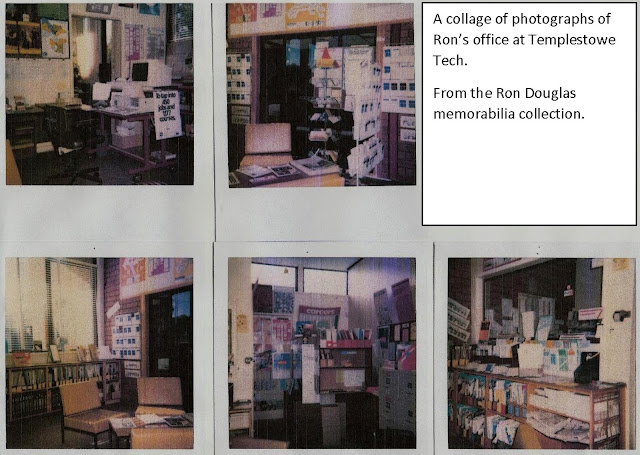
A collage of photographs of Ron’s office at Templestowe Tech. From the Ron Douglas memorabilia collection.

Ron’s desk and computer at Templestowe Tech.
Graduate Diploma Educational Administration
I have made mention of my pursuit of academic qualifications and suggested that I may revisit the time studying the Graduate Diploma in Educational Administration. I was completing the Diploma of Technical Teaching when the Grad. Dip. Ed. Admin. was offered, and it was a natural progression to enrol in the course. I recall that the majority of lecture times were evening but in a couple of instances lectures and tutorials were timetabled during the afternoon.
Fortunately, I was able to arrange time off to attend the sessions, -- School Administration supported staff who undertook professional development, and my role of Careers Officer required many hours outside normal school hours. The course was interesting and
informative and did indeed offer content and values that were most helpful in fulfilling the aims and requirements of my administrative role.
However, the people, staff and students involved in the course were perhaps more interesting than course content and some 27 years later I have fond memories of the two years spent in their company. A more diverse group would perhaps be difficult to find in terms of background and beliefs, religious and otherwise. Staff were of course well-educated people and able to impart their general knowledge and subject matter in an articulate manner. As with most of my work, be it Drawings or Assignments, I have retained them and it is interesting to read the comments of many lecturers, which causes some recall of events.
One of the most interesting people on the course was M.H. M.H was a Catholic Nun who was having “Time off” from her calling and also from her position as Principal of a Collingwood Primary School. Our group (Lecturers and Students) were of course aware of her situation which she referred to as being in mufti. At this time, she was teaching at St. Johns Secondary College, Dandenong where only the Principal was aware of her identity. M.H., as I am sure I have often remarked, is one of the most interesting people I have ever met. We had many conversations covering almost any conceivable subject.
Our group would on occasion adjourn, for the purpose of academic discussion of course, to the Riversdale Hotel where M.H. demonstrated her knowledge of a good Port and being fast learners, we all became connoisseurs. The course was of two years duration and M.H. arranged the Christmas break – up at a Hotel in Richmond where she had contacts. A great time was had by all. M.H. originally had one year off to decide her future, extended to two years and then left the course prior to graduation. M.H. graduated in absentia and we sadly lost contact.
Some twenty-five years later I happened to notice an obituary in a newspaper and the information detailed led me to believe she was a relative of M.H. I phoned the Funeral Director, who was a friend of the family, and he agreed to follow up for me. After a few calls back and forth M.H. phoned me and we had quite a discussion, which after twenty-five years was rather nostalgic. M.H. had indeed left her Order and had continued teaching, including time spent in Papua New Guinea, establishing new Schools. She already had my phone number of course but declined to share hers, which was disappointing, but I respect her desire for privacy. Maybe one day our paths will again cross, and we can renew our association.
Another interesting character was R.B. He and I were teamed together on a Major Assignment, which was a core component of the course. R.B was employed as an Electronic Technician and as a supervisor he was encouraged by his employer to enrol in the course. Melbourne’s Underground Rail Loop was under construction and R.B. was involved in the construction.
Our choice of subject matter was: “PLANNING, FORECASTING AND POLICY FORMATION"
Many hours of research and planning went into this assignment, and our efforts were rewarded when our presentation was assessed. It is worthwhile to reflect on the hours that R.B and I spent in each other’s company, studying but also socially, particularly at the football. R.B. was a Member at North Melbourne, and he did play a few games with the Kangaroos, also with Templestowe in the Diamond Valley League. At this time, North were tenants at the MCG, which therefore was their home ground. North had a good following and I attended a few games, along with R.B and my brother Bert (Graeme).
On game day North Members had access to the MCG Members Stand and there was much passing back and forth of Membership Medallions. R.B. didn’t mind a beer (or 2 or 10) and before quarter, half time and three quarter time breaks, R.B. would move with great speed and when the rest of our party reached the Mezzanine Bar a line of drinks were set up for us. I recall Bert being amazed by the speed and planning of the exercise.
As mentioned, our group attended “Tutorials” at the Riversdale Hotel. One such gathering took place after classes the night before R.B. and I were to present our Major Assignment. R.B.’s immediate superior, Alan Carey Diploma Electrical Engineering, M.I.R.E.E. Communication Maintenance Engineer, Victorian Railways; was to attend the presentation to enhance the presentation. At the “Tutorial” we did quaff copious ales. I left to go home, but not R.B. He and a few other group members went on to the nearby home of one of the group.
After a few nightcaps, the party broke up. Unfortunately, on the way home, whilst stationary at traffic lights in East St. Kilda, R.B. dozed off and was approached by members of the local Constabulary, breath tested and taken to the lock – up, where further tests were conducted. At this time R.B. noted some discrepancies with the test equipment and therefore the readings, which was to prove vital at the subsequent Court hearing. The female Police Officer alleged that she was verbally abused, and several charges were laid.
I learned of the situation next day when the group gathered at College for our presentation. The whole group, and Alan particularly, were very concerned by the possible ramifications of the incident. However, it was important that the presentation take place as scheduled. Our efforts paid off – the research, the written and verbal presentation, along with Alan Carrey’s expert comments was appreciated by all and we gained a grading of B+.
The next hurdle of course was to support R.B. in his effort to win the case against him. Having played with North he was a former teammate of Bill Serong, a lawyer. Part of the defence was concerned with the amount of alcohol consumed on the night. This required more research at the Hotel, specifically the volume of beer jugs, considered crucial, as at that time, two sizes of jug were available. The other aspect of defence was R.B.’s knowledge of the testing equipment and the perceived discrepancy of the readings.
Our day at Prahran Court was an interesting experience, another time at court for me where I was a character witness for someone. I vividly recall the attitude of the Prosecutor, a uniformed Police Officer, and his aggressive questioning technique. I answered all questions truthfully, as one would, but I felt he was attempting to browbeat and tended to misinterpret my answers, which of course I resented. I did say” I believe I have answered your question and am not sure what you want me to say”. The Magistrate intervened saying, “We just want the truth of course” and suggested the Prosecutor move on. One of the course Lecturers /Tutors attended Court as he was also present at the Hotel Tutorial Session prior to the alleged crime.
This bloke was very intelligent, a former private (Church) School Teacher and also a former Lay Preacher. We referred to him as “A Defrocked Psychotic”. He settled into the Witness Box and proceeded to confuse and confound the prosecutor, referring to the session at the hotel “Collegiate Discussion” and a vital component of our presentation preparation. Testimony of R.B., the accused, and his supervisor, casting doubt on the accuracy of the Testing Equipment and the expertise of our Barrister, resulted in all charges being dropped. The Police officers present were visibly angry with the outcome, so we all vacated the Court building as quickly as possible. We didn’t celebrate the victory, deciding it was wise to not visit a hotel in the vicinity. However, R.B. did show his appreciation at our next Lecture giving me a large bottle of Johnny Walker, Black Label.
There are many interesting memories of the two years duration of the course, too many to put to paper, but sometimes out of the blue something will trigger a recollection. So, if you sometimes observe a “whimsical smile” on my dial, I may be recalling another enjoyable memory.
Incidents And Accidents
When I was at Sunshine North Tech. there was a bomb scare. The school received a phone call saying there was a bomb on the premises and parts of school were evacuated. The Police were called. It turned out to be a hoax.
The other incident occurred when the Art teacher fired up an outside kiln resulting in a minor explosion. He was slightly injured and the ambulance called. The area looked like a bomb site with flashing lights, smoke etc. Among the gathering crowd an ex-student who had come along to view his handy work and was apprehended.
Templestowe Bomb Hoax
The school received a Phone call detailing a small area located in the student lockers area. As I was charge of lockers, I was asked to open one bank of lockers with my master key. It was all Clear and a another hoax diffused with no lives lost!
Templestowe Gang Invasion
Also at Templestowe Tech. we experienced a School Invasion. A Gang of youths who called themselves the “Euro Boys” came to the school en masse. They were apparently seeking a student who had wronged them. After some time, they dispersed but Police patrolled streets in the area for some time.
Armed Bank Hold-Up
While at Templestowe Tech. I was “involved” in an Armed Bank Holdup. This was at the school Bank where a few of us were rostered to take the daily banking. However, on this day, I went to the bank at lunch time on personal business. As I stepped into the Bank I noticed the customers kneeling and lying on the floor. And as I later related, I thought I had stumbled on a lunch time revivalist Meeting. Slowly squatting down, I saw a person on the staff side of the counter, waning a gun in the faces of the tellers. One girl was screaming. I later learned that she had been in three holdups, the bank had moved her to other branches to protect her. Obviously didn’t Work! I felt so sorry for her and often wonder how she faired after this third time unlucky.
Meanwhile the robber was yelling – “Fill the (expletive deleted) bag”. He then jumped the counter as there were no pop up screens protecting tellers then and raced out the door. A customer close to that door looked after him.
I poked my head out the other door to see the get-away car disappearing at speed. Soon Police cars with lights and sirens going appeared and separated us customers to get individual statements. A uniformed Officer asked me if I knew the difference between a revolver and an Automatic, I assured him I did - A Revolver just like yours I told him. He then asked how old the robber was, I told him he looked similar to my 19-year-old Son.
The bank Manager called me over, handed me his phone and said I had better call the School. The School Registrar answered, I told her I would be a little late getting back.
She asked,” Have you been held up,”
I answered, “Yes Literally.”
Quite a reception committee awaited me on arrival back at School.
1990’s Retirement (Sort Of!) Move Back To Ballarat
At this time, whilst completing the Diploma of Technical Teaching, at Hawthorn State College, a Graduate Diploma in Educational Administration, was introduced. It is Interesting to note that the College changed names over the years. The Initial qualification, (T.Tr.I.C.) was issued by the Technical Teachers College. Diploma of Technical Teaching (Dip.Tech.Teach.) by State College at Hawthorn, and Graduate Diploma in Educational Administration ( Grad.Dip.Ed.Admin.) by Hawthorn Institute of Education.
These name changes reflected the changing pattern of education and the emphasis on the educational requirements for employment and promotion. After two years of part time study, I graduated with the Graduate Diploma of Education Admininistration. As with all study endeavours, many interesting people and situations are encountered, probably more so during the Ed.Admin. course – perhaps more of this later. The Careers Ed. Work Experience Program continued to prosper, as did the fortunes of the School and Students.
The late 1980's ushered in a period of uncertainty with cut- backs to staff and resources. These cut- backs forced a slowdown of the Program, particularly the Work Experience component, because constant and continuing contact with employers is vital. Also, with insufficient time to counsel students, successful placement was difficult. Because of staff shortages I was required to again take some Practical Classes and It became increasingly difficult to do justice to the Program. This led therefore to the curtailment of services.
After a couple of years operating thus, I decided to retire in 1991. “It was time". I did take some classes as an emergency Teacher during 1992. Ironic that staff shortages resulted in the partial, perhaps total demise, of the Programs when two staff members were appointed. One for Careers Ed. and one for Work Experience.
About this time Dot's health required her to give up work also. She had been employed in the Textile Industry, the Rag Trade, at a variety of Clothing firms manufacturing a wide range of Fashion
152
Garments. Because of her original training and expertise, she was always a well-regarded and valued employee. Our double income over many years enabled us pay off our mortgage and provide our children with social and educational opportunities that may not
otherwise have been possible.
Retirement afforded the opportunity to travel a little, which we did in our newly purchased Caravan. Caravanning is a great way to see the country. Unfortunately, we did not do the " Around Australia " option but we had some good times.

Ron and Dot’s immaculately kept caravan in the backyard at Hampton Street.
We decided to sell our home in Templestowe and move back to Ballarat. After a couple of false starts, lack of buyers / unsuccessful auction, we sold within a week of appointing another Real Estate Agent. After looking at many options in Ballarat we bought our home, off the plan, and moved in on November 28, 1995.
The Move Back To Ballarat
We soon settled in at 2a Hampton Street and the work began again to transform bare front and back yards into what we wanted. For many years, at both Ballarat and Templestowe, we have had back yards of which we were quite proud, pleasant places to be and relax. Being a small area, our new back yard was easier to design. Then of course we change plans, but “finished” state is very good. We have carports, front and rear, and covered walkways around all sides of the house. The developments have been extensive and on-going. It was easy to “pick-up the threads” and renew old acquaintances and make new ones.
Father’s Day 1996 saw the formation of the Ballarat Sub-Branch of The National Serviceman’s Association of Australia. After a couple of years, I was elected to the Committee and appointed Welfare Officer. This position requires me to send Get Well cards and visit ill Members. Unfortunately, some don’t make it and the Cards change from Get Well to Sympathy.
A more positive aspect of Membership (Dot is an Associate Member) was meeting up with old School Mates both, Primary and Secondary. The sub-branch was endeavouring at this time to have a Memorial erected for Ballarat and District National Servicemen.
Plans and Submission went before Council for many months with the delays being most frustrating. The problem appeared to be within the Planning and Heritage Dept. of Council. Although we had a high-level support, I feared that we were caught in a power struggle.
Because of the delays, we missed out on a community Grant for which we applied to Council. We also had a submission prepared for a Veterans Affairs Department Grant but could not submit it until we were given approval to proceed. However, we pressed on and hoped to unveil our Memorial, in the Sturt Street.
Dot and I have both met up with several School / Work mates and renewed contact with many former Sporting teammates. We have made friends with our neighbours in the area, a great bunch of people.

Ron’s membership cards for the RSL; National Servicemen’s Association of Australia, Victorian Branch; Veteran’s card and Airforce Association card and a Certificate commemorating the Korean War. From the Ron Douglas memorabilia collection

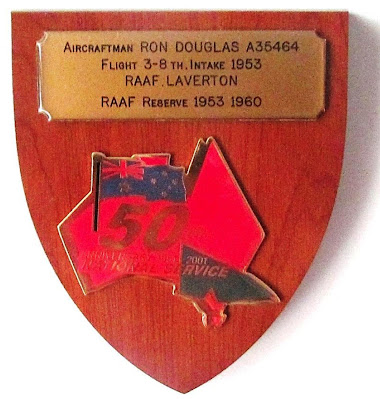
50 Year Commerative Plaque of National Service issued in 2001

Airforce badge with motto PER ARDUA-AD ASTRA-Through adversity to the stars. Ron Douglas memorabilia collection.

Ron’s Australian Defence Medal 2006 and Anniversary of National Service medal, 2001. The larger set for wearing at military functions and the miniature set for wearing at evening/dinner functions. Medal descriptions from Australian Government Honours and Medals website.
The Australian Defence Medal was established on 20 March 2006. It recognises qualifying efficient service of current and former Australian Defence Force (ADF) Regular and Reserve personnel, including National Servicemen, who have served since the end of World War II.
The Australian Defence Medal is a circular medal comprised of cupronickel. The obverse features the Commonwealth Coat of Arms with a sprig of wattle with the top outer edge inscribed with the words ‘The Australian Defence Medal’. The reverse is ensigned with the Crown of St Edward and includes the words ‘For Service’, surrounded by two sprays of wattle in blossom.
The Prime Minister, the Hon John Howard MP, announced the medal on 26 April 2001.
The Anniversary of National Service 1951-1972 Medal is a bronze medal ensigned with the Crown of St Edward.
The obverse depicts an Australian Defence Force emblem with the crossed swords of the Army taking precedence. The Federation Star surmounts the emblem. The words 'Anniversary of National Service' are on the perimeter of the medal and the years 1951-1972 are on the central bottom edge.
The reverse shows the Southern Cross overlaid on spreading rays and surrounded by a cog: a traditional symbol for the spirit of co-operation between the Australian Defence Force and the community.
1996 National Serviceman’s Association
The National Serviceman’s Association was formed due to former members wishing to keep alive the many ideals and the “esprit de Corps” of the original Nasho’s. It allowed members to come together again and demonstrate the pride they felt in serving their country in this way.
The Ballarat sub-branch of the NSA was formed in 1996 and had some 140 members and Associate members. Ron was elected sub-branch Secretary in 2008 which he said was demanding but ultimately satisfying job. He served also as Sub-Branch Welfare Officer and his late wife Dot was an Associate member.
He was involved many volunteer capacities with Veteran Affairs also. He did a couple of T.I.P. courses, which stands for Training in Pensions, so he could qualify as a Welfare and Pension Officer. He was then able to volunteer at the Veteran’s Support Centre which was based at the RSL in Lyons Street North, at the time. He recalled,
“It was a rewarding exercise as I was able to assist Veterans with advice and gained a pension for a few.”
In late 2005 it was suggested that a Memorial to honour National Servicemen should be added to the Memorial precinct in Sturt Street to honour all the Nasho’s from Ballarat and surrounding districts who served their country from 1951 to 1972.
A committee was formed including all ex-service organisation; National Serviceman’s Association, Returned Servicemen’s League, RAAF Association, Vietnam Veterans Association and Legion of Ex-servicemen. The Ballarat City council were represented by the Councillor for the City Ward and the Departmental Manager of the City of Ballarat.
Support was enlisted from local Members of Parliament and Service Clubs such as Rotary and Apex and the like. Several people devoted countless hours of work to the cause writing and presenting submission to Council. This was initially well received until some members of the Council Planning and Heritage Departments objected to and then rejected the proposal.
Thus began a long and difficult journey to achieve the aim of building the memorial. Thanks to the perseverance and support of members, council staff, City Councillors, sponsors and professional people that had been employed on the team, the dream came to fruition.
On February 3, 2008, the Memorial was unveiled and dedicated in a moving ceremony attended by many dignitaries, Nasho's and ex-service organisation members from all over Victoria. On July 10th several members interred a Time capsule onsite which is to be opened in 2030. Documentation will be forwarded to several relevant organisations.

Ron’s nomination for secretary of Ballarat Sub-Branch NSAA which provides a pretty comprehensive summary of his achievements over 60 years.


Ballarat NASHOS Memorial in Sturt Street on the corner of Dawson Street, 2008.

Ron and Dot Douglas and Ern and Mary Dexter at the dedication of the Memorial.

Former NASHOs at Ballarat Memorial Service

Ron presenting local MP Catherine King a Certificate of Appreciation from the Ballarat.

Ron and Dot at the medal presentation with Catherine King. All photographs from the Ron Douglas memorabilia collection.


Ron being presented with a Life Membership of the National Servicemen’s Association of Australia, Ballarat and District Sub-Branch. Presented September 15, 2011, by Lt.Col. Ted Lyons, Patron of the Association.
This is one of only three Life Membership granted by the NSAA, Ballarat and District Sub branch and Ron is rightly very proud of the honour. He was awarded a Life Membership in recognition of the sterling work he did over years for the Sub branch and especially his effort to bring the memorial project to reality. He is the sole surviving Life member.
Dear Messrs and Mesdames,

Inscription: This memorial commemorates the sacrifice and service of those men from Ballarat and District conscripted for National Service during the years 1951 and 1959, and 1965 and 1972. Unveiled by the Hon Tony Robinson MP Minister assisting the Premier on Veterans` Affairs 3 February 2008. Erected by the Ballarat and Districts sub-branch of the National Servicemen`s Association of Australia.


In 2011, Ron was also inducted into the Australasian Order of Old Bastards and has been a card-carrying member ever since!

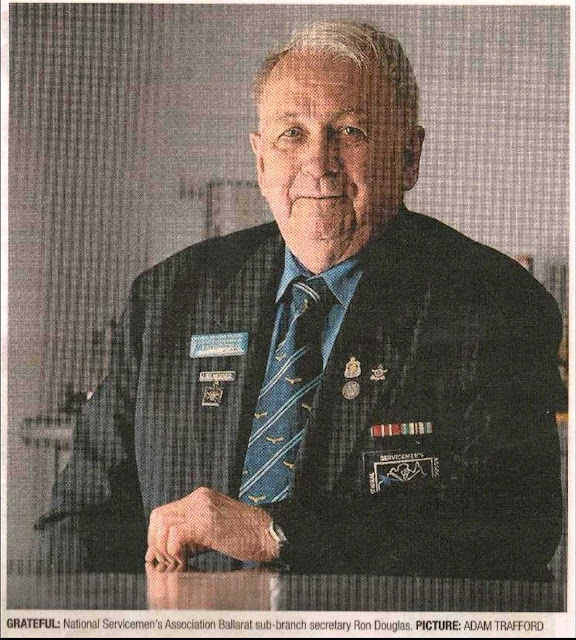

From the Ron Douglas memorabilia collection. Ballarat Courier April 8, 2015.


The Alfred Hall, 1950’s as Ron remembers it. Photo from his collection. 


When I began to support Essendon, they were referred to as Essendon or The Dons. I believe my early fascination with aircraft lead me to follow Essendon rather than any of the other eleven teams in the VFL. The association being of course Essendon Airport. As for the Brain Washing: two out of three children and five out of seven grandchildren, follow the Bombers, not a bad strike rate. Not sure if a couple of the grand - kids are as committed as the others but I like to think so.
When we were young most of us followed several teams. In my case it was: Golden Point (Ballarat League) Williamstown, Vic. Football Assoc. (VFA) and of course Essendon (VFL). Although supporting the Dons from an early age I think the first game I attended was the 1951 Grand Final. I went with Golden Point Football Club, Seniors, Reserves, Under 18, Under 16 and Under 14 teams all attended. No reserved seats those days but we all had a seat. It was a packed house though, from memory this was the year that spectators were directed to sit around the boundary, a very dangerous situation as the ball and players were continually forced over the boundary line into the crowd. It was just good luck that no one was seriously injured, it is perhaps difficult for many to imagine the scene given the stringent rules that apply today.
1951 was the year that Essendon was denied its third consecutive Premiership, having won in 1949 and 1950.
Geelong were Premiers in 1951 simply because the Great John Coleman was out of the Essendon Team having been suspended for striking a few weeks previous. He copped four weeks. As is often the case, he was reported for retaliating. He had been subjected to a
battering all day and of course he eventually reacted. The offender was Harry Casper of Carlton; conspiracy theories abounded at the time, and it was alleged that Collingwood paid money to have Coleman out of the Finals. Apparently, they (Collingwood) thought they were in with a chance, as you can see dear reader, little has changed in their thought processes in the last 5 or 6 decades.
It is somewhat ironic that Harry’s son played for Essendon Reserves many years later. John Coleman is considered the greatest Full Forward ever; the Coleman Medal is awarded each year to the player who scores the greatest number of goals in a season in the VFL / AFL.
I have been known to state that I have hated Carlton since 1951 because they cost us a Premiership. Only joking; Well almost only joking. For many years attendance at VFL games was limited to games played at Geelong involving several teams, not only Essendon.
However, the move to Melbourne by the family provided the opportunity to regularly attend games.
I should mention at this point Dot’s one and only attendance at a VFL /AFL game. The year was 1954 or 55, the Grand Final, Melbourne vs. Collingwood, almost a record crowd. Melbourne won by a very large margin. We had standing room only in front of the old score- board, it was difficult for Dot to see the game and she has had no desire to attend another game-ever!
Another highlight was the Final Series in 1970. Pop and I had Series Tickets (Final Four those days) and I still have memories the great games. South Melbourne played in this Final Series, and it was Bobby Skilton’s last game. Skilton won three Brownlow Medals, a great player he unfortunately never played in a Premiership.
The other highlight was of course Carlton victory over Collingwood. After being outplayed by a far superior team in the first half (Collingwood led by an unbeatable margin. Ron Barassi, Carlton ‘s Coach told his team to handball at all costs. This order led to Collingwood Coach, Bob Rose, being over – run. Really Collingwood was by far the superior team, and one could not help but feel sorry for Bob Rose, who should have won several Premierships. But of course, Collingwood was just being Collingwood; Suffering Delusions of Grandeur.
I have programs for this Final Series among my Collectables. From 1970 I attended matches each week as it was my outlet from work and study which at times was fairly intense. Those days Windy Hill was the place to be, the home crowd was incredible, the place
really rocked. Usually, I stood in the enclosure in front of the Reynolds Stand. Ian often came to the footy with me, during the early 70’s. In 1971 he would have been 7 or 8 years of age.
During the 1972 Season I joined “The Essendon Club” an affiliated Club which covered Members of Essendon Football, Cricket, Bowls and Baseball Clubs. A recruiting drive was being conducted at the time and my 1 st . Year Student Instructor, Morrie Klavins, was a Baseball Club Member and convinced me to join.
I have most of the yearly Medallions from the 1970s. to the 1990s. Membership initially entitled me to a seat in the Showers Stand but the Club later made these reserved seats, at an added cost of course. However, admittance to the enclosure was still available and several rows of seats on the boundary were available to early birds. Early birds we had in our Football Friends Dawn and George who always kept a seat for us. No matter which ground we went to we were assured of a seat, usually on the boundary.
Kerryn and I were regular attendees at games at many League Grounds along with her friend Chris. and often other workmates. These were lean years but as true supporters we were ever hopeful of success. The years of the Baby Bombers began during the Coaching years of Bill Stephen and Des. Tuddenham; it was most fitting that when success was achieved under Kevin Sheedy; recognition was given by Sheeds to his predecessors.
Sheedy became coach in 1981 and I attended his welcome function at Windy Hill and of course was impressed by his enthusiasm and commitment. In 1983 we reached the Grand Final, unfortunately we were soundly beaten, this was the game in which Timmy Watson was flattened, unfairly I still believe, by Colin Robertson of Hawthorn. Hawthorn won by 90 odd points, disappointing in the extreme. I remember calling into the Templestowe Hotel after the match to the unkind comments of fellow patrons. Many of them remarked that they did not expect to see me after such a defeat. I assured them that I would Return Victorious in 1984. This I did and also in 1985.
How well I remember the last quarter in 1984 when we were behind and Kerryn saying, the same as last year, going home. I was able to convince her that all would be well and that we would win. Many times, over the years, if we are not doing well during a game Kerryn will phone and ask “Will I go home yet?” Of course, I again advise her to “Hang in There!”
The teams of 1984 and 1985 were great teams and really should have won more Premierships. 1986 was a real disappointment for supporters. Naturally it was assumed that Essendon would continue on from 1985 and take all before them. Unfortunately, this was not the case and we supporters felt let down.
Mike Neill, a friend on the staff at Templestowe High School, and I journeyed by bus to Sydney during 1986 for the match against the Swans. We left Windy Hill at 8.30 pm on Friday Night July 11, the game being scheduled for Sunday afternoon. A most eventful trip; our bus was the oldest of the fleet and we experienced mechanical problems not long into the journey. The worst of which was a problem with the head lights meaning Tom, our driver had to drive with them on high beam – which was O.K. until he dipped the lights, and then we had no lights at all until he was able to switch back to high beam. Temporary repairs were made, at Goulburn I think, and we arrived in Sydney none the worse for wear.Permanent repairs to the lights were carried out under the supervision of our driver Tom, an Irishman, who was a good bloke and great company.
We were booked into a Hotel in Kings Cross and after a day of sight seeing, The Opera House and a Ferry Ride across Sydney Harbour we had a good night in the Hotel Piano Bar; well lubricated and in good voice. On Sunday after Brunch beside the swimming pool we were taken by bus to the Sydney Cricket Ground (SCG) where we had reserved seats in the Brewongle Stand which was quite new at the time.
This was the era of Dr. Geoffrey Edelstone the flamboyant owner of the Swans, pink car, pink helicopter and of course Leanne the glamorous young wife.
Sydney won the match easily which was bad enough but the excessively loud Music which accompanied each Swans goal was annoying to say the least. This Yankee Style was concentrated on the old Hill Area of the SCG where the Swans Cheer Squad was located. However, you win some and loose some and it was quite an experience to visit the SCG, the reserved seats and amenities in the new stand were first class. Shortly after the game we began our journey home expecting to be able to get to work on time on Monday morning as our ETA was 6.30 am.
Alas this was not to be. Not long into the journey the wheels literally fell off the bus. We were travelling downhill on a divided highway; traffic was heavy including semi–trailers, when disaster struck.
I was seated at the rear over the dual wheels on the left side and my first indication that something was amiss was a loud noise and a bump beneath my seat. The next instant we were swerving down the road with our driver Tom trying to maintain control with the rear of the bus leaning at an acute angle because the dual wheels had indeed fell off.
When we finally came to a halt the rear of the bus was resting on its axel and the wheels not to be seen. A search recovered both wheels, one several hundred yards down the road, the other down the embankment to the left of the road. Thankfully our driver was able to prevent the bus joining this wheel otherwise I may not be relating this tale. Another bus load of supporters in a bus belonging to the same bus company, which was following us, stopped and after much discussion we all boarded this bus and went on to, I think, Goulburn. We crowded into the Bus Depot while contact was made with the Bus Co. Office in Melbourne. After what seemed like several hours, cold, weary and hungry we set off for Albury. Passengers from the two buses packed into one with standing room only.
Tom our driver, good Captain that he was, stayed with his bus and we did not expect to see him again. As can be imagined it was uncomfortable travelling, a long way to travel standing, and few if any offered to share the seating. I remember Mike saying that he had to sit on the floor of course, I told him he may be trampled and never get up. He did sit and he did survive.
I stood all the way to Albury and I am sure that I could not repeat the exercise today. At Albury we boarded another bus that had travelled from Melbourne and commenced the journey home, in comfort but a little the worse for wear. We arrived back at Windy Hill about lunch time and took a Taxi home, too late and too exhausted to go to work. I remember Noel Henry (Vice – Principal and Wordsmith of note) writing up an absence report with very clever comments, I have a copy among my collectables.
Some considerable time later I received an unexpected phone call from Tom our bus driver asking if I remembered him and requesting help. It appeared that a few passengers had reported to the Police that Tom had driven dangerously and that they had feared for their safety. Their motives, it has been alleged, were questionable.
Subsequent Police enquiries resulted in Tom being charged with several offences, the most serious being dangerous driving. Naturally Tom was most concerned and asked if I would attend Court and provide evidence in his favour. I assured him I would certainly do so as I firmly believe that Tom driving skills averted a disaster and possibly saved our lives. An aside, the complainants in the case were from Geelong, perhaps they should have followed that team and not Essendon.
However, we attended Broadmeadows Court to contest the case and after much legal argument and cross examination of witnesses, Tom was cleared of all charges except a couple of minor Logbook infringements. When I was giving evidence, the Prosecutor questioned Tom driving skill and suggested that rather than having confidence in him we were just hoping for the best. I strongly reiterated my belief that Tom driving skills averted a tragedy and saved our lives. The result was greeted with joy by Tom and the Bus Company owner, and I was glad I was able to help out.
Needless to say, the complainants were not as happy with the result.
While I am on Football I should mention the almost constant contact with football experienced at Templestowe Technical School and in the General Community. One of our first students (remember, new school, 80 students, all boys) was Glen Arndt, a couple of brothers attended in later years. Their father, Lance, was a Senior Trainer at Essendon so there was always plenty of discussion about the game.
Other parents over the years were – Colin Hooper who was the Team Runner for Bill Stephen and also Kevin Sheedy, and later Inter – change Steward, Colin is still part of the Club Football Department.
Also a parent was Bob Syme; Bob was a Former Player and Assistant Couch to Des Tuddenham .Bob (Nick – Name Swampy) also coached at Horsham and Templestowe in The Diamond Valley League. I recall Bob phoning me one evening (his son Gary had mentioned that he would do so) to ask for my vote in the up- coming elections. Another parent was Ray (Slug) Jordan whose son was also named Gary. Ray Jordan was an outstanding Junior (u 18) Coach at several Clubs including
Essendon and very highly respected in footy circles. Another contact was Ken Fraser, Principal of Templestowe High School for several years, and the first Principal of Templestowe Secondary College, which came into being with the amalgamation of the High School with Templestowe Technical School.
The creation of the College took place after I retired so I did not work directly with Ken as Principal but did liaise closely in my role of Careers Officer of Templestowe Technical School. As mentioned previously many joint Careers Education / Work Experience / Community Projects were organised between the two Schools. For the record Ken Fraser was a Star Centre Half Forward (No.23) with Essendon, Premiership Captain in 1965 and represented Victoria on several occasions. Doncaster and Templestowe those days seemed to be the home of League Footballers.
The area was zoned to Fitzroy, but many Collingwood Players lived in the district. A few that come to mind: Colin Tulley, Barry Price, at least one of the Richardson brothers Max or Wayne. Murray Weidemann was another; his son who attended Templestowe H.S. with Lindy was also a good player. Thorold Merrett and Ray Gablich were patrons of Templestowe Hotel. Ray (Gabbo) was a regular and a good bloke, well respected by all and sundry. I can picture him now, his large frame almost completely enveloping an under – sized bar stool and laughing and joking.
Being in Fitzroy Zone meant that the club had regular contact; and the school benefited from the association with footballs and player visits. A few students went on to play VFL football. One of our first students, Grant Lawrie, played with Fitzroy and Victoria, and later with Box Hill in the VFA. He was a good all-round student and became a successful Electrical Draftsman, I would like to think that my early tuition in Practical Classes and Solid Geometry were instrumental in his success.
Grant was good enough to be Guest Speaker at a School Careers Day that I organised many years later. The Osborne brothers, Richard and Graham also played for Fitzroy. Graham moved to Tasmania and Richard went on to play with Footscray, Collingwood and Sydney.
Other students played with Fitzroy Juniors and one (Ricky Delmarta) with Collingwood U 18 and later won a Best and Fairest in the VAFA. Also, residents of Doncaster were Paul Roos and Gary Pert, both great players; Paul of course is Coach of the Sydney Swans.
Another notable resident of Templestowe at that time was David Parkin, Coach of Carlton Football Club, and often seen shopping in Templestowe Village. Also regularly sighted shopping with his young family at Bulleen Village Shopping Centre was David Cloke. David, his Wife and three young sons, in Pram or Pusher at that time were regulars; must have lived nearby. Not sure if David was playing with Richmond or Collingwood at this stage.
Time does move on, these three young kids all went on to play AFL: all three initially with Collingwood, later two of them transferring to other teams.
When appointed to Templestowe Technical School we rented a house in Rosanna, Halifax Avenue on the Banyule Estate. Our next-door neighbour was Cec Rheinberger and his family. Cec was playing for Fitzroy at the time and later played for Port Melbourne in the VFA.
Lindy was often called upon to be Baby Sitter to young Brett and thought the world of him; she apparently liked the name also, naming her son Brett many years later.
In the early years the School banked with NAB, Doncaster Branch, which later changed to ANZ Lower Templestowe. The Manager and School Council President was a Member of Hawthorn Football Club. He arranged for Peter Knights (Star Forward) to be Guest Speaker at a Sports Seminar. I had a yarn with him and got his autograph.
Another Guest Speaker I remember was Robert Walls, at that time Coach of Carlton Football Club. He also coached Fitzroy and Brisbane Bears. I remember that Essendon was drawn to play Carlton the next Saturday and discussing the likely outcome. Robert said, “Well one of us will be happy after the game.” It was me as I happily recall.
The recent untimely passing of Ron Evans reminded me of another milestone for the Essendon Football Club. Ron was a legend at Essendon, a Star Forward, Committeeman and Club President; he was also an AFL Commissioner and respected widely for his commitment to the Essendon Football Club, the AFL and football in general. He was a very successful businessman, and again respected by his peers and all with whom he came in contact. The milestone referred to was the decision to Leave Windy Hill for the MCG. That is to say, keep and develop our traditional home as a community asset and training base and play Home Games at the MCG. Emotions were running high amongst members with arguments for and against earnestly debated.
A meeting of Members was called to vote on the proposal, my neighbour, Malcolm and I attended to cast our vote. It was originally intended that the Official Party would sit in the stand and Members would assemble on the oval; it would have been standing room only. However, due to the large attendance the situation was reversed with the Official Table on the oval and Members seated in the Reynolds and Hird Stands.
Ron Evans spoke passionately in favour of the move as did Alec Epis (Kookaburra was most impressive). Ken Fraser also spoke in favour. A couple of Committee Members spoke against the move as did Essendon Council Representatives who lacked credibility as it was generally believed that Council could have done more for the Club over a long period. Quite a few members were not in favour of change, but by far a majority realised that to remain viable the Essendon Football Club had to move. I hadn’t sat in the Reynolds stand for a long time and my view of the Terraces was disturbing; they were a sorry sight with grass (weeds) growing and I was reminded of Fitzroy Brunswick Street ground and South Melbourne’s Lake Oval.
This only increased my resolve to vote in favour of the move to the MCG. The move, in 1991 was soon vindicated with success on and off the field. The Bombers later made Telstra Dome their Home Ground. Windy Hill has been successfully developed into a Modern Training Facility and a Community Centre. I would like to pay a visit to Windy Hill, to take in the changes and to reminisce. It would be a nostalgic journey.
Another enjoyable memory is the Chairman Dinner, Round 18, Essendon v Brisbane on Saturday August 3 ,2002, held in the Limelight Room, Docklands Stadium, as it was then known. I attended with Kerryn as guests of a sponsor. The menu and beverages were magnificent and plentiful. It was the first time that I have had a Scotch at half time! As always, I have kept the relevant menu, etc. among my collectibles.
As this was my birthday I just had to relate the experience as part of my Welfare Report in the August Edition of NASHO NEWS. As follows:
“I must relate to Members the celebration of my recent birthday.
There were 336 guests in the LIMELIGHT ROOM at DOCKLANDS STADIUM—an old acquaintance Tony Charlton was MC. I had met Tony on several occasions at Templestowe RSL. I went on to say: - “Actually my daughter Kerryn and I were guests of a sponsor at the ESSENDON FOOTBALL CLUB Chairman’s Dinner. The Décor and ambience was incredible - BLACK AND RED everywhere. Football Junkies Heaven – only a philistine would fail to be impressed. Our Federal Treasurer was in attendance – I kept myself nice and conversed cordially with him.
The only disappointment was the final result. However, nothing could detract from the great experience, which I just had to share with you all. Next month’s report will be back to the more mundane, till then good health and fortune.”
There were many memorable moments following the Bombers, I am sure there will be many more in the future. A recent Newspaper story in the Sunday Herald Sun, Dec. 14, 2008, reminded me of another Football Identity with whom I had contact on a number of occasions. John Kennedy, Hawthorn F.C. Coach at the time, was also Principal of Swinburne Technical School 1969 or 1970.
This was the first time I met John then a couple of other occasions when he was chairman of the Teachers Tribunal, during a Review of salary and Conditions. One meeting was at either at Treasury Place or Nauru House, not sure which venue. Another time he and a panel visited Templestowe Technical School as part of another survey regarding the changing profile of Technical Teaching.
I was interviewed and required to submit a paper because of my involvement in Careers Education and Work Experience Programs. I always found John Kennedy to be pleasant and courteous person to meet, a gentleman who put you at ease and was interested in your point of view.
A couple of times since returning to Ballarat I have had the opportunity of speaking to John when he has visited; only a brief Hello but a pleasure to again make his acquaintance.
Ron’s Nomination for Life membership Ballarat Districts Sub-Branch, National Servicemen Association of Australia from 2010, which provides an excellent summary of all the work Ron did over the 20 years he was a member:
Dear Messrs and Mesdames,
It is with pleasure that I/we write regarding the Nomination of Ron Douglas for a Life Membership of the Ballarat and Districts Sub- Branch of the National Servicemen’s Association of Australia.I / We believe that Ron qualifies for Life Membership of the Sub – Branch under Rule 31.3 (e) as he has undertaken duties within the Sub- Branch for a period in excess of the requirements, and his efforts on behalf of the Sub- Branch must be considered as “Meritorious”Ron is a founding Member, attending the first Meeting on Father’s Day 1996. Ron was elected to the Committee and has served for some 12 years, or so.During this time Ron has undertaken the role of Welfare Officer administering to the needs of unwell Members, and Families, mailing Get Well Cards, visiting Homes and Hospitals (including ICU and Hospice visits); as well as attending bi- monthly Welfare Officers Meetings.To qualify for the role Ron successfully undertook T.I.P Training Courses i.e. MCRS Claims Officer, Basic Pension Officer and Basic Welfare Officer Courses.Whilst obtaining these qualifications Ron worked for some time at the Veterans Support Centre to further his knowledge and gain expertise.Ron has also represented the Sub – Branch, since its inception, at Quarterly Meetings of the Council of Ex-Service Organisations Committee.Since being elected Secretary, he has been a Delegate at State Council Meetings.When the concept of a Memorial (Monument) to Ballarat and Districts National Servicemen who Served 1951 to 1972, was envisaged,Ron along with a number of dedicated people; worked tirelessly to bring the dream to fruition. Ron wrote the initial Submission to City Council requesting Planning approval and also collaborated in writing a successful Submission for funds from Veterans Affairs.Ron also contributed, with others to the planning and internment of the Time Capsule especially in contacting, with Plans of location, many organisations requesting that they record and comply with our exhumation requests.A submission to The Department of Families, Housing, Community Services and Indigenous Affairs was also successful in gaining funding for our Volunteer Projects and the purchase of equipment. Ron aims to be aware of any Grants that may be available and is always ready to seek new Sponsors. Also, Ron has been involved for many years in the distribution of Sub – Branch Monthly Newsletter.Elected Sub - Branch Secretary in 2008, and currently occupying the position, he has continued to liaise and develop a rapport with other Ex Service, and Community Service organisations, includingNewspapers and Community Radio, thus further enhancing the reputation of National Servicemen, in general and Ballarat Sub – Branch, in particular.Other contributions include Introduction of Business Cards and Official Letterheads which enable a professional, business-like approach to all communications. Another involvement is the time-consuming project involving Local Politicians enabling Nashos to obtain the Medals to which they are entitled. Hopefully this project may assist in gaining New Members.Ron has endeavoured to engender a sense of Camaraderie and Esprit de Corps within the Sub – Branch.”
Inscription: This memorial commemorates the sacrifice and service of those men from Ballarat and District conscripted for National Service during the years 1951 and 1959, and 1965 and 1972. Unveiled by the Hon Tony Robinson MP Minister assisting the Premier on Veterans` Affairs 3 February 2008. Erected by the Ballarat and Districts sub-branch of the National Servicemen`s Association of Australia.
Dot’s nomination for the Committee of the NSAA Ballarat Sub-branch. As can be seen she supported Ron in everything he did for the Sub-Branch from visiting members to selling raffle tickets- a lot of raffle tickets. It takes very dedicated volunteers to sell raffle tickets, speaking from experience and Ron and Dot were certainly the best kind of volunteers:
BALLARAT & DISTRICTS SUB – BRANCH N.S.A.A.NOMINATION for the Position of COMMITTEE.Dot Douglas – Member No. BAL 104.Brief Statement of Relevant Experience:Associate Member several years and Committee (Full) Member 2010 /11/12/13/14Assisted / Supported Ron in his role of Welfare Officer for some 10 – 12 years,Selecting Gifts & Visiting Members at Home, Hospital and in Palliative Care.Involved in distribution of Monthly Newsletter for several years.Involved in approaches to potential Sponsors.Participated in most Sub – Branch activities over this period including fundraising and donation of monthly prizes.Over the last few years Ron & I have sold up to 70 Raffle Books (each year).This is one third of Sub – Branch total allocation.Statement of Intent: Will continue to work with and support Ron in his roll of Secretary, should he continue in the office, and assist other Members where appropriate to enhance the operation of the Sub – Branch.DOT DOUGLAS
Nasho’s Memorial Canberra 2010
In 2010 Ron attended the unveiling and dedication of the NASHO’s Memorial Fountain, at the Australian War Memorial in Canberra. It was officially unveiled by Her Excellency Quentin Bryce AC, Governor General of the Commonwealth of Australia on September 8, 2010. The NASHO’s attended and marched past the assembled dignitaries. They marched in Year level of call-up 1951 to 1972.
The War Memorial press release, 12 September 2010, stated in part:
“Thousands of former National Servicemen and their families came together in Canberra last week to take part in the official dedication by the Governor- General on 8 September of their new memorial fountain located in the Eastern Precinct of the Australian War Memorial.
Beneath sunny skies old mates gathered together to laugh and shed a few tears, swap yarns and remember absent friends in what was one of the largest reunions of former 'Nashos'.
Ron later attended the reception at Parliament House and was fortunate to have his photograph taken with Air Marshall Angus Houston. It was fitting that Ron be afforded the opportunity to have this memento to add to his collection because of all the work he did for the NASHO’s over many years. As Ron said:
“Not many people get to have their photograph taken with the chief of the RAAF.”
Ron pictured with Air Marshall Angus Houston at Parliament House, 2010
Photographs supplied by Russell Byers / Howard Mitchell
The National Service Memorial Fountain commemorates those who served as national servicemen under the two schemes created under the National Service Act 1951 (1951 - 1959) and the National Service Act 1964 (1965 - 1972).
The memorial is dedicated to the 290,000 young men who were called up for National Service and honours the 212 National Servicemen who died in action. 210 servicemen died in Vietnam and 2 died in Borneo.
The memorial fountain features a sandstone plinth (matching the colour of the Australian War Memorial itself) which symbolises the Army; the reflection of the sky in the black polished granite represents the Royal Australian Air Force and the water in the bronze bowl represents the Royal Australian Navy.
Front Inscription: Dedicated to all Australian National Servicemen and in memory of all who died. Plaque : National Service Memorial
Officially unveiled by Her Excellency Quentin Bryce AC Governor-General of the Commonwealth of Australia 8 September 2010
Between 1951 and 1972, over 290,000 young men were called up for National Service.
Approximately 227,000 18-year-old Australian men underwent compulsory training in the Navy, Army and Air Force between 1951 and 1959, at a time of escalating international tension during the Cold War.
Almost 64,000 20-year-old men served in the Australian Army as National Servicemen between 1964 and 1972. They served in Borneo, Vietnam, Malaysia, Papua New-Guinea and Australia, and constituted 40 per cent of those who died on active service.
This memorial was designed by Johnson Pilton & Walker.
Reference Page Monument Australia: www.monumentaustralia.org.au
From the Ron Douglas memorabilia collection. Ballarat Courier, Saturday October 2, 2010.
NATIONAL SERVICEMANS ASSOCIATION SUB BRANCH TO FOLD After 20 years of volunteering and working for the sub-branch the Ballarat National Servicemen’s Association folded in 2015. Ron had been there at the beginning as a founding member and saw it achieve a remarkable event in the building of the NASHO’s memorial in Ballarat. With declining membership as members got older it became unsustainable and so the difficult decision was made to close the sub branch.
From the Ron Douglas memorabilia collection. Ballarat Courier April 8, 2015.
Ron’s Interest In Aviation From A Very Young Age.
I just always liked reading about planes and sent away many times for literature from Commercial Airlines: Trans Australia Airlines (TAA) and Australian National Air Lines (ANA). Even at some stage Kellogg produced cut out models on the packets of cornflakes to assemble.
Then of course as a RAAF Nasho, I was near planes, and I had my first flight from Laverton to Ballarat.
Much later when I was working as a Trade teacher, I had the opportunity to try a Flight simulator. Being a member of a teacher’s Technology group enabled us access to a flight in a simulator at Melbourne Airport.
From memory 5 or 6 of us boarded – I didn’t get in the pilot’s seat, but it was a memorable experience. I could not have done worse than the “Pilot”. He almost clipped the Rialto Building in Melbourne. Just as well it was only a Training Flight! After a couple of sweeps of the Bay, We landed back at base. We were only on board for less than an hour, whereas an airlines crew boarded the other simulator for a 13-hour flight.
Again, I was very fortunate to have this experience and have recorded it in my “Reminiscences” as a stand out experience.
Trip of a Lifetime 2008
By Ron Douglas (aka Salguod Nor) October 2008.
Travelling Companions – Kerryn, (aka Nyrrek Salguod) and Ken and Jack McKenzie.
A long held ambition came to fruition when Kerryn convinced me to join her, along with Ken and Jack on a trip to Scotland, taking in Singapore, England and Wales. Kerryn made all the arrangements with the assistance of her Travel Agent in Bendigo. The attention to detail was marvellous and helped make the trip so successful.
The pre – booking of many of the extras, including Train Travel and Hire Car to visit Mum’s Birthplace, Heanor, Derbyshire, was organisation at its best and provided me with the opportunity to
actually enter the home where mum grew up and talk to the current occupant and neighbours.
Having never held a Passport this was one of the first tasks, the organisation of finances and luggage followed whilst studying maps of our proposed itinerary and then we were off.
We all rendezvoused at Kerryn’s place, Dot Drove me over very early in the morning. We set off from Kerryn’s and drove to the Parking Venue and then by mini – bus to Melbourne Airport (Tullamarine).
After check-in we boarded Our Singapore Airlines flight, first stop Singapore. Kerryn had been advised to book a couple wheelchairs for Jack and myself, not because we are infirm, but to expedite our
passage through customs and it worked a treat throughout our travels.
10 – 15 AM Depart Melbourne Airport on Singapore Airlines (Boeing 747- 400) Flying Time 7 hours 45 minutes
4 – 00 PM Arrive Singapore Airport. Saturday 04 Oct Coach transfer to Hotel.
174
Sunday 05 Oct Accommodation one night – Hotel Miramar Singapore
9-05 AM Depart Singapore Airport Flying Time 13 Hours 25 Minutes
3- 30 PM Arrive London - Heathrow Airport
Sunday 5 Oct Accommodation two nights Ibis Earls Court, Earls Court
Monday 6 Oct. Kerryn and I walked from Hotel to Earls Court Station through to Kings Cross
Station (St. Pancross) Train to Nottingham, picked up Hire Car and drove to No. 3 Caxton Street Heanor, Derbyshire.
Ron and Kerryn outside Ron’s mother’s childhood home, 3 Caxton Street, Heanor.
This is the house where Mum grew up. She along with two cousins was raised by their Granny. Mum’s mother died when mum was only a baby and her dad was killed in a coal Mine accident. I am not sure of the cousin’s circumstances. Mum lived here until she migrated to Australia (Ballarat) under Contract to Knitting firm R Morley to train Machinists. I have Photos of her, and others, demonstrating their Machining Skills in the windows of “Buckley and Nunns Department Store, Melbourne Circa 1928.
In Heanor we spoke to the lady who occupies the house, and her neighbours, who remembered the Meakins, Mum’s Cousins, from whom she purchased the residence some 45 years ago.
We spoke to the owner ,Violet, and several of her neighbours and were given a tour. The stairs to the upstairs bedrooms were very steep, perhaps 45 degrees. Violet insisted that I look at her new bathroom. It would have been logical to have bedroom and bathroom downstairs. However I followed her up the stairs, she said, “I don’t get many gentlemen callers these days.” I replied, “Violet, it’s those bloody stairs! they would be exhausted by the time they Climbed up them.”
However, a gentleman did call for her driving a large Yank Tank (large American car). He was impatient to get going, we wished each other well and said goodbye. As it was lunch time we called at the closest Pub, I think the “Jolly Colliers.” We entered the Pub and said G’day (as one does in a foreign land) to the Barman and he responded with “Bloody Australians.” I replied, “We Aussies don’t have an accent, anyway, I have come to see where me Moom Coom Froom.”
He said, “You better have a beer.”
I noticed the lunch Special, Steak and Kidney Pudding (Pie)and Chips. It was wonderful, just like my mum made!
We drove back to Nottingham and then took the train to Kings Cross and caught the Tube back to Earls Court. We walked back to Earls Court Hotel. What a wonderful Day!
Day 3 – Plymouth. We went on a boat trip around harbour, where Pilgrim Fathers embarked on the Mayflower, as did Sir Francis Drake to attack the Spanish Armada. Charels Darwin also sailed from here in HMS Beagle.
Nuclear Subs laid up (Reactors removed) Portuguese and German ships in harbour.
I have reluctantly come to the conclusion that to detail every City, Village, Landmark, would result in a tome to rival War and Peace therefore I will list highlights visited and add comments to some. I trust dear reader that you may wish to research further points of
interest.
Highlights:
Salisbury-View the Cathedral
Stonehenge- Ancient stone circle
Plymouth-see previous entry above
Cornwell Penzance- Sunny day seaside eating a real Cornish pasty, doesn’t get any better than that.
Bath-renowned ancient spa town
Stratford Upon Avon-Shakespeare’s Birthplace
Cardiff-Capital of Wales, Cardiff Castle
Chester / Tintern Village shopping
Lake District- Lake Windermere
Gretna Green- Witnessed Marriage Ceremony
Glasgow Drive around City – History enthralling - Private Club for Dinner
Lock Ness- Cruise on Lock Lomond
Ben Nevis Britain’s Highest Mountain – Chairlift to summit Aviemore -Scottish Ski Resort
Scottish Highlands-Drive to Culloden (Famous Battlefield)
Perth and Dundee and on to old University Town St. Andrews which is the Home of Golf.
Edinburgh- Scottish Capital. Tour shows us the Royal Mile, Princes Street and views of the famous Castle.
Rosslyn Chapel- Knights Templar. Magnificent Chapel being restored. Incredible!
History. Worth following up. Refer” The DaVinci Code” Novel and Film.
Stirling Stirling Town similar to many others, stopped at Castle, took photos of William Wallace statue. Castle is where Mary Queen of Scots was Crowned Queen at 6 months of age.
Bannockburn Village to King Robert Hotel where we experienced a
Piper piping in the Haggis in procession, we Toasted the Haggis and partook of this Scottish delicacy washed down with a few drams of “The Water of Life”
Piper played, young girl danced Highland fling and Sword Dance.
Comedians kept all involved, we were singing Yankee Doodle Dandy and Waltzing Matilda, accompanied by the Bagpipes. We were still singing 0n the bus back to the hotel.
The Borders on to Hadrian’s Wall, once defending England from the Picts and the Scots.
Durham- Explore cobbled streets, Norman Cathedral and Castle on Palace Green.
York- Reputedly the most haunted City in England Walled Town. (Romans)
Leeds- Dinner and overnight stay
Cambridge- Famous University, dates to 12 th Century. I can say I attended Cambridge. Well, I have trod the hallowed grounds!
London- Many of our party left us to take other tours. A few tears. Back to Ibis Hotel where we started in Earls Court.
Droved past houses of Parliament and Tower of London.
Next day walked a couple of blocks and caught a double decker bus No.74. Great view from open top deck. Bought ticket for City Tour, Including River cruise.
Visit Tower of London, incredible history – River cruise was exciting. Then Bus to Buckingham Palace – walked all around – striking building, Gates and monuments. Hoped to see Changing of Guard, but not on Sunday. Walked further round Palace to Souvenir Shop. Everyone is making a Quid. Had lunch then caught bus to Trafalgar Square (Nelsons Column.) and other Statues/
Monuments, including Queen Victoria and King George 1V.An Indian Festival had taken over, a lot of noise.
Almost forgot - Had a ride on Scenic Wheel (London Eye) Built on the Thames River by British Airways. Big Sunday crowd, incredible views.
Went to a pub which advertised 3 foe 1 Pints, but this was next week, wouldn’t bring the offer forward. Spoke to a Scotsman (Piper in Queens own Regiment.). Also spoke to character named Bob Barker, a Pom with a sense of humour. Not sure if he was fair dinkum, but an interesting local. We walked around the corner with him to “The Sherlock Holmes Pub.” An interesting place full of memorabilia and showing the film “Hounds of the Baskerville.”
Had a beer, then caught a bus to Westminster Station, Train to Earls Court, changed trains and got off at South Brougham, short walk to our hotel. Must pack for tomorrow’s flight to Singapore.
Breakfast at IBIS Hotel then walk around Earls Court, lunched at a little café (small shops of every description everywhere including a fruit market.
Then Shuttle Bus to Heathrow Airport., cue up to verify tickets then Kerry n’s organisation kicked in. Wheelchairs for Jack and I at every Airport to get through Customs without any hassles.
Eleven-hour flight (Time Zones) left London 8pm arrived Singapore 2pm next day.
Drive from Changi Airport to Hotel Miramar Hotel where we stayed on outward trip
16 th floor, wonderful rooms and facilities. Service throughout Singapore was great.
After breakfast we were accosted by Taxi driver “Ricky” outside hotel, offered his services, $25 for an hour tour. He took us to a large jewellery complex where some manufacturing took place. Large number of staff all trying to sell to no avail. Then on to China Town, Ricky would get a commission for any sales at some shops.
Kerryn bought a camera (not a Ricky’s store) all stall holders on the make, I bought some cheap caps to take home.
Joined tour after lunch at 1pm. First stop museum of early Singapore then on to Raffles Hotel which was a wonderful experience. Had coffee and cake in Raffles Long Bar. The only place in Singapore where you can litter. In the early days there was a peanut plantation and Tradition decreed that you drop shells on the floor which was awash with shells. Rather dangerous if you had a pint or two.
Then visit to a “Pewter Shop” excellent demonstration and quality goods for sale.
Back to hotel at 6-30 pm. after another hectic day.
A memorable visit to Changi Museum, one cannot fail to be moved by the history of this place. I personally knew a former prisoner of War 2 who spent several years in this hell hole. He became a good friend, and I was able to do the odd job for him.
Also in Singapore is the Kranji Memorial /Cemetery the final resting place for Allied soldiers who perished during the battle for Singapore. Dedicated to the men and women from the United Kingdom, Australia, Canada,
Sri Lanka, India, Malaya, New Zealand and the Netherlands.
Within the Cemetery the Memorial bears the names of over 24,000 casualties of the Commonwealth land and Air Forces who fought to defend Singapore. Like all War Graves the whole area is immaculately maintained. A striking feature is the young age of the majority of those who are interred here.
“Lest We Forget”
Last night in Singapore, great entertainment by a Singing group from the Philippines.
Depart Singapore Airport 9.00 am. Flying time 7 hours 10minutes
Arrive Melbourne Airport 7:10 am. Collect Car from parking area and home to good old Ballarat, exhausted but elated, and as stated in the opening statement
A Trip of a Lifetime - not the Finis.
Tea and cake at Raffles. Ron on the right with Kerryn next to him.
Laird of Glencoe. This card shows Ron’s entitlement to use the title Laird as he is the owner of an estate in Scotland. The fact that the land concerned is just one foot square doesn’t matter at all to Ron.
Appendices
Appendix 1: The Williams Family
Robert Noakes Williams (1801-1882) Ned William’s father. He married Sarah Ann Elizabeth Crowden (1801-1854)
Robert Thomas Williams (1823-1905). Ned Williams older brother who lived and died in
England.
Mary (Williams) Tate. 1840-1916. Ned Williams’s sister. She married Professor
Ralph Tate.
Professor Ralph Tate, 1840-1901. Ned’s brother in-law. This photograph was taken in Sydney in 1882. Ralph and Mary later lived in Adelaide. Ned moved there and lived with them for a few years in the late 1890’s. He left Ballarat in about 1898 returned a couple of years later.
Edward Robert King Williams,1862-1926. Ned’s nephew. He married Louisa Bartlett (1863-1941). They live in Howitt Street Ballarat and looked after Ned when he returned from Adelaide. He lived with his nephew in Howitt Street until he died in 1901. Edward was the son of James Alfred Williams (1831-1896) and Mary Anne Yeo (1831-1883)
Copy of the Niven illuminated address presented to Ned Williams in 1884 by Ballarat Rowing Club.
Appendix 2: Iconic Ballarat Buildings
The Alfred Hall
The Alfred Hall, 1950’s as Ron remembers it. Photo from his collection.
A recent edition of the Ballarat Courier March 31, 2007, published an article regarding the Alfred Hall, which was situated on the site of the present-day Big W store on the corner of Curtis and Grenville Streets, Ballarat. The Alfred Hall was built in six weeks in 1867 and straddled the Yarrowee Creek, with half the Hall in Ballarat East half in Ballarat West as the creek formed the boundary between the two municipalities.
There was great rivalry between the two halves of Ballarat, and for many years after the amalgamation, some bitterness as many residents believed, with some justification, that the “Top End of Town” received preferential treatment. We all know where the seat of Local Government (City Council) is today: The present City Hall was the Ballarat West ‘Headquarters ‘ whilst Ballarat East Town Hall was in Barkly Street opposite the Ballarat East Fire Station and the area was known as The Town Hall Gardens.
Over time the site has seen many uses including the Ballarat East Library and the Ballarat Girls Secondary School. The clothing manufacturing firm C.J. Wilson also occupied the site for a number of years. In recent times the site has been redeveloped by The Victorian Education Department and is now the Senior Campus of Ballarat Secondary College.
As a matter of interest, Dot. worked for C.J. Wilson P/L. from the age of 15 years on this site and later in the purpose-built factory in Scott Parade until the firm closed its Ballarat operation in 1957, the year we were married.
She subsequently gained immediate employment with Paddle Shoes and remained with this firm until Kerryn was born. Several years later when we moved to Melbourne Dot Again worked for C.J.Wilson in Fitzroy and renewed acquaintances with her old bosses. The Scott Parade factory has for many years been occupied by Waller and Chester Printers and Dot has several times had a conducted tour of the premises by Clark Chester when we have visited on NASHO business. Clark is a Sub – Branch Member and sponsors the printing of our Monthly Newsletter.
Now back to The Alfred Hall, built of wood it was not supposed to be a permanent construction. However, it lasted almost 100 years, only being demolished in 1956. During our formative years, from Primary School, Technical School and teen -age years prior to its demolition, we often visited the Hall for a variety of functions.
The Blind Institute of Victoria conducted concerts; many of the performers were blind and were remarkably talented. We attended in School groups and also to regular performances of The Victorian Symphony Orchestra conducted by Bernard Heinz (I think now Sir Bernard). The Hall also hosted School Speech Nights – a copy of Junior Technical School Program is included in Volume 1 of this increasingly weighty tome. The Ballarat Motor Show, Trade and Home displays and exhibitions were held at the venue; indeed the location and size of the Alfred Hall was a wonderful venue for almost any important function.
The Civic Hall in Mair Street replaced The Alfred Hall and now it is to be, at least partly, also demolished, the price of progress I suppose.
The Alfred Hall. Occasion of the first motorcycle race, September 12, 1905. From Ballarat Historical Society Collection.
The Town Hall
Whilst reminiscing about Ballarat icons, I recalled an early association with our City Hall. When I was, probably 10 or 11 years old I had the opportunity to climb the bell tower. Those days the Bells were rung on Sunday mornings and special occasions in the actual Bell / Clock Tower. In later years a Carillon was installed adjacent to City Hall on the corner of Armstrong Street and Bath Lane. This now provides the melodious sounds that were previously obtained by Bell Ringers who climbed the Town Hall Tower to manually create the music we all enjoy.
I remember climbing the Tower one Sunday morning with Dad and I think from memory, my brother Kev. on the invitation and guidance of Mr. Bill Collie who was a relative. Bill Collie was a Bell Ringer with a long association with City Hall, he may have been a Caretaker at some stage.
The climb up the Tower was an arduous one, the staircase needed repairs and at the top of the tower it was open to the elements. I recall it was quite windy that day. The Belfry was the home to countless pigeons and their droppings were everywhere. These conditions no longer exist as several renovations over the years have restored the City Hall to its former glory.
There have been several changes to the many rooms, mainly to accommodate the numerous staff now employed by The City of Ballarat. The large Ballroom upstairs, which was used for weekly dances and official functions, has been converted to offices and Conference Rooms. Readers will recall that the Ballarat Rowing Club Centenary Celebrations were held at this venue in 1961.
In recent times I have attended meetings at City Hall in connection with the planning of the Proposed Memorial to National Servicemen to be erected in Sturt Street. The whole place has changed and it is difficult to visualise the configuration exactly as it once was.
However, the building is maintained, and the internal and external appearance is quite grand and is a significant reminder, along with many other preserved buildings in the City, of the proud history of Ballarat.
NOTE: Both the Alfred Hall and the interior of the Town were designed by noted Ballarat architect Henry Richards Caselli. He also designed Bailey’s Mansion, now St. John of God Hospital and multiple churches and buildings around Ballarat in the boom building period of the 1870’s. He served as President of the Ballarat City Rowing Club from 1874 until his death 1884.
Ballarat Town Hall circa 1950’s with view of the clock tower.
Appendix 3: Ron, Football and Essendon Football Club
ESSENDON Football Club — As indicated previously I have followed The Mighty Bombers since an early age. It was of course my duty to encourage (brain wash) my children and grandchildren to also barrack for the team in Black and Red. Supporters have been known for years as the Black and Red Horde and for the last twenty years as Sheedy’s Army.When I began to support Essendon, they were referred to as Essendon or The Dons. I believe my early fascination with aircraft lead me to follow Essendon rather than any of the other eleven teams in the VFL. The association being of course Essendon Airport. As for the Brain Washing: two out of three children and five out of seven grandchildren, follow the Bombers, not a bad strike rate. Not sure if a couple of the grand - kids are as committed as the others but I like to think so.
When we were young most of us followed several teams. In my case it was: Golden Point (Ballarat League) Williamstown, Vic. Football Assoc. (VFA) and of course Essendon (VFL). Although supporting the Dons from an early age I think the first game I attended was the 1951 Grand Final. I went with Golden Point Football Club, Seniors, Reserves, Under 18, Under 16 and Under 14 teams all attended. No reserved seats those days but we all had a seat. It was a packed house though, from memory this was the year that spectators were directed to sit around the boundary, a very dangerous situation as the ball and players were continually forced over the boundary line into the crowd. It was just good luck that no one was seriously injured, it is perhaps difficult for many to imagine the scene given the stringent rules that apply today.
1951 was the year that Essendon was denied its third consecutive Premiership, having won in 1949 and 1950.
Geelong were Premiers in 1951 simply because the Great John Coleman was out of the Essendon Team having been suspended for striking a few weeks previous. He copped four weeks. As is often the case, he was reported for retaliating. He had been subjected to a
battering all day and of course he eventually reacted. The offender was Harry Casper of Carlton; conspiracy theories abounded at the time, and it was alleged that Collingwood paid money to have Coleman out of the Finals. Apparently, they (Collingwood) thought they were in with a chance, as you can see dear reader, little has changed in their thought processes in the last 5 or 6 decades.
It is somewhat ironic that Harry’s son played for Essendon Reserves many years later. John Coleman is considered the greatest Full Forward ever; the Coleman Medal is awarded each year to the player who scores the greatest number of goals in a season in the VFL / AFL.
I have been known to state that I have hated Carlton since 1951 because they cost us a Premiership. Only joking; Well almost only joking. For many years attendance at VFL games was limited to games played at Geelong involving several teams, not only Essendon.
However, the move to Melbourne by the family provided the opportunity to regularly attend games.
I should mention at this point Dot’s one and only attendance at a VFL /AFL game. The year was 1954 or 55, the Grand Final, Melbourne vs. Collingwood, almost a record crowd. Melbourne won by a very large margin. We had standing room only in front of the old score- board, it was difficult for Dot to see the game and she has had no desire to attend another game-ever!
Another highlight was the Final Series in 1970. Pop and I had Series Tickets (Final Four those days) and I still have memories the great games. South Melbourne played in this Final Series, and it was Bobby Skilton’s last game. Skilton won three Brownlow Medals, a great player he unfortunately never played in a Premiership.
The other highlight was of course Carlton victory over Collingwood. After being outplayed by a far superior team in the first half (Collingwood led by an unbeatable margin. Ron Barassi, Carlton ‘s Coach told his team to handball at all costs. This order led to Collingwood Coach, Bob Rose, being over – run. Really Collingwood was by far the superior team, and one could not help but feel sorry for Bob Rose, who should have won several Premierships. But of course, Collingwood was just being Collingwood; Suffering Delusions of Grandeur.
I have programs for this Final Series among my Collectables. From 1970 I attended matches each week as it was my outlet from work and study which at times was fairly intense. Those days Windy Hill was the place to be, the home crowd was incredible, the place
really rocked. Usually, I stood in the enclosure in front of the Reynolds Stand. Ian often came to the footy with me, during the early 70’s. In 1971 he would have been 7 or 8 years of age.
During the 1972 Season I joined “The Essendon Club” an affiliated Club which covered Members of Essendon Football, Cricket, Bowls and Baseball Clubs. A recruiting drive was being conducted at the time and my 1 st . Year Student Instructor, Morrie Klavins, was a Baseball Club Member and convinced me to join.
I have most of the yearly Medallions from the 1970s. to the 1990s. Membership initially entitled me to a seat in the Showers Stand but the Club later made these reserved seats, at an added cost of course. However, admittance to the enclosure was still available and several rows of seats on the boundary were available to early birds. Early birds we had in our Football Friends Dawn and George who always kept a seat for us. No matter which ground we went to we were assured of a seat, usually on the boundary.
Kerryn and I were regular attendees at games at many League Grounds along with her friend Chris. and often other workmates. These were lean years but as true supporters we were ever hopeful of success. The years of the Baby Bombers began during the Coaching years of Bill Stephen and Des. Tuddenham; it was most fitting that when success was achieved under Kevin Sheedy; recognition was given by Sheeds to his predecessors.
Sheedy became coach in 1981 and I attended his welcome function at Windy Hill and of course was impressed by his enthusiasm and commitment. In 1983 we reached the Grand Final, unfortunately we were soundly beaten, this was the game in which Timmy Watson was flattened, unfairly I still believe, by Colin Robertson of Hawthorn. Hawthorn won by 90 odd points, disappointing in the extreme. I remember calling into the Templestowe Hotel after the match to the unkind comments of fellow patrons. Many of them remarked that they did not expect to see me after such a defeat. I assured them that I would Return Victorious in 1984. This I did and also in 1985.
How well I remember the last quarter in 1984 when we were behind and Kerryn saying, the same as last year, going home. I was able to convince her that all would be well and that we would win. Many times, over the years, if we are not doing well during a game Kerryn will phone and ask “Will I go home yet?” Of course, I again advise her to “Hang in There!”
The teams of 1984 and 1985 were great teams and really should have won more Premierships. 1986 was a real disappointment for supporters. Naturally it was assumed that Essendon would continue on from 1985 and take all before them. Unfortunately, this was not the case and we supporters felt let down.
Mike Neill, a friend on the staff at Templestowe High School, and I journeyed by bus to Sydney during 1986 for the match against the Swans. We left Windy Hill at 8.30 pm on Friday Night July 11, the game being scheduled for Sunday afternoon. A most eventful trip; our bus was the oldest of the fleet and we experienced mechanical problems not long into the journey. The worst of which was a problem with the head lights meaning Tom, our driver had to drive with them on high beam – which was O.K. until he dipped the lights, and then we had no lights at all until he was able to switch back to high beam. Temporary repairs were made, at Goulburn I think, and we arrived in Sydney none the worse for wear.Permanent repairs to the lights were carried out under the supervision of our driver Tom, an Irishman, who was a good bloke and great company.
We were booked into a Hotel in Kings Cross and after a day of sight seeing, The Opera House and a Ferry Ride across Sydney Harbour we had a good night in the Hotel Piano Bar; well lubricated and in good voice. On Sunday after Brunch beside the swimming pool we were taken by bus to the Sydney Cricket Ground (SCG) where we had reserved seats in the Brewongle Stand which was quite new at the time.
This was the era of Dr. Geoffrey Edelstone the flamboyant owner of the Swans, pink car, pink helicopter and of course Leanne the glamorous young wife.
Sydney won the match easily which was bad enough but the excessively loud Music which accompanied each Swans goal was annoying to say the least. This Yankee Style was concentrated on the old Hill Area of the SCG where the Swans Cheer Squad was located. However, you win some and loose some and it was quite an experience to visit the SCG, the reserved seats and amenities in the new stand were first class. Shortly after the game we began our journey home expecting to be able to get to work on time on Monday morning as our ETA was 6.30 am.
Alas this was not to be. Not long into the journey the wheels literally fell off the bus. We were travelling downhill on a divided highway; traffic was heavy including semi–trailers, when disaster struck.
I was seated at the rear over the dual wheels on the left side and my first indication that something was amiss was a loud noise and a bump beneath my seat. The next instant we were swerving down the road with our driver Tom trying to maintain control with the rear of the bus leaning at an acute angle because the dual wheels had indeed fell off.
When we finally came to a halt the rear of the bus was resting on its axel and the wheels not to be seen. A search recovered both wheels, one several hundred yards down the road, the other down the embankment to the left of the road. Thankfully our driver was able to prevent the bus joining this wheel otherwise I may not be relating this tale. Another bus load of supporters in a bus belonging to the same bus company, which was following us, stopped and after much discussion we all boarded this bus and went on to, I think, Goulburn. We crowded into the Bus Depot while contact was made with the Bus Co. Office in Melbourne. After what seemed like several hours, cold, weary and hungry we set off for Albury. Passengers from the two buses packed into one with standing room only.
Tom our driver, good Captain that he was, stayed with his bus and we did not expect to see him again. As can be imagined it was uncomfortable travelling, a long way to travel standing, and few if any offered to share the seating. I remember Mike saying that he had to sit on the floor of course, I told him he may be trampled and never get up. He did sit and he did survive.
I stood all the way to Albury and I am sure that I could not repeat the exercise today. At Albury we boarded another bus that had travelled from Melbourne and commenced the journey home, in comfort but a little the worse for wear. We arrived back at Windy Hill about lunch time and took a Taxi home, too late and too exhausted to go to work. I remember Noel Henry (Vice – Principal and Wordsmith of note) writing up an absence report with very clever comments, I have a copy among my collectables.
Some considerable time later I received an unexpected phone call from Tom our bus driver asking if I remembered him and requesting help. It appeared that a few passengers had reported to the Police that Tom had driven dangerously and that they had feared for their safety. Their motives, it has been alleged, were questionable.
Subsequent Police enquiries resulted in Tom being charged with several offences, the most serious being dangerous driving. Naturally Tom was most concerned and asked if I would attend Court and provide evidence in his favour. I assured him I would certainly do so as I firmly believe that Tom driving skills averted a disaster and possibly saved our lives. An aside, the complainants in the case were from Geelong, perhaps they should have followed that team and not Essendon.
However, we attended Broadmeadows Court to contest the case and after much legal argument and cross examination of witnesses, Tom was cleared of all charges except a couple of minor Logbook infringements. When I was giving evidence, the Prosecutor questioned Tom driving skill and suggested that rather than having confidence in him we were just hoping for the best. I strongly reiterated my belief that Tom driving skills averted a tragedy and saved our lives. The result was greeted with joy by Tom and the Bus Company owner, and I was glad I was able to help out.
Needless to say, the complainants were not as happy with the result.
While I am on Football I should mention the almost constant contact with football experienced at Templestowe Technical School and in the General Community. One of our first students (remember, new school, 80 students, all boys) was Glen Arndt, a couple of brothers attended in later years. Their father, Lance, was a Senior Trainer at Essendon so there was always plenty of discussion about the game.
Other parents over the years were – Colin Hooper who was the Team Runner for Bill Stephen and also Kevin Sheedy, and later Inter – change Steward, Colin is still part of the Club Football Department.
Also a parent was Bob Syme; Bob was a Former Player and Assistant Couch to Des Tuddenham .Bob (Nick – Name Swampy) also coached at Horsham and Templestowe in The Diamond Valley League. I recall Bob phoning me one evening (his son Gary had mentioned that he would do so) to ask for my vote in the up- coming elections. Another parent was Ray (Slug) Jordan whose son was also named Gary. Ray Jordan was an outstanding Junior (u 18) Coach at several Clubs including
Essendon and very highly respected in footy circles. Another contact was Ken Fraser, Principal of Templestowe High School for several years, and the first Principal of Templestowe Secondary College, which came into being with the amalgamation of the High School with Templestowe Technical School.
The creation of the College took place after I retired so I did not work directly with Ken as Principal but did liaise closely in my role of Careers Officer of Templestowe Technical School. As mentioned previously many joint Careers Education / Work Experience / Community Projects were organised between the two Schools. For the record Ken Fraser was a Star Centre Half Forward (No.23) with Essendon, Premiership Captain in 1965 and represented Victoria on several occasions. Doncaster and Templestowe those days seemed to be the home of League Footballers.
The area was zoned to Fitzroy, but many Collingwood Players lived in the district. A few that come to mind: Colin Tulley, Barry Price, at least one of the Richardson brothers Max or Wayne. Murray Weidemann was another; his son who attended Templestowe H.S. with Lindy was also a good player. Thorold Merrett and Ray Gablich were patrons of Templestowe Hotel. Ray (Gabbo) was a regular and a good bloke, well respected by all and sundry. I can picture him now, his large frame almost completely enveloping an under – sized bar stool and laughing and joking.
Being in Fitzroy Zone meant that the club had regular contact; and the school benefited from the association with footballs and player visits. A few students went on to play VFL football. One of our first students, Grant Lawrie, played with Fitzroy and Victoria, and later with Box Hill in the VFA. He was a good all-round student and became a successful Electrical Draftsman, I would like to think that my early tuition in Practical Classes and Solid Geometry were instrumental in his success.
Grant was good enough to be Guest Speaker at a School Careers Day that I organised many years later. The Osborne brothers, Richard and Graham also played for Fitzroy. Graham moved to Tasmania and Richard went on to play with Footscray, Collingwood and Sydney.
Other students played with Fitzroy Juniors and one (Ricky Delmarta) with Collingwood U 18 and later won a Best and Fairest in the VAFA. Also, residents of Doncaster were Paul Roos and Gary Pert, both great players; Paul of course is Coach of the Sydney Swans.
Another notable resident of Templestowe at that time was David Parkin, Coach of Carlton Football Club, and often seen shopping in Templestowe Village. Also regularly sighted shopping with his young family at Bulleen Village Shopping Centre was David Cloke. David, his Wife and three young sons, in Pram or Pusher at that time were regulars; must have lived nearby. Not sure if David was playing with Richmond or Collingwood at this stage.
Time does move on, these three young kids all went on to play AFL: all three initially with Collingwood, later two of them transferring to other teams.
When appointed to Templestowe Technical School we rented a house in Rosanna, Halifax Avenue on the Banyule Estate. Our next-door neighbour was Cec Rheinberger and his family. Cec was playing for Fitzroy at the time and later played for Port Melbourne in the VFA.
Lindy was often called upon to be Baby Sitter to young Brett and thought the world of him; she apparently liked the name also, naming her son Brett many years later.
In the early years the School banked with NAB, Doncaster Branch, which later changed to ANZ Lower Templestowe. The Manager and School Council President was a Member of Hawthorn Football Club. He arranged for Peter Knights (Star Forward) to be Guest Speaker at a Sports Seminar. I had a yarn with him and got his autograph.
Another Guest Speaker I remember was Robert Walls, at that time Coach of Carlton Football Club. He also coached Fitzroy and Brisbane Bears. I remember that Essendon was drawn to play Carlton the next Saturday and discussing the likely outcome. Robert said, “Well one of us will be happy after the game.” It was me as I happily recall.
The recent untimely passing of Ron Evans reminded me of another milestone for the Essendon Football Club. Ron was a legend at Essendon, a Star Forward, Committeeman and Club President; he was also an AFL Commissioner and respected widely for his commitment to the Essendon Football Club, the AFL and football in general. He was a very successful businessman, and again respected by his peers and all with whom he came in contact. The milestone referred to was the decision to Leave Windy Hill for the MCG. That is to say, keep and develop our traditional home as a community asset and training base and play Home Games at the MCG. Emotions were running high amongst members with arguments for and against earnestly debated.
A meeting of Members was called to vote on the proposal, my neighbour, Malcolm and I attended to cast our vote. It was originally intended that the Official Party would sit in the stand and Members would assemble on the oval; it would have been standing room only. However, due to the large attendance the situation was reversed with the Official Table on the oval and Members seated in the Reynolds and Hird Stands.
Ron Evans spoke passionately in favour of the move as did Alec Epis (Kookaburra was most impressive). Ken Fraser also spoke in favour. A couple of Committee Members spoke against the move as did Essendon Council Representatives who lacked credibility as it was generally believed that Council could have done more for the Club over a long period. Quite a few members were not in favour of change, but by far a majority realised that to remain viable the Essendon Football Club had to move. I hadn’t sat in the Reynolds stand for a long time and my view of the Terraces was disturbing; they were a sorry sight with grass (weeds) growing and I was reminded of Fitzroy Brunswick Street ground and South Melbourne’s Lake Oval.
This only increased my resolve to vote in favour of the move to the MCG. The move, in 1991 was soon vindicated with success on and off the field. The Bombers later made Telstra Dome their Home Ground. Windy Hill has been successfully developed into a Modern Training Facility and a Community Centre. I would like to pay a visit to Windy Hill, to take in the changes and to reminisce. It would be a nostalgic journey.
Another enjoyable memory is the Chairman Dinner, Round 18, Essendon v Brisbane on Saturday August 3 ,2002, held in the Limelight Room, Docklands Stadium, as it was then known. I attended with Kerryn as guests of a sponsor. The menu and beverages were magnificent and plentiful. It was the first time that I have had a Scotch at half time! As always, I have kept the relevant menu, etc. among my collectibles.
As this was my birthday I just had to relate the experience as part of my Welfare Report in the August Edition of NASHO NEWS. As follows:
“I must relate to Members the celebration of my recent birthday.
There were 336 guests in the LIMELIGHT ROOM at DOCKLANDS STADIUM—an old acquaintance Tony Charlton was MC. I had met Tony on several occasions at Templestowe RSL. I went on to say: - “Actually my daughter Kerryn and I were guests of a sponsor at the ESSENDON FOOTBALL CLUB Chairman’s Dinner. The Décor and ambience was incredible - BLACK AND RED everywhere. Football Junkies Heaven – only a philistine would fail to be impressed. Our Federal Treasurer was in attendance – I kept myself nice and conversed cordially with him.
The only disappointment was the final result. However, nothing could detract from the great experience, which I just had to share with you all. Next month’s report will be back to the more mundane, till then good health and fortune.”
There were many memorable moments following the Bombers, I am sure there will be many more in the future. A recent Newspaper story in the Sunday Herald Sun, Dec. 14, 2008, reminded me of another Football Identity with whom I had contact on a number of occasions. John Kennedy, Hawthorn F.C. Coach at the time, was also Principal of Swinburne Technical School 1969 or 1970.
This was the first time I met John then a couple of other occasions when he was chairman of the Teachers Tribunal, during a Review of salary and Conditions. One meeting was at either at Treasury Place or Nauru House, not sure which venue. Another time he and a panel visited Templestowe Technical School as part of another survey regarding the changing profile of Technical Teaching.
I was interviewed and required to submit a paper because of my involvement in Careers Education and Work Experience Programs. I always found John Kennedy to be pleasant and courteous person to meet, a gentleman who put you at ease and was interested in your point of view.
A couple of times since returning to Ballarat I have had the opportunity of speaking to John when he has visited; only a brief Hello but a pleasure to again make his acquaintance.
Acknowledgements
My thanks go to my little sister Toots who first set out to try and find a copy of the Ballarat Rowing Club history. She then mentioned it to friend who thought that her neighbour might be able to help.
The neighbour with an interest in rowing history was Kate Elliott.
Kate responded to the call, made contact with me and the rest, as they say is history!
I have had several attempts to put in words my appreciation of her involvement in the project.
We met for the first time just over a year ago in May 2023 and what followed was many visits, usually on a Thursday after work.
What started out as Rowing Club History (post Olympics) as detailed in my Memoirs, became and increasingly weighty Tome covering most of my life.
Your undoubted knowledge and expertise in writing and all things rowing and the fact the fact that we “Hit it off” straight away was made this such an enjoyable experience.
I appreciated our shared interest and values and your leadership in the project and your dedication to the task.
It is a great pleasure to work with someone with so many shared interests, values, and respect, which has developed into a Friendship that is valued.
Many thanks to Kerryn who also joined many of the Thursday meetings and bought cake and co-ordinated meetings.
Many thanks to all my family and friends who contributed in so many ways to my story. There would be no story without you.
Best Regards and thanks,
Ron.
Random Thoughts and Memories
I have taken the liberty of including this section for Ron and his family to jot down memories and thoughts regarding this memoir and maybe adding other stories that may come to light. While this memoir is extensive there are still additions to be made and other memorabilia added.
This is not the conclusion but the just the beginning and Ron’s story is TO BE CONTINNUED!
Kerryn (daughter)
My father has always been my number 1 mate, he has always been there for me no matter what I have wanted to do or have achieved in my life.
A very supportive, kind man with a sharp wit and extremely smart and always quick with the perfect joke or saying just at the appropriate time.
Dad was always the one in the family that was patient, understanding, compassionate and calm. Always looking for the logic behind everything that was said and done.
I remember him dinking me on his bike to school, this was Magpie St. Primary, then he would ride onto work at John Hollway and Sons. One memory was dad writing a book report for me in about grade 5, the book was “The BlackTulip” and dad/I got a B+ for it! When the decision was made to move to Melbourne as Dad had secured a teaching position at Templestowe Tech which was still being built but had many portables that was being used as classrooms, I asked mum and dad if I could stay in Ballarat and live with nan and pop but the answer was NO. It was worth a try I thought. Dad was funny and he always said that we were moving to Melbourne to expand the gene pool.☹ After moving to Melbourne dad and I and 3 of my girlfriends always went to the footy. Busy Saturday morning getting ready with the mandatory ham and cheese, vegemite and cheese sandwiches etc then the thermoses of coffee and tea. As soon as we walked in the gate dad always use to turn to me and Chris, my girlfriend and say “How many bags of donuts today girls?” “Enough for you too dad.”
Another thing at the footy was if the Bombers were ever loosing I would turn to dad and say “Can we go home now “and he would say “ Just stick it out, they’ll come good.” Well, I still text him now with that same saying and he texts me back either “OK” or “Me too.” These are just a few things that I love, adore, appreciate about dad there are a million other things but I think that you would have the idea by now xx
Toots (little sister Margaret)
So proud of my eldest brother Ron for all of his achievements.
Thank you for gathering all this information on his life, many things I don’t know of as there is 11 yrs between us.
Congratulations Ron on having your book published Fond memories
Little sister Margaret (Toots)
Brooke (Grand-daughter)
Ronald Douglas, or to me its pa.
Pa is a strong, gentle, kind, witty, smart and funny man. Always has the perfect joke at the right time. Always quick to notice, understand and react to things around him. When I first moved to Ballarat in 2007, I was 17 years old. My two main people that took me under their wings were pa and nana. My highlights of my weeks were our Tuesday night dinners at pa and nanas house. Every week there would be a home cooked meal ready when I arrived, conversations about our week and a warm welcome. Pa would without question drive me to and from work or appointments before I got my car license. Along the way he would always have a story about most buildings, shops or people from his many ventures around Ballarat. His generosity was always there. When I became a qualified hairdresser, pa became a regular at the salon, with fortnightly haircuts. 10am Friday mornings becoming one of my favourite times of the week. He has always supported and followed my hairdressing career around Ballarat.
I now continue his haircuts at home. My children Sophie and Lincoln come with me for visits, which they now relate pa for his unlimited amount of chocolate frogs and his high fives. Phrases that will always stay with me and pa now continues with my children, “give us a wink” and “pet”. Pa has accomplished a lot of things in his life so far and I have loved being a part of and hearing about all of it. I love being his granddaughter.
Brooke
Jordy (Grand-daughter)
Pa, you’re a man of wisdom and inspiration. You’ve always encouraged us to be the best version of ourselves and you’ve taught us many life skills over the years. Your intelligence and achievements are incredible, and something to be proud of.
Our beer drinking days, building in the shed days, kicking the football days and enjoying each other’s company whist given history lessons are very fond memories that will be cherished forever.
You’re still kicking goals!
We are so proud of you and blessed to call you Pa / Great-Pa.
Your guiding hand on my shoulder will always remain and lead me and my children through life.
Love you always, your favourite little girl.
Jordy xo
Ian (Son)
Dad
I am forever grateful for being the father you are. During my early years of being bought up to my adulthood you have taught me many skills. Your knowledge, intelligence and achievements are incredible. I am so proud to call you my Dad.
I have great memories of going to the football games with you. You would stand on 4 large VB cans and I would be up on your shoulders so we could get good view from the people in front.
I can remember at times going to the Tempy pub with you at a young age sitting up at the bar having a raspberry and lemonade.
Thanks Dad you’re the best.
Cheers to you from Ian
Source: The Life and Times of Ron Douglas: Reminiscences of a Raconteur or The Ravings of a Ratbag. Ron Douglas. 2024. See Original Scan. Extracts also published in 2025-03 DTHS Newsletter
Jan2026: Unpublished by Google for violation of community standards.
Jan2026: Note added explaining the term "ratbag" and recording the historical and humourous use of the term "Rice Eaters".
No comments:
Post a Comment