Manningham Aboriginal History

The Wurundjeri

The aborigines who once inhabited the area of Doncaster and Templestowe belonged to the Wurundjeri tribe. The name is made up of two words “Hurrun” meaning the white Manna Gum that grew along the river flats, and “Jeri” - a grub that lived in the tree and was considered a delicacy by the aborigines.

Melbourne people know very little of this tribe who lived and roamed across their land. Our image of aborigines and knowledge of their customs comes from tribes in the north of Australia who have been studied, written about, and photographed in recent years.

Templestowe Memorial Reserve - ANZAC War Memorial & Memorial Park

Templestowe Memorial Park and War Memorial

Corner High Street and Foote Street, Templestowe Lower

Templestowe Memorial Reserve ANZAC War Memorial - Google Maps 2014

Templestowe Memorial Park - GoogleMaps 2017
Templestowe Memorial Reserve has been developed by a local service group as a war memorial. It primarily serves an ornamental function but also provides a pleasant area for sitting and relaxing.

http://www.manningham.vic.gov.au/templestowe-memorial-park


1854  - Church of England granted a two acre site opposite, what is now, the Services Memorial Park on the corner of High St. and Foote St.
A school building erected on the site and church services conducted.

History of St Mark's Anglican Church Templestowe


Templestowe War Memorial

Templestowe war memorial - Photos: Graeme Saunders 


Templestowe war memorial - Photos: Graeme Saunders


Templestowe war memorial - Photos: Graeme Saunders

Templestowe war memorial - Photos: Graeme Saunders
Commemorates those who have served in World War One.

Monument characteristics :  A five tier granite monument tooped with two granite columns and triangular block with rising sun insignia
Location: High Street, Services Memorial Park, Templestowe, 3106
GPS Coordinates: Lat: -37.7574  Long: 145.118947


War Memorial at Templestowe 2014 inscribed with the names of those from Templestowe who died in the WW1 [1914 to 1919] and also those who returned. There are discrepancies with the names on the Memorial with the names in the Roll of Honor book of Templestowe State School No. 1395.  DP1231. Needs transcription

Front Inscription:
For King and Country. A tribute to the memory of the glorious sons of Templestowe who died in the Great War 1914-1919.
[ Names ]
They never know the secret game of power. All that this earth can give they thrust aside. They crowded all their youth into one hour. For this fleeting dream of right they died.
They fought that we may live.
(DTHS Note: Probably source for the quote is "The Victorious Dead" by Alfred Noyce as quoted in "Canadian Corner" by John Pateman)
[ Names ]

Templestowe war memorial - Photos: Graeme Saunders
Inscription in Proximity:
City of Doncaster & Templestowe
This reserve was the site of the Bulleen Shire Hall from July 1875 until 1910, when it became the Shire Pound.
In 1971, the Council of the City of Doncaster and Templestowe renamed the reserve to "Services Memorial Park" to honour the men and women who fought in all wars since Federation and also to honour members of local service organisations who have contributed to the quality of life of the city.
In 1990, the First World War Memorial was relocated from its original site at Anderson Street to this reserve with the financial assistance from Council, the Rotary Club of Templestowe an the Templestowe Returned Services League.
The official ceremony of dedication was conducted by His Worship the Mayor of Doncaster & Templestowe, Cr. Trevor Waring JP on the 75th anniversary of ANZAC Day, 25th April 1990

http://monumentaustralia.org.au/themes/conflict/ww1/display/33706-templestowe-war-memorial/


Templestowe Memorial Park - GoogleStreetView 2015


War Memorial, Templestowe Memorial Park - Google Maps (Tay 2017)


War Memorial, Templestowe, 2012 Memorial Park (John Young)

Templestowe WWI War Memorial c1920s - Opposite James St. Postcard by Kodak -  (John Young Collection

Extract from Memorials and Markers

In the 1920’s, War Memorials were being erected to the soldiers who had given their lives during the First World War. At Warrandyte a simple monolith was placed high up above the road outside the new R.S.L. building. At Doncaster, sculptured panels with an honor roll were attached to the front of the Athenaeum Hall. When a public meeting was held at Templestowe in 1922, Mrs. Carl Aumann suggested that both a Memorial Hall and a Monument be erected. The machine gun that was part of the memorial at Doncaster was confiscated by the army on the outbreak of the 1939/1945 War. When Doncaster Road was rebuilt and widened, the front of the Athenaeum Hall, including the old entrance and projection room, had to be removed. The panels were replaced on a newly-built front wall with steps leading up to them.

The memorial standing in Anderson Street opposite James Street is possibly in a hazardous position. Already, cars that have failed to take the corner, have crashed through the fence on either side of the monument. If damaged, the sculptured decoration and the round columns would be difficult and expensive to replace.
Twenty years ago the attractive miniature brass cannon, that surmounted the structure, was stolen.

In Templestowe, between Parker and Foot Streets at High Street, is the City Services Park. The park was formed at the instigation of the secretary of the R.S.L. A stone opposite the entrance simply states - "Lest We Forget”. It is to be hoped that these words still have meaning for the next generation. This land has great historical significance, for it was the first home of local government in the city. In 1872, the Roads Board Office was built here. Later, the building became the Shire Hall and the Shire Pound was on the same land. Tt seems an oversight that this fact is not commemorated in the park.

Irvine Green writing in 1978 02 DTHS Newsletter

Templestowe War Memorial Dedication in Anderson Street (opposite James Street), Templestowe, in 1921. In 1990 it was shifted to Services Park, Ruffey Street Templestowe. DP0510


Templestowe War Memorial c1970 Opposite James St. Coleen Bower. Facebook        


Anderson Street, Templestowe late 1960s part of the east side of Anderson Street,Templestowe, opposite the east end of James Street, showing the War Memorial in its original position, Brian Mullens International Scout ute outside the former home of pioneer Robert Hunter, and in the distance the home of Brian Mullens father and mother Mr and Mrs Eddie Mullens.  DP1118


War memorial.  date ??   From Ben Frawley


PROPOSED SOLDIERS' MEMORIAL FOR TEMPLESTOWE.

A communication was received by the Doncaster council at its meeting on Tuesday night, February 11 from the Templestowe memorial committee stating it had been decided to erect a monument at Templestowe to perpetuate the names of the district soldiers who have fallen in the war. The site chosen was opposite the post office, and the council was asked to grant its permission for the erection, subject to the approval of the country roads board.—Ex-Cr. Thos. Hunter, secretary of the committee, addressed the council in support of the request, and stated that it was proposed to expend about £300 on this monument. The venue selected was close up to Smith's fence on the eastern side of the main road at its junction with Anderson street. If the council granted the con-cession, it would not interfere with the traffic along the main thoroughfare, and very slight in coming up towards Doncaster. The committee was unanimous in selecting that site, as it was near the centre of the population, and within easy reach of all the public buildings. The monument would take up about nine or ten square feet, and would be protected by an iron railing. The president (Cr. McNamara) moved that the necessary permission be granted for the erection of the memorial, subject to the approval of the board.—In seconding, Cr. H. Clay congratulated the Templestowe committee on having decided to erect this monument, also on the site chosen, which was the most suitable in Templestowe. It was a move in the right direction, and the least they could do for those who had lost their lives was to erect something to perpetuate their memory. The resolution was unanimously carried, and Mr. Hunter thanked the council for its support.

Source: 1919 'PROPOSED SOLDIERS’ MEMORIAL FOR TEMPLESTOWE.', The Reporter (Box Hill, Vic. : 1889 - 1925), 14 February, p. 5. , viewed 09 May 2023, http://nla.gov.au/nla.news-article257148909


MEMORIAL AT TEMPLESTOWE. 

The residents of Templestowe intend to erect a monument on the main road in memory of fallen soldiers, and also a memorial hall to replace the present mechanics institute, which has become inadequate for the needs of the district. Altogether, 27 young men from Templestowe served in the war, and only 10 returned. An initial effort to form a nucleus of a fund for the two objects raised £400, of which £300 is to be spent on the memorial. This was further augmented by a bazaar held on Friday and Saturday, and which was opened by Mr. W. H. Everard, M.L.A., assisted by Mr. W. Angliss, M.L.C., and Cr. F. M'Namara, the newly elected president of Doncaster shire council. There were large attendances on both days, and a substantial surplus will result. 

Source: 1920 'Bacon-Curing Plant Extension.', The Age (Melbourne, Vic. : 1854 - 1954), 7 September, p. 8. , viewed 09 May 2023, http://nla.gov.au/nla.news-article203072607


TEMPLESTOWE MEMORIAL : TRIBUTE TO THE HONORED DEAD. GUIDE TO DUTY AT THE CROSS ROADS.

A handsome memorial in the form of a column erected by residents of Templestowe to perpetuate the memory of their fellow citizens who fell in the great war, was on Sunday afternoon last unveiled by Major-General Forsyth, C.M.G., in the presence of a large assemblage among whom were Mr. W. H. Everard, M.L.A. the Presdent (Cr. H. J. C. Clay) and councillors of Doncaster Shire, and Chaplain-Captain Tregear. The memorial, which has been placed in a commanding position at the corner of Anderson road and James street Templestowe, consists of a base of two steps, a rock-faced sub-base, two smooth-faced blocks, and an elegant canopy, which is adorned with a bronze rising sun and surrounded with a minature cannon in bronze. The names of the men who enlisted from the district have been placed on the memorial in raised lettering, with the following inscription: For King and Country. A tribute to the memory of the glorious sons of Templestowe who died in the great war, 1914-1919. "They never knew the secret game of power; All that this earth can give they thrust aside; They crowned all their years into an hour; And for one fleeting dream of right they died." The ceremony was commenced with a selection by the Doncaster District Band, after which Cr. Clay briefly addressed the gathering making special reference to the gallant men of Templestowe who were at rest far from their homeland. A hymn "Nearer my God to Thee," was sung, followed by the Lord's Prayer, addresses by Cr. McNamara, president of the Memorial Committee, and Chaplain Capt. Tregear, and the singing of another another hymn," "Lead kindly light." In introducing Major-General Forsyth, Mr. Everard congratulated the committee and residents on the erection of such a magnificent monument. He asked those present to at all times extend a helping hand to the returned men. It was their duty, as well as that of the Government, to do what was right by those who had done and suffered so much for Australia. He was one who believed that the promises made should be fulfilled. Although the Government had not been able to do all it would have wished, it was not forgetful of its duty. He described the major-general as one whom the Australian soldiers loved to follow. Major-General Forsyth expressed delight at being present. On such an occasion their thoughts should turn to the honored dead, who gave their lives so that Australia might maintain its position among the natons of the world. In no small part, considering the numbers sent, had the result of the war been due to Australia. He trusted the priceless gift that had been bequeathed us would not be misused, but that out of the horrors of war there would arise nobler and more worthy aspirations on the part of the great nations. He firmly belied that the men who had not returned were not dead, but that they had joined the deathless army of Australia. Though their bodies lay beneath the soils of distant lands; their souls went marching on. The genuine returned men needed as much help as possible. He had no sympathy for the slacker who fought little, but sponged much. In releasing the flag which draped the column, he added "May this memorial ever stand as a guide at these cross roads to all. those who in future may pass it, and in passing be under some trouble or in doubt. May the names on the face of this monument speak to those people so that they will not hesitate one in start, but step firmly on the path of duty, even unto death, as the men who owned these names have done." With bowed heads the gathering stood while the "Last Post” was sounded, after which the memorial was formally handed over to the Doncaster Shire Council by the Memorial Committee, and accepted by Cr. Clay. The singing of the National Anthem concluded a beautiful and impressive ceremony. The memorial was viewed with admiration by those present, who lingered for some time to dwell with reverence on the memories and deeds of the gallant dead of Templestowe.

Source: 1921 'TEMPLESTOWE MEMORIAL', The Reporter (Box Hill, Vic. : 1889 - 1925), 23 December, p. 3. , viewed 09 May 2023, http://nla.gov.au/nla.news-article257160079


W. H. Everard

W. H. Everard 1917-1950 - Parliamentary Representative

James Rouget succeeded Ewen Cameron for the seat of Evelyn in 1914, but at the elections of 1917 he was defeated by William Hugh Everard. Bill Everard or "Breezy Bill" as he was often called was the first of our parliamentary representatives to be active in the electorate. He was the first to truly represent the people.

 
Everard was born at East Melbourne in 1869, a son of Mr. John Everard who was a member of the first Parliament of Victoria. He represented Rodney. Bill went to school at Mornington Grammar and then to Scotch College where he matriculated by passing in nine subjects. He was a keen Shakespearian scholar and in his characteristic manner had a quote for every occasion. Everard was an indefatigable man who thrived on milk for all of his eighty years and found six hours sleep sufficient. He worked at being a politician and as a result had a way of getting what he wanted.

Bill Everard made a habit of visiting fairs and local football matches. He would walk right round the grounds - stopping to talk to everyone along the way. By the end of the day, he would have made many friends and had the additional bonus of gaining a thorough knowledge of local affairs. Such a practice had its problems. On one occasion at Templestowe, he met a man he knew and in his usual breezy manner greeted him. "Hullo! Hullo! How are you, how's your father?" "The Dad died last year.", he was told. "I'm sorry to hear that. How's your mother?" Later in the day, after meeting more people than it was possible to remember, he again came across the same man. "Hullo! Hullo! How are you, how's your father?" he again greeted him. "He's still dead." was the quick reply.

Using a list of people who were ill, Everard would visit hospitals on Sundays. He never passed a school without calling in to speak to the children. Every Arbour Day and Empire Day he would visit at least two of the schools in his electorate. At first there were five and later seven. He took care to rotate around these schools. He was very keen on Arbour Day and helped to plant trees. After his death, children at the schools planted trees in his memory. Once a colleague said to him, "Why do you worry with schools, children don't vote?". Everard knew that children had parents, and after his thirty three years in office several generations of children grew up to be voters.

Soon after his election, Everard became concerned after the welfare of the fruit and berry growers in the hilly sections of his electorate. The roads were in a terrible condition, often being unpassable. He obtained two million pounds to help improve roads. One of his ideas was to have white posts at the side of the road to mark potential hazards.

Early in the 1920's, he revived the idea of kerbside markets. Four of these were organised. One was at the Kew Junction. Growers could pull their wagons up at the kerb and sell their produce direct to housewives.

In 1932 Bill Everard became Chairman of Committees and in 1934 he was appointed Speaker in the Legislative Assembly.

William Hugh Everard died in 1950. He was given a State Funeral. After a service in St. Paul's Cathedral he was cremated at Fawkner.

Bill Everard will always be remembered by Everard Drive at Warrandyte, a road built at his instigation to give work to unemployed during the 1930 depression.

1977 11 DTHS Newsletter


William Hugh Everard 1869-1950

Speaker: 1934-1937   Legislative Assembly: 1917-1950

William Everard was the son of John Everard, who had been a member of the first Legislative Assembly. He was born at East Melbourne, educated at Scotch College, and became a partner in and eventually proprietor of the family firm of tea merchants, Everard Brothers.


In 1904 he married Hannah Clarissa Smith. He entered parliament as the Nationalist member of the Legislative Assembly for Evelyn in 1917, and held the seat until his death in 1950, being successively identified with the Nationalists, the Economy Party, the United Australia Party, the Liberals and the Liberal Country Party. In 1929-31 he was a member of the Committee of Public Accounts, and in 1932-34 he was chairman of committees.
In 1934 he was elected Speaker and retained the position until 1937. In 1945 he was briefly a minister in the McFarlan 'caretaker' government. He died at Kew and was survived by his five children.

https://www.parliament.vic.gov.au/archive/speaker/former/everard.htm


William Everard (Australian politician)

William Hugh Everard (28 Nov 1869 – 12 April 1950), Australian politician, was a Member of the Victorian Legislative Assembly for the Electoral district of Evelyn from 1917 until his retirement in 1950. He is the son of John Everard, who had been a member of the Victorian Legislative Assembly holding non-continuous terms between 1858 and 1874.[1]

Everard was educated at Mornington Grammar School and Scotch College. He was a partner and eventually proprietor of the family firm, Everard Brothers, in business as tea merchants. Everard was Chairman of the Sir Colin Mackenzie Sanctuary, Healesville, from 1949–1950, President of Old Scotch Collegians and a founder and president of Old Scotch Football Club.

Everard represented the Nationalist Party, the United Australia Party, the Liberal Party and the Liberal and Country Party while a Member of Parliament. He was Speaker of the Legislative Assembly from 1934–1937.[2] He was Minister of Lands and Forests in the Macfarlan government from October–November 1945.[3][4]

References
http://www.parliament.vic.gov.au/re-member/bioregfull.cfm?mid=357
http://www.parliament.vic.gov.au/speaker/former/everard.htm
http://www.parliament.vic.gov.au/re-member/bioregfull.cfm?mid=1052
Peter Aimer (1974), Politics, Power and Persuasion. The Liberals in Victoria, James Bennett, East Hawthorn, Victoria, page 121.

https://en.wikipedia.org/wiki/William_Everard_(Australian_politician)


William Hugh Everard [picture].


Date: [ca.1947-ca. 1960]
Description: 1 photographic print : gelatin silver ; 26 x 20 cm.
Copyright status: Copyright undetermined
Terms of use: Copyright restrictions may apply.
Identifier(s): Accession no:H93.359/45
Subjects: Everard, William Hugh, 1869-1950; Politicians -- Victoria; Victoria; Gelatin silver prints; Portrait photographs
Index terms: Victoria; ministers; Lands Department; government; politicians
Notes: Copy photograph of an original photograph ca. 1947.
Written on verso: William Hugh Everard. 2.10.1945 to 21.11.1945.
Some damage around edges.
Contents / Summary: Portrait of a man, bust, head turned slightly to left, mustache.
Source / Donor: Gift; Mr Graham Perham, Department of Conservation and Natural Resources; 1993.
Is part of: In collection: [Portraits of Victorian Surveyor-Generals and Ministers for Lands]
Biographical / Historical note: William Hugh Everard (1869-1950) was born in 1869 at East Melbourne.He was Minister of Lands and of Forests between October 1945 and November 1945. He died 12 April 1950 at Kew, Victoria.
Link to online item: http://handle.slv.vic.gov.au/10381/153591


Enid Menkhorst

Mrs Enid Menkhorst - Through Shadowed Vale 

Mrs Enid Menkhorst, who died recently at the age of 85 years, was a life member of our Society. Born at Doncaster in 1892, she was the daughter of Percy and Salome Crouch and grew up on the family orchard in Williamsons Road at a time when fruit growing was well established in the district.

Mrs. Menkhorst attended both Doncaster and Templestowe State Schools, and after her marriage lived at Shepparton where she was actively involved in the work of the Country Women's Association for many years. She was a person who was endowed with particular gifts and abilities in the realm of handcrafts. She joined the Doncaster and Templestowe Historical Society in 1967 and as a foundation member was very actively involved until advancing years made it impossible for her to continue to attend meetings.

Mrs Menkhorst wrote an account of her childhood years at Doncaster in which she recalled not only much of the happiness and joy of those days but also something of the difficulties and hardships. For such records as these, our Society is indeed grateful.

1977 11 DTHS Newsletter

Muriel Green

Through Shadowed Vale - Cr. Muriel Green 1923-1997

With the death of Muriel Green on 4th March, 1977, the Doncaster and Templestowe Historical Society has lost one of its most ardent workers.

Muriel was a foundation member of our Society and at the time of her death held office as President, having served that office with distinction for six successive years (1971-77). During this time she was absent from one meeting only. Muriel‘s first office was as Secretary for two years (1967-68) and she was closely associated with the exhibition at Schramm‘s Cottage on its original site, organised in conjunction with the proclamation of the Shire as a City in 1967. It was as a result of this exhibition that our Society was established.

Mrs Muriel Green, wife of Irvine Hebert Green, was first secretary of the Doncaster & Templestowe Historical Society. Photo: Irvine Green c1967 DTHS-dp0277

Museums In The United States Of America

Looking into my crystal ball of the 1980's, I can hear the voices of Muriel Green and Clive Petty describing on C.B. (Citizen Band) radio features of Schramm's Cottage to eager visitors.

This was one of the fascinating aspects of modern developments in museums, and historic monuments my family and I saw in U.S.A. recently.

On entering the Maritime Museum on Fishermen's Wharf in San Francisco, we were given hand-held radios and a detailed map of the area indicating the listening posts to use the C. B. radio. At each spot indicated, a tape recording described the feature fully. As a spoken description can convey so much more than a written notice, we came away feeling that we had learnt a great deal about the early sailing days of San Francisco.

The East Doncaster Reserve - Zerbes Reserve

The East Doncaster Reserve - Zerbes Reserve

The east of the section, the East Doncaster Reserve on the north corner of both areas of land once owned by Straube and Walther.

Johann Friederich Walther was born in 1831 near Gorlity in Prussia. He attended the Gymnasium until he was 17, when his family emigrated to Australia. They tried farming near Warrnambool for a few years before buying the land at Waldau. The next year, Johann married his partner's sister Johanne Christianne Straube. The wedding ceremony took place in Straube's house. It was probably the first marriage to be performed in Doncaster. Four years later, Johann and Christianne Walther left the district, for Johann had been offered the position of schoolmaster at a German/English school. Walther had a successful career as a teacher and on his retirement became secretary of Trinity College of Music, for he was an accomplished organist. There have been over 380 descendants of John and Christianne Walther.

1977 02 DTHS Newsletter

Schramm's Cottage - Christmas and Easter Services

Carols Among The Pines 1977

It was a pleasant summer evening on Sunday, December 19th, when over 1,000 people gathered at Schramm's for “Carols Among the Pines". The grounds around the Cottage provided an ideal setting and the red jackets of the municipal band members, the white frocks of the choir members from St. Gregory's and the audience covering the lawn made a very colourful sight. We were especially delighted that our Historical Society President, Cr. Muriel Green, who had been very ill for some time, was able to be present. The band entertained the crowd prior to the commencement of the program. During the hour-long service the audience joined in singing several carols, led by the choir, and several artists sang solos. The excellent accompaniment provided by the band was a highlight of the evening.

The arrangement of the program was a credit to the producer and musical director, Mr. M. Hughes, and the compere and narrator, Mr. D. Kinsey, evoked just the right atmosphere. The net proceeds from the sale of programs has been given to Doncare. Quite a few people took the opportunity to view the interior of the Cottage, either prior to or after the service. We hope that they were not only inspired by the carol service, but impressed by Schramm’s so that they will tell others about it.

Source: 1977-02 DTHS Newsletter


The Easter Service

On 21st April, 1892, Pastor Schramm led his congregation in a ceremonial procession out the
gates of the pioneer Lutheran Church on Waldau Hill.  The new brick church had been opened, and only the cemetery was left in the old church grounds.

After nearly 80 years, a religious service was once again held among the graves of Waldau Cemetery at dawn on Easter.Day. 
Members of the Historical Society helped by hoys of the 2nd Doncaster East Scouts, prepared-.the.-grounds for the service. An altar was set up, and a cross of flowers made by Pastor Zweck was hung on a pine tree. A harmonium from the Box Hill, church was played by Eric Collyer. The return of interest in the Waldau Cemetery was symbolised by both the hour of dawn and the text of the service, based on 1 Corinthians 15: 20-23: "But the truth is that Christ has been raised from death”.

Source: Irvine Green A.I.A.P. writing in 1971-05 DTHS Newsletter


Dawn Easter service 1980


Dawn Easter service at Schramm's Cottage, Doncaster, 1980, led by Rev. Edwin Koch. Photograph printed by the State Library of Victoria in 1992 from original print taken in 1980. SLV-b35548 http://www.slv.vic.gov.au/pictoria/gid/slv-pic-aab77621

Public Reserves

The East Doncaster And George Street Reserves - The story of the land and the people who lived on it.

Along both sides of George Street from Victoria Street to Blackburn Road is an area of 320 acres. In 1853, a syndicate of three men paid £959/18/6 for this land. Doncaster had no name at that time and Victoria Street was an unnamed road that went only as far as "Friedensruh”, Thiele’s new farm.

The syndicate was formed by three German pioneers: John Friederich Straube, Johann Gottlieb Hilbrig, and John Walther. The partners divided the land amongst themselves. Straube's land was on the west to a line just past the present Dehnert Street. Hilbrig owned the next block. East of that was another block owned by Straube. This reached to about the position of the pavilion at the reserve. Walther had the land at the east but only north of the road now called George Street. The remaining block on the south-east corner was sold to Andrew Kaiser. Frederich Straube and John Walther were the first owners of the land that was to become the East Doncaster and George Street Reserves.

The Naming of Reserves

The orchards and farms are fast being cut up in our city. Among the streets and houses, some open land remains in the form of Parks and Reserves.

A reserve and an orchard are both basically-open land. The orchardist uses his land. He cultivates it, grows his crops, and harvests the fruit. The orchardist lives on his land and becomes part of it, and the land becomes part of him. When the orchardist leaves his land, the land is still identified with him. If the land becomes a reserve, the reserve becomes known by the name of the orchardist who is identified with the land.

Irvine Green writing in 1977 02 DTHS Newsletter

The Schuhkraft and Rasmussen House

The Rasmussen House built by Fred Schuhkraft (1886)

The Rasmussen house stands on the south side of Serpells Road, near Williamsons Road. It is a colourful brick house with a surrounding verandah and slate roof. It was built by Fred Schuhkraft in 1886.

Fred Schuhkraft was born in King Street in 1861. His father, Gottfried, had come from Mutenberg, and, on arriving in Victoria went to Camberwell where he married Maria Fankhauser. They later moved to Waldau. The Fankhausers came from the Austrian Tyrol. Being Protestants, they had been subjected to a great deal of pressure by the Austrians, who demanded that they should either join the Church of Rome or be banished. As a result, four hundred had to leave their native land. Maria was among a group of these who sailed for Australia in l849.


Ewen Hugh Cameron

In 1874 a former resident of our district, E.H.Cameron, was elected as M.L.A. for Evelyn. At that time the electorate of Evelyn included Warrandyte and after a rearrangement in 1889, it also included Doncaster and Templestowe.

Cameron arrived in Melbourne in 1853 at the age of 22. He had come from Kilmonivaig, Inverness, Scotland. He first worked with his brothers in the building industry before going to Warrandyte. Cameron purchased the Diamond Accommodation Store. At that time the Anderson's Creek Gold Field was still a canvas town and the store was a large tent, with flags flying over the top. When the land sales were held he bought a block near the corner of Webb Street and built a permanent building. In August 1857 a post office was opened in the store and E. H. Cameron became our first postmaster.


Cameron ran another store across the river in the mining town of Queenstown, and then in 1863 took up a 100-acre farm at Kangaroo Ground. His farm "Pigeonbank", which is still standing, became a show place and was awarded the prize for the best kept farm in the district.

In 1867, Ewen Cameron married Agnes, the youngest daughter of Eltham pioneer John Belle. Agnes Cameron was a small charming woman, who made up for her size with great dignity. She was well liked and as the wife of a Cabinet Minister became respected not only in the district but also in Melbourne. In "Pioneers and Painters", her granddaughter described a shopping trip to the city. When her cab drew up outside Robertsons and Moffetts in Bourke Streets; the doorman would throw open the door where a floor-walker in striped trousers and frock coat would usher her to a chair. She did not go to departments, deferential salesmen would bring goods for her selection to where she was seated.

Cameron held his position of M.L.A for Evelyn till his retirement in 1874. He was an enthusiastic hardworking member. After only two years in office, the residents of Anderson's Creek held a meeting to show their appreciation for his help in the progress of the town. It Was due to his efforts that both the school and the bridge were built.

During 1894-1902 and again in 1909-1914 Cameron was a member o:f the Railway Standing Committee. He was very concerned that there was no train to many fertile areas. Much of the development in Victorian Railways at that time was due to his untiring work. Cameron had an impressive parliamentary record. He was Minister of Mines and Water Supply 1902-1904, and Minister of Public Health from 1904. From 1904 to 1908 he was Vice-President of the Board of Land and Works. He took part in the Royal Commission on Aborigines (1877) and was Chairman of the Board of Enquiry into Coranderek Aboriginal Station (1888) and did much to rectify conditions there.

Cameron was a member of the Eltham Roads Board and Shire for 50 years, being the first Shire President, and for 52 years a representative for St. Andrews on the Castlemaine Mining Board. Pike stated that "The tenure of these two positions unchallenged, probably constituted a record unequalled in public life in Australia."

Ewen Cameron had a long and active life in parliament. He was not thought to be an eloquent speaker, but commanded high respect in the Assembly for his sincerity. He retired in November 1914 and died in the following year.

Source: Bernadette Waldron & Irvine Green writing in 1976 11 DTHS Newsletter

Cameron, Ewen Hugh (1831–1915)

Ewen Hugh Cameron (1831-1915), farmer and politician, was born on 24 July 1831 at Kilmonivaig, Inverness, Scotland, son of Donald Cameron, farmer, and his wife Ann. He migrated to Melbourne in the Hurricane in 1853, and engaged in the building industry before going to the newly-opened Anderson Creek goldfield in 1855. The diggings proved unprofitable and Cameron had to take contracts as well as mine his own claim. He was appointed first postmaster at Warrandyte in January 1857 and ran a store; in 1860 he took up a hundred-acre (40 ha) farm at Kangaroo Ground.

In 1874 Cameron was returned for Evelyn to the Victorian Legislative Assembly; he held the seat continuously until 1914 when, as 'Father of the House', he retired. He entered parliament at a difficult time; he stoutly opposed the reform movement led by Graham Berry and was often in strife with his electors; but in the elections of 1877 he easily defeated the Berry candidate. Cameron was minister of mines in the Irvine government of 1902 and health in the Bent ministry of 1904. In 1877 he served in a royal commission on the Aboriginals and in 1881 as chairman of a board of inquiry into the Coranderrk station he did much to rectify conditions there. More notably he was chairman of the Railways Standing Committee. Much of the development in Victorian railways at that time was due to his untiring work.

Though Cameron was not eloquent and therefore never seriously considered for premier, his sincerity enabled him to keep out of factional squabbles and won him unusually high respect in the assembly. For fifty-two years he represented St Andrews on the Castlemaine Mining Board and for more than fifty years was a member of the Eltham Roads Board (later Shire Council); his tenure of both positions was never contested, a record probably unequalled in public life in Australia. In 1867 he married Agnes, eldest daughter of John Bell, a farmer at Kangaroo Ground; they had eight sons and three daughters. Cameron died at Kangaroo Ground on 27 September 1915.

Select Bibliography

  • A. Sutherland et al, Victoria and its Metropolis, vol 2 (Melb, 1888)
  • J. Smith (ed), The Cyclopedia of Victoria, vol 1 (Melb, 1903)
  • Weekly Times (Melbourne), 24 Nov 1900, 9 Jan 1909
  • Argus (Melbourne), 28 Sept 1915.

Louis R. Cranfield, 'Cameron, Ewen Hugh (1831–1915)', Australian Dictionary of Biography, National Centre of Biography, Australian National University, http://adb.anu.edu.au/biography/cameron-ewen-hugh-3149/text4699, published first in hardcopy 1969, accessed online 18 August 2017.


Ewen Hugh Cameron

Ewen Hugh Cameron (24 July 1831 – 27 September 1915) was a builder, store-keeper and politician in colonial Victoria (state of Victoria post 1901), member for Evelyn in the Victorian Legislative Assembly from 1874 to 1914.[1]

Born in Kilmonivaig, Inverness-shire, Scotland, the son of Donald and Ann Cameron, Ewen Cameron arrived in Melbourne in 1853 and was engaged in the building industry with his brothers.[1] He was a storekeeper at Anderson's Creek and Caledonia gold-diggings, a postmaster at Warrandyte in 1857 and farmed at Kangaroo Ground from 1860.[1] Cameron was a member of the Castlemaine mining board and Eltham road board. He was the inaugural Eltham shire president in 1871 and president again later several times.[1]

Cameron was Minister Mines and Water Supply from 10 June 1902 to 16 February 1904; Minister for Public Health, commissioner Public Works, vice-president Board Land & Works from 16 February 1904 to 31 October 1908.[1]

Source: "Ewen Hugh Cameron". Re-member (Past Members). Parliament of Victoria.
https://en.wikipedia.org/wiki/Ewen_Hugh_Cameron . AUG2017


Ewen Hugh Cameron

Born: 24 July 1831 (Kilmonivaig, Inverness) Died: 27 September 1915 (Kangaroo Ground)
Parents: Donald, farmer, and Ann
Marriage: 1867 Kangaroo Ground, Agnes Bell; 8s. 3d.
Occupation: Farmer
Religion: Presbyterian
Career: Arrived Melbourne 1853 and engaged in building industry with brothers; storekeeper Anderson's Creek and Caledonia diggings; postmaster Warrandyte 1857; farming Kangaroo Ground from 1860. Member Castlemaine mining board, Eltham road board.; First Eltham shire president 1871, and several times later

Sourcehttp://www.parliament.vic.gov.au/re-member/


Additional Research:

Tom & Jane Petty's Home, Doncaster Rd, Doncaster

Tom & Jane Petty's Home, Doncaster Road, Doncaster (where ??)

"Jane Petty had waited five years in Bradford, Yorkshire, for her husband Tom, a skilled and prosperous weaver, to send for her when he had establish a home and livelihood in the wilds of Doncaster. Now she had made the long sea voyage. Her almost unrecognizable, bearded husband had met her at Sandridge (Port Melbourne). And, with her three children, she had walked all the way from there to Doncaster, excited at the prospect of seeing her new Australian home.

John & Jane Petty's first home in Doncaster  (Facebook)

Jane glanced past the little cottage with its rope ladder leading to an attic, its earth floors covered with sacking, and looked for the two-storied house Tom had written about. She had imagined it would be much the same as the grand house she had been used to in England. Then she realized: this was it! She cried every night for three weeks."

Joan Webster publishing an extract from Webster, Joan Katherine 2012, Fruits of their labours : orchard empire to urban affluence : a folk history of Doncaster, Freelance Features, Castlemaine, Vic


Fatal Dray Incident

Tom Petty died in 1877:

Mr Candler, the district coroner, held an inquest at Bulleen on Saturday touching the death of Thomas Petty, a market gardener, aged 67 years, which occurred under peculiar circumstances on the 22nd inst.

Richard Clay, market-gardener at Bulleen, said that the deceased resided at the same place. About 2 o'clock on the morning of Wednesday, the 21st inst., witness was driving a fruit-cart to town, and when about 500 or 600 yards from the gate in front of deceased's house he heard a groan. Stopped his horse, struck a match, and saw the deceased lying on the road, his face being covered with blood. Deceased was in a kind of stupor, and although he could speak, yet he was unable to give any account of what had happened to him. With the assistance of Mr. H. Serpell, witness conveyed the deceased to the nearest house, and medical aid was sent for. When about 200 yards from the place where he found the deceased, witness met a dray, the horse of which was going at a sharp trot, whilst the driver could not be seen.

Thomas Petty son of the deceased, deposed that on Wednesday morning he was going to the market and met on the road a dray in which there were two men. On saying "Good night" he was answered by his father, whom he had failed to recognise in the dark. This took place about a quarter of a mile from his father's house. The deceased and a woodcarter named Leber were on perfectly good terms. He (witness) had no reason to suppose that his father had met with any foul play. The deceased died at 11 o'clock on the night of the 22nd inst.

Gottlop Leber, woodcarter, Bulleen stated that be had known the deceased for 17 years. On the night of Tuesday last he (witness) started from Prospect-hill Hotel, Kew, with a load of manure. The deceased was with him, and lay upon the top of the load. They stopped at two hotels on the road, and had some ale. Witness subsequently fell asleep on the dray, and knew nothing of what happened afterwards. His horse took him home all right, and on his arrival there he was woke up by his wife

Thomas S. Ralph, legally qualified medical practitioner, deposed that he had attended the deceased soon after he received his injuries, and found that his face was severely contused, and that he had a wound through the scalp on the top of the head. The cause of death was injury to the brain. The injuries appeared to have been causes by a fall, and not by direct violence from any person.

The jury returned a verdict that the deceased died from injuries to the head, accidently caused by falling from a dray.

1877 'FATAL DRAY ACCIDENT.', The Argus (Melbourne, Vic. : 1848 - 1957), 27 February, p. 6. , viewed 17 Aug 2017, http://nla.gov.au/nla.news-article5915049


Jane Petty

Jane died in her home (the one above ???) in 1894
http://www.norburys.info/individual.php?pid=I1000&ged=norburys


Thomas Petty House


Thomas Petty's house, 1856  The original home of the Petty family, Doncaster Road, now the site of Harcourt Street. It was built by Thomas Petty about 1856 in 'flemish bond' brickwork. The photograph shows Mrs Schmit and son Jimmy.  DTHS-DP0191

Location not known .....  Possibly Cnr Doncaster Road and Harcourt Lane ???


John Keys

John Keys

When Keys was elected to Parliament, the Shire of Bulleen had become an active place. Unlike most earlier representatives who had little to do with the area, John Keys' name appeared on many documents and letters connected with the district.

John Keys came from Ireland to Australia at the age of 3, with his parents in 1841. His father had a dairy farm at Preston. John worked briefly on the farm and then in a grocery business. A little later he became an accountant.

He was Secretary of the Dandenong Roads Board 1858-1873, and then he was Secretary and
Engineer of the Shires of Dandenong and Moorabbin. He became President of the Carrum Irrigation Trust. His family founded the township of Keysborough, and were prominent Methodists.

Keys was MLA for South Bourke 1880-1889, and he was MLA for Dandenong and Berwick 1889-1894, 1894-1900. He died in 1904.

1976 08 DTHS Newsletter


John Keys


James Fergusson

James Fergusson

From 1871, James Fergusson represented our district as a member for South Bourke.
He had come from Glasgow and was the son of a temperance missionary who married Eliza Hislop. 
Fergusson came to Melbourne in 1856 and set up as a lithographic printer and engraver. He lived at Malvern and was a member of the Gardiner Roads Board. Fergusson had two terms in Parliament, from 1871 to 1874 and again 1877 to 1880.
He died in 1888 at the age of 59.

1976 08 DTHS Newsletter


James Fergusson


Born: 1829? (Tradestown, Glasgow)  Died: 03 April 1888 (Malvern) 
Parents: Peter, temperance missionary, and Eliza, nee Hislop 
Marriage: Henrietta Hanstein; no children 
Occupation: Engraver and lithographer 
Religion: Presbyterian
Career: In business Melbourne c1856 as engraver and printer; partnered John Mitchell as Fergusson & Mitchell c1857, variously described as engravers and lithographers, lithographic printers and stationers. The firm also operated in Dunedin, NZ; member Gardiner road board. Connected with building and investment societies.;Hawthorn borough councillor 1871-1876


"Earlsdon" - Corbett's house. 562 Doncaster Road

The Corbett Home - "Earlsdon"

Part of the house that David Corbett built in Doncaster Road is now over one hundred and twenty years old. The first stage, consisting of four rooms, was built about 1857. The second stage, the two front rooms and back were added about 1890. After 1900, one of the front rooms was extended westwards and a verandah added to that side giving the house the symmetrical look it has today.

David Corbett's house, "Earlsdon", 562 Doncaster Road 1957.The earliest part of the house was built shortly after David Corbett settled in Doncaster in 1857, and the front was added about 1900.  DTHS-dp0212

Hibbert Newton

Hibbert Newton

Hibbert Newton, a barrister and politician, was born in Ballyglen County, Wicklow, Ireland, in 1820. He graduated from Dublin University and was admitted to the Irish Bar in 1845.

He arrived in Melbourne in April, 1853. He was admitted to the Victorian Bar in 1854. He established a large practice in Melbourne Court. He retired many years before his death, owing to ill-health.

Hibbert Newton was MLA for South Bourke, 1859-1861, and was the Postmaster-General for one month in 1860. In 1865 he represented Mornington.

Bernadette Waldron writing in 1976 08 DTHS Newsletter


Hibbert Newton

Born: 1820? (Ballinglen, County Wicklow)
Died: 30 May 1890 (East Malvern)
Parents: H. Newton, J. P., and Dorothea
Marriage: 1 Mar 1859 Oakleigh, Catherine Elizabeth Liddiard; 2s. 1d.
Occupation: Barrister
Religion: Church of England
Education: Trinity College, Dublin 
Career: Admitted Irish Bar 1845; arrived Melb. Apr 1853 and admitted Vic. Bar 1854; Postmaster General in 1860; had large practice in Melbourne County Court; retired owing to ill health many years before his death.;

http://www.parliament.vic.gov.au/re-member/details/612-newton-hibbert


George Patton Smith

George Patton Smith

Perhaps this Scottish gentleman was attracted by the discovery of gold. He was born at

Berwick-on-Tweed in 1829 and arrived in Melbourne in 1855. He was a linen draper at Sandhurst until 1857. After this period he settled in Melbourne and began a career in journalism, first for the Age, then, the Argus, where he assisted Wilson Gray as law reporter. He rejoined the Age and then studied Law.

He was admitted to the Bar in 1861. He had been a friend of David Syme but this friendship was severed by acting on behalf of E.Langton in a libel case against the Age.

George Paton Smith was elected to the Legislative Assembly in 1866 as the representative for South Bourke as a Liberal and a Protectionist.

For one year in his first term of office, 1868-1869, he was the Attorney-General of Victoria.

He served until 1871 but did not seek re-election. However, he was re-elected 1874-1877. In 1877 the electorate of South Bourke was divided and Mr. Smith was elected for the Boroondara portion.

He died on 9th December 1877.

Bernadette Waldron writing in 1976 08 DTHS Newsletter


Michael O'Grady

Michael O'Grady

A typical true-hearted Celt, Michael O'Grady was born in Roscommon County, Ireland in 1824, the son of a farmer. He went to London as a boy and worked for the People's Provident Society. He emigrated to Sydney in 1855 to establish a branch of the business, and transferred to Melbourne the following year.

Louis Lawrence Smith

Louis Lawrence Smith

From 1859 to 1871, the South Bourke electorate was represented in the Legislative Assembly of the Victorian Parliament by four interesting men. Perhaps the most colourful personality was the first of these politicians, medical practitioner and businessman, Louis Lawrence Smith.

He was born in London, the son of a theatre proprietor and entrepreneur. He was educated in London and at the Ecole de Medicine, Paris. In his student days there, he participated in many adventures during the revolution which deposed Louis Phillippe.


Sidney Ricardo

Sidney Ricardo

M.L.A. South Bourke July, 1857 - August; 1859

The Victorian Parliament was less than a year old when the first local resident was elected to represent our district. Sidney Ricardo, a successful farmer of Templestowe entered the Legislative Assembly in July, 1857.

Ricardo was 24 years old when he arrived in Port Phillip in 18#3. He joined the small community on Unwin's Special Survey and commenced a new life as a farmer.  After a few years, Ricardo had become established and married Lucretia Flint at Heidelberg.

Ricardo’s farm of 150 acres was at the bend of the river north of the present Banksia street bridge.  It was ideal farming land with deep rich soil and the river to provide water; as a result excellent crops of potatoes and vegetables were grown.  By 1860, Ricardo's farm was reported by the Department of Agriculture to be the richest farm in South Bourke.

Water Wheel and Gold Crushers, Warrandyte

Grant's Crusher 

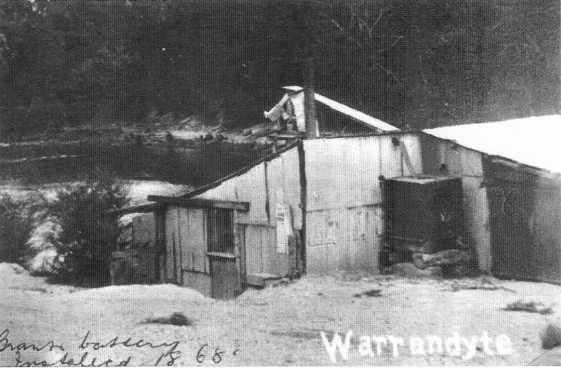
In Warrandyte, Lewis Grant built a water wheel on the Yarra behind the post office to drive a crusher, for the purpose of extracting gold.

Grants Battery (Gold Crusher) 1868 (Warrandyte Heritage)

Extract from 1969 11 DTHS Newsletter

Lewis Dudley Grant

It says “Lewis Dudley Grant is the Beloved Son of Lewis Grant”. Lewis Grant comes to Warrandyte is an entrepreneur who came from Bendigo, where he has been a shopkeeper, a miner, he built crusher but he comes to Andersons Creek , he takes up the pub.
He builds a Hotel water wheel and crusher behind where the old post office is today.

Lewis Grant and Lilly Gravestone, Andersons Creek Cemetery

Mining Disaster at Templestowe 1892

THE MINING DISASTER AT TEMPLESTOWE.  RECOVERY OF THE BODIES.  THE PROBABLE CAUSE OF THE  ACCIDENT.

The rescue party at work at the Antimony Hill mine, Templestowe, to recover the bodies of the unfortunate men Young and Grant, who were overwhelmed and drowned by the waters from the old workings on Saturday morning, continued their labours all Sunday afternoon and evening without success. They plodded on steadily through the night, and at half-past 4 o'clock yesterday morn- nig they were able to reach the body of Grant. It was buried by dƩbris just 2ft. from the wall of the shaft, and in the cavity through which the waters had flowed. It was at once taken to the surface, and laid out in the engine-house. Five hours later the second body was got out. It was situated similarly to the first, and was difficult to reach because of the water and of the fallen earth. The news of the finding of Grant's body attracted a large crowd of men, women, and children to the pit's mouth, and when, at a quarter-past 9 o'clock, the signal to "Haul up, men on" was heard and it was understood that the second body was being brought up there was an affecting scene. The widow of the one and the father of the other were present, and though they had known all along that there was not the slightest hope of the lives of either being saved, the certainty of death seemed to add intensity to their suffering. So soon as the wife could be induced by the women around to submit to be taken away the bodies were removed to Finn's Upper Yarra Hotel, the people who had been spectators of the sad scene on the hill-top, and the hardy miners, who had worked incessantly, though they knew there was no hope of saving life, forming a procession behind the conveyance.

Senior-constable Burton, of Heidelberg, having communicated the fact of the recovery of the bodies to the coroner for Bourke, Mr. Candler, the inquest was fixed to be held at Finn's Hotel, on the next (this) day, at 11 o'clock. Mr. Nicholas, the senior-inspector of mines, made a second examination of the mine later in the day, and his conclusions upon the management and working of it will be given by him in evidence to-day, so far as it may concern the inquisition.

When the work of the recovery of the bodies was over, and the manager, Mr. J. C. Matthews, was able to spare time to the consideration and discussion of the circumstances under which the men were working, and the probable causes of flooding, a more precise statement of the facts was obtainable. Prior to the advent of Mr. Matthews as manager the Antimony Hill Company had worked the lode through the Zig-zag or No. 1 shaft. The shaft was sunk vertically for about 100ft., and then it followed the lode (which dipped north) in zig-zag sinks until it reached a total depth of 282ft. The inconvenience of working through this shaft was so great that the manager strongly urged the directors to permit him to sink a new and vertical shaft. His advice was not taken until in a drive running north a prospect of good promise was struck. Then the directors sanctioned the new shaft, and determined to sink it to the depth of 400ft. in four lifts of 100ft. each, believing that when they had reached that depth they would be in a capital position for working the old lode, and also for exploiting the country to the north. The new shaft was started at a point 166ft. north of the No. 1 shaft, the manager choosing that distance after careful calculations and measurements for the reasons that he would be able to run a drill-hole through to the old drive, and tap the water with which since the abandonment of the work in the old shaft it had become filled. The water in the old workings would always be a hindrance to him, and he could not com-bat with it in the old shaft, because he only had a whim there, and baling by whim power is a tedious, expensive, and practically impossible process. In the new shaft he would have the advantage of steam power, and would have the water well under control. He therefore located the shaft where he did because, while it would pass 7½ft. from the terminal point of the drive, and thus, as he thought, be sufficiently far re-moved to ensure safety, it would yet be near enough to permit of its being tapped by a drill. So far as could be observed yesterday by examination and measurement, the manager's calculations were accurate. The northern drive is 159ft. in length, and the second shaft 166ft. removed from the old shaft, so that the space of 7ft. which he desired to keep between them, appears to exist. Then, again, the depth of the second shaft being only 231ft., and full allowance being made for the difference of the altitude on the hillside, the new shaft should be 11ft. above the level of the top of the drive. So that in addition to the end of the drive being 7ft. further north than the shaft, its cap should be 11ft. deeper in the ground than the floor of the new shaft. If the measurements are correct, and there is little doubt that they are—the manager has had many years' experience, and should know his business—then the water must have "wept," or percolated through the small block of ground separating the shaft from the drive. This is the manager's explanation, and there is evidence which goes to commend it as being the correct one. In the weekly report of the operations of the mine, published in The Argus yesterday, there appeared the information—"Sunk 12ft., total 231ft.; shaft in good working country; water increasing. Cut leader in shaft on the 9th, showing little antimony and gold." Apart from the painful coincidence that the report (dated the 12th) and containing the remark "water increasing" should appear in the same issue as the record of the flooding and consequent disaster, the report has an important bearing on the cause of the flooding. The shaft had passed through good solid country till quite recently, when the character of the ground changed, and there were indications beside that of the "leader" referred to of the proximity of a lode. It would appear that this new lode, which will be making from the south and dipping north, joins with the other near the end of the old north drive, and that, as is usually the case at such a junction, the ground is of a soft character, through which water would percolate easily and rapidly. If this junction had been known prior to the sinking of the shaft it would have been foolhardy to have chosen the spot or to have continued the sinking without taking the precaution of putting in a drill hole ahead to test the solidity of the ground.

When Young and Grant went to work at midnight on Friday they were aware of the changing character of the country, and were cautioned to be careful in their work, because they were approaching the locality of the old drive. On the shift before, one of the men had reported that he had seen water oozing from the floor of the shaft, but it was demonstrated that he was mistaken, and Young and Grant commenced their work without any apprehension of danger. They had cleared away and sent to the surface some mullock— two or three buckets only—and had bored and charged a "sinking" hole, using dynamite as the explosive. About 3 o'clock they fired this, and returned after the explosion to see whether it had done the work expected of it. They filled a bucket and signalled to the braceman to have it raised to the surface, but it had barely started its ascent when the knocker line ring "one," signifying "stop." After that came the noise of the rushing waters, the extinguishing of the lights, and the vain attempt of the braceman to render aid. An inspection of the mine when cleared showed that the charge of dynamite in the "sinking hole" had not acted as expected, but had torn sideways through the soft ground lying between the bottom of the shaft and the end of the drive, and had thus opened up a pas-sage for the water. It was but small at first, and was unnoticed as the bucket was filled, but immediately afterwards it gathered strength and poured in in such a torrent that the men had only time to signal the bucket to a standstill before they were overwhelmed. In the suction they were drawn into the cavity started by the blast and widened by the waters, and there they remained till they were discovered dead and disfigured.

1892 'THE MINING DISASTER AT TEMPLESTOWE.', The Argus (Melbourne, Vic. : 1848 - 1957), 16 August, p. 6. , viewed 06 Aug 2017, http://nla.gov.au/nla.news-article8450019

see more at: http://trove.nla.gov.au/newspaper/result?q=mining+disaster+at+templestowe


Historical Markers

Extract from President’s Report

Three Historical Markers are to be erected in the City, to commemorate the Toll Gate to be situated at the Thomsons Reserve on the Corner of Doncaster and Tram Roads.

The next will be on Finn's Reserve in honour of "Finn’s Pub" and bricks from the original building will be used for this.

The third will be for the State Crusher on the river bank at Warrandyte. It is hoped that on completion a suitable ceremony will be held to highlight the occasion.  Our Society has supplied information, design, bricks and wording for the plaques; so we hope you will be able to attend when they are finished and unveiled.

Patrick O'Brien

Patrick O'Brien

Parliamentary Representative, South Bourke October, 1856 - August, 1859

In the first Parliament, Doncaster-Templestowe was a part of the electorate of South Bourke, with two representatives in the Legislative Assembly:  Charles Pasley and Patrick O'Brien.  In the Legislative Council, there were five representatives for the Southern Province:  Donald Kennedy, Thomas Herbert Power, William John Turner Clarke, Thomas McCombie, John Barter Bennett.

Patrick O/Brien

Blacksmiths

The Orchards Of Doncaster And Templestowe - 7 Blacksmiths


Orchards relied heavily on horses. Horses were needed for ploughing, spraying and the many carting jobs in the orchard and on the roads; and horses wore horseshoes that had to be regularly replaced by the blacksmith.
The first pioneers were forced, by necessity, to do all the jobs around their farm and this included looking after their horses’ shoes. Templestowe had a blacksmith in the early 1850’s when Archibald McLaren opened a forge in Bridge Road, Bulleen. Often the early blacksmiths shops were like John and Joe Hicks forge in Anderson Street, Templestowe, merely a fire, anvil and water barrel set up in the open under a gum tree.

John Smedley built a blacksmith and wheelwright shop in 1859, near the corner of Doncaster Road and High Street. His house and forge was on the site of the Doncaster Park Primary School, now demolished. On the door of the ‘smithy’, Smedley nailed his emblem - a large horseshoe encircling a smaller one. Smedley called his house “Journey’s End”. John’s sons, William and John continued in their father’s trade but Frank became an orchardist in East Doncaster. In the 1860’s and 70’s other blacksmiths established themselves along Doncaster Road.

In the Templestowe Township, William Hunter built a blacksmith shop in 1878. William, after learning the trade from Hicks, bought land at the corner of James and Anderson Streets. He built his ‘smithy’ in the key position on the corner of his house alongside in James Street. He called himself a blacksmith and veterinary surgeon. Hunter was mainly interested in the care of animals, so in 1892 he put Sylvester Mullens in charge of the ‘smithy’ and concentrated on his veterinary work. Eight years later Mullens took over the business and William Hunter moved to Camberwell Road.

Sylvester Mullens was the son of Stephen Mullens the Warrandyte pioneer. In 1885, Sylvester went to Gisborne to learn his trade at the well-known Gardiner ‘smithy’. There were a number of apprentices who paid 2/6 a week board, and worked without wages for the privilege of learning a trade. After working for a few years at the Cherry Chum factory, he came to Templestowe.

The Hillman brothers took over Laurie’s forge in Doncaster Road near Williamsons Road in 1889. Soon afterwards, Curtis Hillman moved to the blacksmith shop that George Hislop had built on the corner of Wetherby Road. When Curtis died early in the century, his wife, Anne, carried on the business with Dan Harvey as manager. Anne married a blacksmith Fred Sleeth who was working for her. Dan Harvey went to Templestowe and took over Calder’s forge at the corner of Foote Street and Thompsons Road. Calder and Hunter were rivals on the Shire Council. When Calder was repeatedly beaten by Hunter on Council issues, Calder said he would beat Hunter in business and used his ample capital to set up a rival blacksmith shop.

As orchards flourished, so the horse population grew. Instead of the one general-purpose horse that the first settlers had, a successful orchardist would have a fair sized stable. There would be two or three draught horses for ploughing and pulling a jingle, a fast horse for a jinker or buggy, a hack to ride down to pick up the mail or round up the cows, and perhaps ponies for the children to ride to school. By 1890, a blacksmith’s shop was a busy place and every locality had its forge.
A ‘smithy’ was always active. As well as shoeing horses, there was orchard equipment to be repaired, picks and quarry tools to be sharpened, and wagon wheels to be mended. If it was made of iron, a blacksmith would make it and a blacksmith would repair it.

Sleeth's (late Hillman's) Doncaster Orchard Implement Works (blacksmith). South-east corner of Doncaster and Wetherby Roads. Shows employees; and two fruit wagons; a low-slung jingle; and a plough. Also shows a tall girder pole with what appears to be a mail box attached to it.  Signwriting on Shop: Coachbuilder. A Sleeth. Late A Hillman. Doncaster Orchard Implement Works. Hillman Implement Maker. Horse Shoes. General Blacksmiths. (Frederick Bernard Sleeth died on 25 November 1953) DP0046

A forge was always a dark place for the smithy had to see the colour of the hot iron and in the dark, the fire was always spectacular. The large bellows sent air hissing through the fire, which glowed, and spat. Close to the fire, the sound of the Smithy’s heavy hammer rang out as he beat red-hot iron on the anvil. Other equipment stood around the shop such as heavy rollers to bend iron tyres and there were always horseshoes hanging on the wall.

The fruit growing industry had its own problems not experienced by other farmers and the initiative of Doncaster orchardists, with the skill of the blacksmiths, developed specialised equipment for their own requirements. The two-wheeled cart or dray, used for all carrying jobs in the orchard, had a very high body. A day spent lifting heavy cases; onto the cart was hard work. The Doncaster coachbuilder, Hillman, built a cart with a dropped axle and lower body. A peculiarity of the vehicle was the jingling sound made by the wheel hub as it revolved around the axle, and that sound gave rise to the name, “The Low Jingle”.

Fruitgrowers appreciated the work saved by the low jingle, but found a problem with it. Because the body was low, and the top of the wheels protruded above the cases in the carts, in wet weather mud splashed over the fruit. A new version was built with smaller wheels. Hillman s jingle had the shafts level with the floor, making them too low for the horse, Tolly, another blacksmith, made an improved version of the low jingle. He used a similar body with small wheels, but the shafts were higher and were supported by curved timber brackets at the front of the cart body.

Four-wheeled vehicles were not favoured in the orchard for it was easier for a horse to pull a two-wheel cart out of soft or muddy ground. For going to market, a four-wheel fruit grower’s wagon was used. These enclosed carts protected the produce during wet, stormy weather and were more comfortable for the driver.

In 1856, Thomas Serpell proudly wrote that his family had bought an American plough! Indeed, the plough was the basic tool of any farm. In these early years, only the mould-board plough that turned over the soil was made of iron. The beam and handles were timber. One horse pulled a plough, which dug a single furrow. Different varieties of the simple plough were developed for special purposes.
For the manufacture and maintenance of all the equipment on orchards, the blacksmith filled an important role.


Source: The Orchards Of Doncaster And Templestowe By Irvine Green Published By Doncaster-Templestowe Historical Society 1985 - Original Scan


Hunter & Mullens' Blacksmith Shop

The future of the site at 133 James Street Templestowe is at present being decided in Council, with an application for a restaurant on this historic comer.
It is perhaps appropriate that our members are familiar with the history of the blacksmith’s shop, which stood on this site since 1878.
The following article is taken from Irvine Green’s Historic Building No 14, printed in our newsletter in August 1971. This article was written to commemorate the closure of the blacksmith’s shop in 1970, after nearly 100 years of service to the people of Templestowe.
The early pioneers needed to do all the jobs around their property. This included looking after their horses’ shoes. As orchards flourished, so the horse population grew. Instead of the one general-purpose horse of the early settlers, a successful orchard would have a fair sized stable. There would be two or three draught horses for ploughing and pulling a jingle, a fast horse for a buggy, a hack to pick up the mail, or round up cows and perhaps a few ponies for the children.
By 1890, a blacksmiths’ shop was a busy place and every' locality had its forge.
At Templestowe, William Hunter opened Mullens' Blacksmith shop in 1878.
Williams’s parents, Robert and Elizabeth Hunter came from Glasgow where Robert had been a shipbuilder.  In Templestowe, they lived on the road to Heidelberg.
William Hunter was a blacksmith and veterinary surgeon. After learning his trade from John and Joe Hicks, who had operated a forge in Anderson Street, Templestowe in the 1860’s. William bought land in the Templestowe Village at the comer of James and Anderson streets. He built the smithy in the key position on the comer and his house alongside in James Street.
When the first Shire of Templestowe Council was elected in 1890, William Hunter was elected President, a position he filled on two future occasions.
Hunter was more interested in the care of animals than in blacksmith work, so in 1892 he put Sylvester  Mullens in charge of the smithy and concentrated on his veterinary work. Eight years later Mullens took over the shop and Hunter moved out of the district.
Sylvester Mullens was the son of Stephen Mullens the Warrandyte pioneer. In 1885, Sylvester went to Gisborne to learn his trade at the well-known Gardiner smithy. He was one of a number of apprentices who paid 2/6 a week board and worked without wages for the privilege of learning the trade.
The Mullens were hard workers and capable of tackling any job, qualities that were necessary for the variety of work demanded from blacksmiths.
Sylvester was soon successful and his business flourished.

Source: 2005-07 DTHS Newsletter

During the 1880’s and 1890’s the smithy was always active. As well as shoeing horses, there was orchard equipment to be mended, picks and quarry tools to be sharpened and wagon wheels to be repaired. If it was made of iron, Mullens would make it and Mullens would repair it. Some considered a blacksmith capable of any job. Mrs Tuckeband, an old German woman at Doncaster, once went to Charlie Hillman’s forge to have a tooth pulled out. She said a blacksmith would have suitable tongs.
Even when there were no customers; there was always work to be done. Blacksmiths used to make their own nails. In a room at the rear of the shop there was a bench where often a row of men would be making nails. They would cut off a measured length of square rod, then hammer it into shape in a jig.
Parts for ploughs, cultivators and vehicles were always made and kept ready for repairs. Horseshoes were made and stored on battens nailed to the walls behind the anvil. Often hundreds of shoes, sorted into sizes, hung on the wall, ready for use.
The name “blacksmith” covers a range of skills. A farrier’s job is to shoe horses. The name comes from Latin ‘ferrum’ meaning iron. The farrier would heat a length of iron in the forge fire. A large bellows worked by a rocker arm would send a blast of air into the fireplace to heat the iron bar. At first, blacksmiths used charcoal, but after gasworks were built, coke became available. The farrier lifted the red hot bar with tongs and on the conical end of the anvil, hammered the shoe into shape. A piece of iron at the top was drawn down forming a clip to hold the shoe in place. Eight nail holes were punched in the shoe and a grove was forged to prevent the nail heads from projecting. When finished the hot shoe was quenched in the barrel of water to harden the iron and cool the tongs.
To shoe the horse, the farrier who of necessity, knows how to handle a horse, stood with his back to it and drew the horse’s foreleg up between his thighs. The old shoe was removed and the hoof trimmed with a paring knife. The hot show was pressed onto the horn of the hoof to bum itself into place, then nailed in position.
Wheelwrights were an important part of a coach building shop. Wheels sometimes broke and their iron tyres wore out. The iron rim was curved into the correct diameter on a tyre-bending machine and the ends were welded together. The iron tyre was evenly heated until it expanded enough to fit over the rim and cooled to make a tight fit.
Blacksmiths were the service stations of the past. Their owners looked for a similar situation, when choosing a location. Nowadays service stations now stand where once a blacksmith’s shop stood.
In Templestowe as elsewhere tractors gradually replaced horses on the orchards and blacksmiths began to close down. The district did not lose all of its horses though teenaged girls on large allotments kept ponies. These kept the Templestowe forge going until Jack Mullens retired in the 1970’s and later the forge was rebuilt at Schramm’s Cottage in the reconstructed wheelwrights’ shop.

Source: 2005-09 DTHS Newsletter


Hunter and Mullens Blacksmiths

W. Hunter S Mullens General Blacksmith, Wheelwright Templestowe.  DTHS-DP0507


At the end of 1970, the last remaining blacksmith shop in our district ceased to operate when Jack Mullens retired. Mullens smithy is on the corner of Anderson and James Streets, Templestowe, a brick building with an old timber section at the rear.

The first pioneers were forced by necessity to do all the jobs around their selection. This included looking after their horses' shoes. Templestowe, the first area of our city to be settled, had a blacksmith shop in the early 1850's. It’s years before Archibald McLaren had competition when John and Joe Hicks opened a forge in Anderson Street opposite the present shopping area, before moving to Church Road corner. They set up an anvil, fire, and water barrel in the open under a sheltering gum tree.

Doncaster settlers were without a blacksmith until John Smedley arrived in 1859. Smedley's forge was on the site of the Doncaster Park School, while George Salem had a forge at Waldau.

As orchards flourished, so the horse population grew. Instead of the one general purpose horse of the early settlers, a successful orchard would have a fair-sized stable. There would be two or three draught horses for ploughing and pulling a jingle, a fast horse for a buggy, a hack to ride down to pick up the mail or round up cows, and perhaps ponies for the children to ride to school. By 1890, a blacksmith's shop was a busy place and every locality had its forge. At Templestowe, Mullens black-smith's shop was opened by William Hunter in 1878. William's parents, Robert and Elizabeth Hunter came from Glasgow where Robert had been a ship-builder. In Templestowe, they lived on the road to Heidelberg. They also selected 300 acres on the Yarra east of Deep Creek. Here they grazed-cattle and cut timber. Robert and his eldest son Robert were both builders. In 1879, 150 acres of this land, was, used by William. Part of this is now Pygmalion Farm on Warrandyte Road.

William Hunter was a blacksmith and veterinary surgeon. After learning his trade from Hicks, William bought land in the Templestowe Village at the corner of James and Anderson Streets. He built the smithy in the key position on the corner and his house alongside in James Street. Hunter was a keen gardener. He planted an attractive garden of trees and shrubs around the house. Some of these are still growing on the vacant block.

When the first Shire of Templestowe council was elected in 1890, William Hunter was elected president – a position he filled on two future occasions. Later his brother, Thomas, was also Shire President for three years.

Hunter was more interested in the care of animals than blacksmith work, so, in 1892, he put Sylvester Mullens in charge of the smithy and concentrated on his veterinary work. Eight years later, Mullens took over the shop and William moved to Camberwell Road.

Sylvester Mullens was the son of Stephen Mullen, the Warrandyte pioneer. In 1885, Sylvester went to Gisborne to learn his trade at the well-known Gardiner smithy. He was one of a number of apprentices who paid 2/6d. a week board and worked without wages for the privilege of learning the trade. After working for a few years at the Cherry Churn factory he came to Templestowe. The Mullens were hard workers and capable of tackling any job - qualities that were ideal for the variety of work demanded from blacksmiths. Sylvester was soon successful and his business flourished.

During these years, the smithy was always active. As well as shoeing horses, there was orchard equipment to be mended, picks and quarry tools to be sharpened, and wagon wheels to be repaired. If it was made of iron, Mullens would make it and Mullens would repair it. Some considered a blacksmith capable of any job. Mrs. Tuckerband, an old German woman at Doncaster, once went to Charlie Hillman’s forge to have a tooth pulled out. She said that a blacksmith would have suitable tongs.

Even when there were no customers, there was always work to be done. Blacksmiths used to make their own nails. In a room at the rear of the shop, there was a bench where often a row of men would be making nails. They would cut off a measured length of square rod then hammer it into shape in a jig. Parts for ploughs, cultivators and vehicles were always made and kept ready for repairs. Horse shoes were made and stored on battens nailed to the Walls behind the anvil. Often hundreds of sets of shoes, all sorted into sizes, hung on the wall ready for use.

Wet days caused a problem. When orchardists could not work, they would bring in their repairs, but having plenty of time would stay to talk. So the blacksmiths could not get on with their work. The name "blacksmith" covers a range of skills. A farrier's job is to shoe horses. The name comes from the Latin "ferrum" meaning iron. The farrier would heat a length of iron bar in the forge fire . A large bellows worked by a rocker arm would send a blast of air into the fireplace generating a hot fire to heat the iron red hot. At first, blacksmiths used charcoal, but after gasworks were built, coke became available. The farrier lifted the red-hot bar with tongs and on the conical end of the anvil and hammered the shoe into its shape. A piece of iron at the top was drawn down forming a clip to hold the shoe in place. Eight nail holes were punched in the shoe and a groove was forged to prevent the nail heads from projecting. When finished the hot shoe was quenched in the barrel of water to harden the iron and cool the tongs.

To shoe the horse, the farrier, who of necessity knew how to handle a horse, stood with his back to the horse and drew the horse's foreleg up between his thighs. The old shoe was removed and the hoof trimmed with a paring knife. The hot shoe was pressed into the horn of the hoof to burn itself into place, then nailed in position.

Wheelwrights were an important part of a coach-building shop. Wheels sometimes broke and their iron tyres wore. The iron rim or tyre was curved into the correct diameter on a tyre bending machine and the ends were welded together. The tyre was made a fraction smaller than the wooden rim of the wheel. The iron tyre was evenly heated until it expanded enough to fit over the rim and cooled to make a tight fit.

There were also assistants called strikers who hammered the iron held in position by the blacksmith. There were coach and body builders, and painters and sign writers. Everyone in the district could tell a Mullens coach body by its distinctive style of decorative scrolls and signwriting. Blacksmiths were the service stations of the past. Their owners even looked for a similar situation when selecting a location. In fact in many places, a service station now stands on the site of a blacksmith's shop. At Templestowe, a service station has been built on the corner of Foote Street and Main Road. This was the site Calder chose for his smithy, that was later run by Dan Harvey then Crampton. A service station was proposed for Mullens corner.

Dan Harvey's Templestowe implements works, at the east corner of Foote and Union Streets Templestowe. The photograph shows a fruit wagon, drays and carts and a group of workman outside the entrance to the works. The premises were built by A. Calder.  DTHS-dp0506

Dan Harvey and unknown person at the wheel of his Vele motorcar, outside his forge at Templestowe. 1907 DTHS-dp0172


Along Doncaster Road, there was a blacksmith shop at all the main intersections. Some of these have a service station on the same site. Smedley's land was on the corner of Doncaster Road and High Street. Charles Hillman and David Laurie started a forge near Williamsons Road where Chequered Flag Motors stands. Then Hillman and his brother Curt ran it until Curt went to East Doncaster. Later Tolley moved the forge below Beaconsfield Street. Spencer built a brick shed for his smithy at the corner of Elgar Road. Townsend was near the Church Road corner and Hislop built a blacksmith's shop on the south-east corner of Weatherby Road. Several blacksmiths rented this shop. There was Waters, Lowe, and Curt Hillman. After Hillman's death, his wife kept the forge going until she married Sleeth. At the Blackburn Road corner the farrier, Sell, had a forge on south-west corner.

The situation at Warrandyte was different. There were fewer horses but many mining tools needed repairs. This was a true, blacksmith's work. George Sloan built a forge up the hill opposite the post office. He later closed this and, with his brother Paul, built another in a picturesque setting among the wattles on the river bank.

In 1909, Sylvester Mullens eldest son, Jack, started work in his father's forge. After the First World War, conditions began to change. In 1920, Jack Mullens built his first truck body for the family's T-model Ford. In 1927, the front of the old building was pulled down and the present brick building erected. A petrol pump was installed. Until then, petrol was bought in 4-gallon tins from the grocer. Gradually tractors took the place of horses on the orchards and blacksmiths began to close down. The district did not lose all of its horses. As orchards were sold for homes, teenage girls on large allotments kept ponies and hacks. These kept the Templestowe forge going but now Jack Mullens has retired and the blacksmith shop has closed for business.

Irvine Green A.I.A.P. writing in 1971 08 DTHS Newsletter


Andrea Simmons (Facebook 2017) remembers: "I was one of those teenage girls who needed my horse shod 1968 - 1972. Jack was such a character.  No phone bookings, just turn up on a Saturday morning and wait, often a couple of hours!


Vibrante Restaurant (2017)

Vibrante Restaurant Website Background showing Templestowe Motor Body Works. Previously Hunter & Mullens Blacksmith 2017


William Hunter built this Blacksmith shop in 1878. In 1900, S Mullens took over the business which was run until 1972. This corner is now the site of Vibrante Restaurant. https://www.vibranterestaurant.com.au/

Mullen's Blacksmith Shop

The heart of a blacksmith shop is its chimney and fireplace. When the chimney from Mullens Blacksmith shop was offered for the Schramm's Cottage Project, it was eagerly accepted. In May, members of the Society and pupils from Templestowe High School, with Mr. and Mrs. Eagles, loaded the brick from the chimney into Mr. Ivan Peter-Budgeƫs truck and moved them to Schramm's Cottage.
It is planned to incorporate the chimney in Finger's Barn. The Barn is being moved to Schramm's Cottage by members of Doncaster Apex.

1973 08 DTHS Newsletter


Farrier John's dying skill keeps kids' horses in shoes


John Mullens 74 is a most popular fellow among the youngsters of Doncaster and Templestowe.

After school and on Saturdays, he is surrounded by kids and horses for John is a farrier, one of the last around Melbourne.

The forge where he shapes and shoes for the kid's horses is almost 100 years old and has always been operated by Mullens, a family which pioneered the district.

Horse riding is a popular sport amongst the youngsters of this growing city only 10 miles from Melbourne and John Mullens is kept busy at the forge assisted, of course, by his young clients.

Picture Caption Top Left: For almost 100 years, the men of the Mullens family have plied their trade around this old brick forge.

Picture Caption Top Right: the the craggy face of a disappearing tradesmen... John Mullens peers into the future that spells doom for most who carry on his trade.

Picture Caption Bottom Left: In former days perhaps, an apprentice, but now just a boy with a horse. Kevin Whighton, 13 of Templestowe holds Belle while she is shod.

Picture Caption Bottom Middle: The gnarled sure hands mould a horseshoe with supple pressure and persistent strength rare in the age of automation.

Picture Caption Bottom Right: Still glowing, the shoe goes to the anvil to take shape under the farriers hammer.

Picturescope Newsday 30Oct1969

Blacksmiths

Blacksmiths were an integral part of any farming community in past times, and along the main Doncaster Road, there was a "smithy" at each major intersection. They were kept busy shoeing horses as well as making tools and repairing implements for local orchardists.

John Smedley set up a forge east of the junction of Doncaster Road and High Street. The long steep hill up to the Eastern Golf Links was known by local residents as Smedley's cutting.


David Laurie had a forge west of the intersection of Doncaster and Williamsons Roads. This was later moved to the vicinity of Beaconsfield Street and in 1889 was taken over by the Hillman brothers.

Spencer built a brick forge for his "smithy" near the intersection of Elgar Road Road.

George Hislop set up a blacksmith's shop on the south east corner of Doncaster and Wetherby Roads.  Several blacksmiths rented the business in subsequent years most notably Curtis Hillman. After Hillman's death his wife kept the forge going until she married Fred Sleeth who then conducted the business.  The Hillmans were also coach builders and made wagons and carts for local orchardists and designed the "LowJingle" a two-wheel cart with a dropped axle to ease the work of lifting heavy fruit cases onto the cart. These were used for all carrying jobs on the orchard. Four-wheeled wagons were used to convey fruit to the markets and were frequently also used as the family conveyance.

To service the requirements of residents in East Doncaster, W. Sell established himself as a farrier on the south west corner of Doncaster and Blackburn Roads.

The premises first established by W Sell on the south west corner of Doncaster and Blackburn Roads. Looking east along Main Road (now Doncaster road) towards Donvale.


The increasing use of tractors replacing horsepower in later years gradually brought about the demise of local blacksmiths and the last surviving business in Doncaster, at the corner of Doncaster and Wetherby Roads, closed about 1960.

Source: Doncaster A Short History Collyer 2013 - DTHS Edited by Eric Collyer


Sell - Farrier

Grandpa's blacksmith shop on the corner of Blackburn Rd and Main Rd. Tyres and harrows leaning against the wall. Still have some of the tools he used there, and even some of the books that have the jobs he did for people; shoeing horses, pointing ploughs, repairs etc. I would say this would've been taken in the 20s, so I don't suppose many people would remember it.

Source: (Trevor Sell writing in Facebook 2017

Note: Also William Sell was an agent in East Doncaster, in a land sale in Box Hill around 1923. 
SourceCraig Martin writing in Facebook 2017


Smithies Helped Build our Cities


BEHIND our  modern motor service stations lies a rich history of village blacksmiths. Blacksmiths operated their forges and shod horses on the same sites which are now occupied by modern service stations. Attracting the passing traffic was the name of the game then, as it is now, so both the smithies and their modern counterparts favored corner sites.

All main intersections along Doncaster Rd had a smithy. A traditional smithy car link on the south-west corner of the inter-section of Doncaster and Williamsons roads has recently passed into history.
A new commercial building has replaced the Chequered Flag Motors, which was the original site of Charles Hillman and David Laurie's forge. The forge was later moved to a site slightly west of Beaconsfield St, which was until recently Bob Jane's car sales.

Travelling east along Doncaster Rd, you can see the site where Hislop the blacksmith pumped his bellows into the fire and fixed horseshoes in his smithy shop on the corner of Doncaster Rd and Wetherby St. A Caltex service station replaced it until it, too, was demolished. After Hislop, the blacksmiths on this corner were Mr Lowe, Mr Curt Hillman. Hillman's widow and then Mr Sleeth.

On the south-west corner of Doncaster and Blackburn roads, opposite the Methodist Church, the Ampol service station stands on the site formerly occupied by the farrier J. Sell.

In Templestowe, former smithy sites include 2 Union St which was built by a blacksmith called Caulder. Later it was let to Dan Harvey and later still, the smithy Crampton. It is now an Ampol service station.

On the corner of Anderson and James streets. William Hunter worked a forge in 1878, which later became Sylvester Mullens. Older people would no doubt remember how as children they warmed their hands at the forge tire on the way to school.

A local blacksmith was versatile. He not only shoed horses, but was an adept bonesetter and manipulator. William Hunter of Templestowe is credited with being a veterinary surgeon. However, his version of veterinary surgery was very limited. His variety of tongs (long handled pincers for grasping hot metal) often doubled to pull teeth.

The blacksmiths made and mended anything made of iron. They shod horses, sharpened picks and tools and made nails by cutting a measured length of square rod which was hammered into shape in a jig.  Many jobs were similar to those needed for cars today. Blacksmiths did 'wheel-alignments' when a wagon wheel broke. Spare parts were kept at forges for ploughs, cultivators and other horse-drawn vehicles just as service stations today keep them for Cars. There were smith-coach body builders, such as Mullens, with painters and signwriters for new vehicles and smash repairs.

Around 1927, Mullens installed the district's first petrol pump. Until then, the few car owners bought petrol in four gallon tins from the grocer.  Some of Doncaster-Templestowe's black-smiths serviced the district's first cars while still servicing horses.

Source: Doncaster & Templestowe News. 6NOV1991