
A local history book, "The Life and Times of Ron Douglas: Reminiscences of a Raconteur or The Ravings of a Ratbag", has been added to the Ballarat Mechanics Institute (BMI) collection.
The term "ravings" as used throughout, is the author's humorous self-depreciation.
Authored by historian Kate Elliott, the book follows Ron Douglas’s multifaceted life—from his days as a rower and captain of the Ballarat Rowing Club during the 1956 Olympic era to his time as a "Nasho" and his career in higher education.
As at Mar2025, the book can be purchased for $50 (postage included). Contact DTHS for details.
A NEW book based on the life of a local sporting personality has been published, with a copy submitted to the Ballaarat Mechanics Institute (BMI) collection.
"The Life and Times of Ron Douglas: Reminiscences of a Raconteur or The Ravings of a Ratbag" follows Mr Douglas' life as a rower, captain of the Ballarat Rowing Club (including in the the 1956 Olympic era), a Golden Point State School student, baseballer, Hollways worker, a ‘Nasho’. and higher educator.
“It was quite interesting to go over all this stuff,” he said.
“It started off as 40 pages and went to many more. I wonder how I had the time to do all this,” he laughed.
“It’s great that people can read the story."
Mr Douglas and the book’s author Kate Elliott – an historian, athlete and coach – recently donated a copy to the BMI collection via president Paula Nicholson and curator Ellen Becker.
Handing over the book in the Heritage Reading Room, Mr Douglas was accompanied by his sister, daughter and extended family.

Ravings immortalised: Author Kate Elliott and Ron Douglas at the BMI. Photos: EDWINA WILLIAMS

Ron Douglas presents his book to BMI curator Ellen Becker.
“Another really important chapter in Ron’s book was his return to Ballarat in the 1990’s with his wife Dot and his involvement in getting the Nasho’s Memorial erected in Sturt Street.”
Mr Douglas and Elliott said they developed a friendship while the book was being developed, which they will treasure and maintain for years to come.
His daughter Kerryn Douglas praised Elliott for her efforts, enthusiasm and kindness, having witnessed the book being developed over many cuppas and slices of cake.
“We are so happy and thankful to have met her,” she said.Ms Nicholson said Mr Douglas’ appreciation for higher education and access to information aligns with the mission of the BMI.
Source: Excerpt from Tales from a raconteur and ratbag - Ballarat Times 5Jan2025 Jan2025
The following is a historical tribute published with permission:
The Life and Times of Ron Douglas AKA Salguod Nor: Reminiscences of a Raconteur or The Ravings of a Ratbag (Part 1)

“Life Experiences”
This narrative is a condensation of my life experiences. To do justice to a lifetime of experiences is impossible in a given time frame. Daily experiences are the life blood of ones being and are to be enjoyed. This account highlights education, career changes and sporting endeavours. It is my long-held belief that we should all endeavour to improve our educational standards and almost everyone can do it if they nurture a goal.
Douglas Coat of Arms

Motto: Jamais Arriere (Never Backward)
Limited edition. Written by Ron Douglas. Edited by Kate Elliott First published 2024
Text by Ron Douglas and Kate Elliott
Design by Kate Elliott
Editing and formatting by Kate Elliott
Printed by Waller and Chester Printers, Ballarat, Victoria
All rights reserved. Apart from any fair dealing for the purpose of private study, research, criticism or review as permitted by the Copyright Act no part may be reproduced, stored in a retrieval system, or transmitted in any form or by any means electrical, mechanical, photocopying, recording, or otherwise without the written consent of the author.
Dedication
This narrative is dedicated to my family, friends and my mates from all the ages and stages of my life thus far. Thanks for the memories.
Ron Douglas AKA Salguod Nor
Contents:
PREFACE
1.RON DOUGLAS FAMILY AND SCHOOL. Family tree-Magpie Street-Ned Williams connection-Golden Point Primary School-Cricket-Ballarat Junior Technical School
2. ROWING. Ballarat Rowing Club 1950-1956-Baseball
3. EMPLOYMENT and further education
4. NASHOS
5. TEACHING- A CAREER CHANGE. Footscray Tech-Sunshine Tech-Templestowe Tech
6. 1990’s RETIREMENT - sort of! Back to Ballarat. National Servicemen’s Association and NASHO’s Memorial
7. TRIP OF A LIFETIME
9. APPENDICES
1. Ned Williams-family
2. Iconic Buildings of Ballarat
3. Essendon Football Club
Preface
Everybody has a story. This started off as a rowing story. Ron had been trying to track down the history of Ballarat Rowing Club, and through a neighbour, who knew my interest in rowing history, he contacted me. The rest, as they say, is history, or to be precise a personal history of Ron Douglas AKA Salgoud Nor. For reason’s best known to himself, Ron’s alter ego “Salgoud” is just his name spelt backwards!
As I had a copy of the BRC history written by Tom Cotton, I made contact and to Ron’s great delight was able to give him a copy. On the first visit, I saw some of Ron’s extensive collection of memorabilia and was astonished to find someone else who had kept rowing programs and ephemera from the 1950’s. I also have a large collection of regatta programs and ephemera from the 1970’s when I started rowing. We instantly connected on our shared love of the sport and of the friendship and experiences rowing offered us.
I offered to write Ron’s rowing story. As time went on and I delved deeper into Ron’s archive and listened to his stories, it grew into something more. Ron had already written quite a bit about his life, growing up in Golden Point, going to Golden Point Primary School, rowing, playing baseball, working at Hollways and his time in Nasho’s which all offered a fascinating insight to growing up in Ballarat in the 1940’s and 50’s. My task was to take his story and add the photographs and memorabilia and turn it into a narrative that could be published as a book.
Another really important chapter in Ron’s book was his return to Ballarat in the 1990’s with his wife Dot and his involvement in getting the Nasho’s Memorial erected in Sturt Street. I am quite sure without Ron’s hard work and determination that would not have happened. He is justifiable proud of this achievement also.
Ron’s story is the story of an ordinary working-class lad growing up in Ballarat. What is extraordinary and worth preserving are his unique memories of many facets of daily life that now are things of the past. He volunteered his time and enthusiasm to so many facets of his life-his sport, his education, his employment, and most importantly his family. They don’t make them like this anymore.
As time went on, we also discovered many interesting coincidences and parallels. His mother worked at Morley’s Mills so did my father. He did Nasho’s in the RAAF and my Dad served in Nasho’s in the army. His uncles and his Dad had a goldmine at Blackhill and I have gold miners on both sides of my family, notably owning Corbett’s Goldmine at Gordon. His eldest daughter Kerryn was born in 1958, the same year as me. He played baseball as a teenager, I played softball. We were both teachers at one stage of our careers. Without a doubt the greatest interest we shared, was our passion for the sport of rowing and the great times and wonderful camaraderie, memories and friendships we both experienced albeit at different clubs, but the result was the same. Great times and great stories
It has been a privilege and a pleasure to work with Ron on his story and I hope his children and grandchildren appreciate the wonderful raconteur and storyteller Ron is, as well as his wonderful life. I hope anyone else reading enjoys the many adventures and misadventures Ron has had just as I did.
One of nature’s true gentlemen-well rowed Ron! (Kate Elliott June 2024)
Ron Douglas Family And School
Family tree
Magpie Street
Ned Williams connection
Golden Point Primary School Cricket
Ballarat Junior Technical School

Ronald George Douglas, 3/08/1934
Ron as a baby. Ron’s photograph won a prize in THE STAR CHILD BABY QUEST 1935. On the back of the photo is written Return to Matheson’s, Ballarat Baby Carriages PH.2377 Ronald George Douglas Age: 8 and 1/2 Months
Ron’s story should, like all good stories start at the very beginning. As Ron is fond of saying he was “…… born in Golden Point, at a very early age.” As he and his mother and the midwife were the only ones there, we will have to take his word for that! Ron Douglas was born on August 3, 1934. His entry to the world occurred at Peel Street South, Ballarat which was the home of Nurse Rose Black. Nurse Black was a local midwife of Scottish ancestry.
He was the first-born son of parents George and Mary Douglas. They lived at 2 Grant Street West for the first three years of Ron’s life. His sister Eva was born in 1936 and during 1937 the little family moved to 24 Magpie Street, Golden Point. Five more children followed Kevin, Graeme, Jeanette, Ian and Margaret. (Ian died aged 3 months from pneumonia.)
The midwife who delivered Ron was fondly referred to as “Narny” Black. She became Ron’s Godmother and was a friend of the family until she passed away at 80 years of age.
“I stayed in touch with “Narny” throughout my childhood and teens. I recall making her a tinware billy during my apprenticeship when I was about 16.”
Some of Ron’s earliest memories are of when the family lived at 2 Grant Street West.
There was a mixed business directly opposite the house. This business is still operating today. According to family history, Ron aged nearly three, decided to cross a very busy road to the shop to get a bottle of soft drink for his Dad when he came home from work! There was panic all round when Ron went missing. Fortunately, the shopkeeper returned the young adventurer to his home.

Ron in a more peaceful pose in his pram at Grant Street.
Ron also believes he can remember the commotion when the Coliseum Theatre, just two blocks away from their home, burnt down on March 12, 1936. It was a big event in Ballarat’s history and there would have been a lot of noise, smoke and activity making an impression on a not quite three-year-old.
When the family moved to 24 Magpie Street. Magpie Street was still under construction beyond William Street, adjacent to the Golden Point School Plantation. In those days many schools had a Plantation that the students and parents planted and maintained and then harvested as an investment. Mt. Pleasant Primary School also had a plantation further up Magpie Street. Both these areas became part of the Sovereign Hill Historical Museum.
Our block was on the corner of William Street. The land fell away sharply at the rear of the block and filling from the road construction work was used to level the block. Railway sleepers were used as posts and we could walk under the bottom rail. Ron remembers riding his trike down a very rough William Street hill, hitting a rock and being thrown over the handlebars. It was very traumatic for the three-year-old and he bore a scar on his forehead as a visible reminder of the accident for many years. He also remembers neighbours passing by on foot on bicycles as there were not many families owned cars in those days.
“I’ll never forget once being given a ride home from town in a 1938 Packard which was a luxury car in those days.”
Family Tree - Parents

Mary Elizabeth Smith Farnsworth 1906-1957

George Alfred Douglas 1902-1980
Ron’s parents were George Alfred Douglas and Mary Elizabeth Smith Farnsworth. They married in 1933 and had seven children, with eldest son Ron being born in 1934. George’s father was a miner, Charles Alfred Douglas and his mother, Janet Williams. With his father dying young from Miners Complaint or silicosis, young George became head of the family and breadwinner at age 15. His brother Fred was only 13 and Ted the baby was only 2 or 3 years old.
Ron’s mother, Mary Smith Farnsworth, was born about 1906 in England. She emigrated to Australia 1928. She married George Douglas on August 12, 1933. She died in 1957 just before Ron got married.
Mary, as well as her cousins, Herbert and Joe Meakin, were bought up by their grandmother Mary Farnsworth nee Flecher, in the village of Heanor, Derbyshire. Both Mary’s parents died when she was young. Her mother, Elizabeth Clues, possibly died in childbirth in 1908 when Mary was 2 and her father, Joseph Smith Farnsworth, was killed in a mining accident in 1917 when she was about 12 or 13. Her father had remarried after Elizabeth died, so when he died, Mary was sent to live with her grandmother rather than with her stepmother.

Mary with her father Joseph circa 1917, in Heanor.
Mary Elizabeth trained as a knitting machinist with I and R Morely in England and was one of 30 machinists bought out to work in the new Morley Factory, Ballarat that opened in 1928. They were bought out to Australia under contract for 2 years.
She sailed to Australia on the steamship the “Orviento” departing England from the Port of London on April 20, 1928. She was one of three girls from Heanor sailing to a new job in a new country. The other two were Miss D.L.Allen and Miss E.M.Meakin. It would have been a huge adventure for them. Also sailing was Mr.Ted Hall and his wife Winnie and child. They remained friends with Mary. They arrived in Melbourne in June after six weeks at sea.
E.M.Meakin was probably also Mary’s cousin as her two cousins that she grew up with, Joe and Herbert, also had the surname Meakin. Mr. Ted Hall and his wife Winnie were possibly related to Mary’s stepmother, Leah Farnsworth, whose maiden name was Hall. Winnie was referred to as “aunty” and she made the knitted suit that baby Ron is pictured in on at the
start of the story.

Mary pictured with possibly her grandmother and her cousin E.M.Meakin before her departure to Australia, about 1927. Mary is in the middle of the picture.

Mary and her cousin E.M.Meakin possibly just before they embarked for Australia.

Pictures of Mary on board the ship the Orviento on her way to Australia in 1928. She originally came out on a two-year contract but obviously decided to stay on. She continued to work at Morley’s until her marriage in 1933. The steamship ORVIENTO

I and R Morley Factory, Doveton Street North, Ballarat, 1928. Pictured at right Ron’s mum Mary and other Morley machinists, demonstrating their skills in Buckley and Nunn store in Melbourne circa 1929/30. Mary is the machinist on the far right. I and R Morley staff. Mary Farnsworth is in the front row at the extreme right.

Pictured above Morley staff in about 1928. Mary Farnsworth is second row, 2nd from right. Morley staff in June 1929. The staff trebled in the first year, from about 30 in 1928 to approximately 90 in 1929.

Paternal Grandparents

Jeanette (Janet) Williams 1880-1951

Charles Alfred Douglas 1878-1917
Ron remembers his grandmother Janet Williams and also his great grandmother Williams who was Ned Williams sister. Ned is mentioned later in this narrative. Ron’s Grandmother lived in Williams Street just around from where Ron lived in Magpie Street. His uncles Fred and Ted also lived there. He can remember that they had a gold mine and battery somewhere in the bush just outside of Ballarat that he visited when he was very young.
Maternal Grandparents

Joseph Smith Farnsworth 1882-1917. Photo of Joseph circa 1904 aged 21
Elizabeth Farnsworth (nee Clues)1882-1908.
Joseph Farnsworth and Elizabeth Clues married in 1904 and lived in Heanor, Derbyshire. Ron’s mother Mary was only very young when Elizabeth died in April 1908. A brother Joseph was born and died in March 1908. It is not known if Elizabeth died of complications because of his birth. Joseph remarried sometime in 1910 to Leah Brookes (maiden name Hall). Leah was a widow and about 10 years older than Joseph. Joseph was killed in the Summit, Kirby Coal Mine when he was crushed by a fall of coal, in 1917 aged 36. Leah died in 1920.

Joseph Smith Farnsworth circa 1910. As Joseph is dressed in a suit, this is possibly a photo of him on his wedding day when he married Leah (Hall) Brookes.
This is the extract from the Mansfield Reporter newspaper detailing the tragic accident that occurred. Joseph was only 36 when he died:
Mansfield Reporter Friday July 6th 1917.Colliery Fatality at KirkbyAn inquest was held on Friday afternoon in the Primitive Methodist School, East Kirkby on the death of Joseph S Farnsworth, aged 36, of Forest Street East Kirkby, who was injured in a fall of coal at the Kirkby Colliery, on Monday the 25 ult, and who died the Wednesday following. Mr. R S Richardson, manager and Mr. Ellis Fermor attended on behalf of the Butterley Company. Mr. C. Bunfield and Mr. F Rawson were present for the Nott’s Miners Association, and Mr. Fraser H M Inspector of Mines.Leah Farnsworth, widow of the deceased gave evidence of identification. Her husband remarked that when he got home “he was done for” she attached no blame to anyone. Henry Dodsley, of Derby Road, East Kirkby, said he was working with Farnsworth in the stall. They were both filling tubs. Witness heard the fall of coal and called out to ask if the deceased was all right, the only answer he heard was “Oh dear” he went round to where the deceased was working and found him pinned by “the fall” with his back to a prop. Assistance was secured and the deceased extricated and conveyed home. The police reported that Farnsworth was badly crushed in the chest and back. He had three ribs broken and one lung was penetrated. He was attended up to his death by Drs. Walker and Nisbet. A verdict of “Accidently killed by a fall of coal” was returned. The sympathy of the colliery company with the widow was expressed by Mr. Fermor and Richardson.
Golden Point Primary School
At 4.5 years of age Ron commenced his education at Golden Point Primary School, No.1493 in 1939. He attended until 1945. He recalls the day he started school, a young neighbour who was an older student, took him to his Prep teacher, Miss Crimmins. There were about 50 or 60 children starting with the younger ones, like Ron who were only 4.5 years old placed in the Prep Grade and those older ones that were 5 went into Grade 1. Golden Point Primary School was established in the 1870’s and when Ron started there it was still not connected to the town sewerage system and so the children had to endure the smell of the “dunnies” which had cans in them that were only emptied once a week.
World War 2 broke out the same year Ron started at school there was also considerable earthworks in the school yard for air raid shelter. These trenches were 5-6 feet deep and were in a zig zag pattern in the school grounds. The school held regular Air Raid Drills were the children all filed out of class and into the trenches practicing for the real thing.Thankfully this did not eventuate.
After Golden Point PS, he attended Ballarat Junior Technical School for three years. There was a competitive entry with all students having to pass an entrance Examination to attend. It was the only Technical School in Ballarat at that time. He says, “We were fortunate to have a good educational grounding at Golden Point which I believe was invaluable when I returned to study in later life.”
Some of the Pointies, as those hailing from the suburb of Golden Point were called, that he went to school with were Vic Dubberly, Frank Atkinson and Bill Elliott who became a good mates and crew members later during Ron’s rowing career. Others he recalls were Ron Plover, Ron Walters, Keith (Micky) Harris, Bob Drake, Jack Andrewartha, Graeme Stevens, Les New, Ken Smith, Micky Way and Ian Clark who later served as Mayor of Ballarat. In the school photos of Prep, Grade 1 and 2, Ron and Les figure prominently! They were, as Ron said, “a pair of little ravers.”

Golden Point Primary School, 1939. Grade Prep. Ron is fourth from right in the front row with Les Glover next to him fifth from right. Keith (Micky) Harris is third from right

Grade 1, Golden Point Primary School, 1940.

Grade 2, Golden Point Primary School, 1941.
Miss Fanny Mitten taught Ron in Grade one and his Grade 2 teacher was Miss Costello. Miss Crimmins, his Prep teacher also taught him in Grade 3 and Mr. Ted Crimmins, her brother, was Ron’s teacher from Grade 4 and Grade 6. Mr. Callahan was his Grade 5 teacher. The fact that Ron clearly remembers their names some 89 years later is testament to the impact they had on him at the time.
Ron’s recollections of his primary schooling were mainly positive, especially of his teachers and the valuable learning they imparted. Although it was wartime, life did go on and Primary school days are fondly remembered. Ron believes his education at Golden Point was of a very high standard, with dedicated teachers who were able to instil in their students a real interest in learning. The sound grounding in General Knowledge, basic Grammar and arithmetic learned at primary school was invaluable in Ron’s later studies.
When in Grade 5 and 6, the children were all rostered into groups of 4 to 6 and pushed or pulled a rather large handcart around the rather hilly Golden Point neighbourhood collecting recyclables. Ron’s family also billeted two American soldiers, John and Harold, who sadly were both killed at the battle of Guandal Canal. Ron has a letter from a Mrs. Fitzgerald from the USA who he believes to be the mother of John.
The district of Golden Point during this time and later was a vibrant community. The school was attended by children whose families had attended for several generations and still lived locally giving a real sense of community. Important in the community at this time were neighbours, friends, churches and the local Golden Point football team, known as the "Rice Eaters" (Editors Note: This historical nickname was a reference to the many people of Chinese heritage who were a vibrant and much valued part of the community dating from the 1850’s goldrush immigration.)
The area now encompassed by the Sovereign Hill Historical Park, was another community hub in those days. There was a swimming pool built by voluntary labour and the Post Office Dam, or “Posties” which were hubs of activity swimming and fishing. The Postie’s Dam, circa 1950, is pictured below.
Also vivid in Ron’s memory, are the Chinese market gardeners selling their produce from handcarts in Mt. Pleasant. He remembers them walking single file from Main Road, along Barkly Street to the Chinese Presbyterian church in Young Street. They walked in single file as was the custom then. One of the Golden Point school “gang”, Micky Way, lived at the church, as his grandfather was the minister there. Micky’s grandfather was the Rev. John Tong Way, head of a very prominent Chinese family who made a great contribution to Ballarat.

Golden Point pool built by the community. The Posties Dam was downhill from this.

The Chinese Presbyterian Mission Church and Manse with members of the Tong Way family in the foreground, March 1906
Pictures and text from the sign outside the house in Young Street where the Chinese Church and Manse stood. Ron’s friend Micky Way lived there with his grandfather, Rev. Tong Way

A building erected on this land c. 1880 was the Presbyterian Manse for Reverend John Tong Way,the last Superintendent Missioner responsible for the welfare of the Chinese population of Ballarat and other gold-mining districts throughout Victoria. The Mission Church next door was built and opened in May 1885 and removed in 1949. It was described in the Chinese Mission Report of 19 October 1885 as "a neat structure, seated for 120, and stands on a little hill overlooking the Chinese Camp".Reverend Tong Way, his wife Mary and their large family resided here between 1903 and 1949, when he retired after having devoted his working life to the pastoral cares and spiritual guidance of his Chinese countrymen for over 60 years.Reverend Tong Way was ordained at St Andrew's Kirk,, Ballarat, in May 1905, and continued his life's work until his retirement at the venerable age of 88 years. He died in 1960 aged 99, and is buried in the Presbyterian section at the New Ballarat Cemetery. His epitaph reads:

L to R: George Alfred Douglas, Ron’s father aged about 15, his brother Fred aged 13 and their father Charles Alfred Douglas. This photograph was taken not long before Charles Alfred died in 1917. He is seen holding the family dog. Charles Alfred was only about 40, but the hard life of a miner obviously made him look much older. Fred (Fredrick James) was born 1904.Youngest brother Ted (Edwin) was born in 1915.He was just 2 when his father died.

Janet Douglas, Ron’s maternal grandmother nursing him as a baby. She lived in Williams Street which ran off Magpie Street and as she died in 1951. Ron has memories of Grandma Douglas.

Ron’s father, George Alfred Douglas. He was a plumber by trade.
.

Mother of George Alfred Douglas, Mary Elizabeth in the backyard at 24 Magpie Street. The school pine plantation can be seen in the background. Behind her is the fence and you can see the yet unsealed Williams Street and a house on the corner. Photographs are circa 1950.

Ron, Kevin- holding the cat, Graeme and Eva sitting on a seat in the backyard.

Family in the backyard at Magpie Street. From left to right: George holding Jeanette, Mary, Kevin, Graeme and Eva.

Left: Ron, his mum Mary and sister Eva, shopping on a Saturday morning at Pattersons
Department Store in Sturt Street, Ballarat.

24 Magpie St. pictured about 2018.

Ron’s father George and his uncle’s Fred and Ted, outside their goldmine which was somewhere in Blackhill, Ballarat, circa 1940. Ron remembers visiting the mine when he was very young and that it had poppet legs, so was a reasonably substantial mine. This was the basis of Ron’s interest in mining. From left to right: Fred Douglas, unknown, George Douglas and Ted Douglas.

George Douglas working on a new house with other men in the company he worked for. George Douglas, Ron’s father, is left front holding the pipe.
Ballarat Junior Technical School 1946-1948
In 1946 Ron commenced Form 1 (Year 7) at Ballarat Junior Technical School, which was attached to the Ballarat School of Mines (SMB). In those days the admittance was by entrance exam, and he was fortunate to be recommended without having to sit the exam.
The advantages of a Junior Technical school working within the School of Mines structure, were numerous. Some of the Trade Classes were conducted in the SMB workshops by fully trained Trade Teachers. In Ron’s case, at least initially, the same teacher took night classes in plumbing and Sheetmetal. Ron’s first teacher was Mr. Danny Mullins, who retired during
Ron’s first year. He was replaced by Mr. Ken Scull. At that time lead work was a major component of the plumbing trade and Ken made a scull in beaten lead for a Trade Exhibition which was a real work of art.
Ken was a great teacher and very supportive when Ron returned to school many years later. Another teacher Ron remembers well was Mr. Jim McCulloch who joined the teaching staff after his retirement from the RAAF.
“Jim was a great teacher and under his tutoring, my instrumental drawing knowledge and skills increased greatly. This stood me in good stead throughout my teaching career.”
Ron recalls that apart from his solid grounding in his trade:
“My attendance at Junior Tech was fairly mundane-my only sporting achievement was a third placing in Under 13 freestyle event, swimming for Green House! I did also manage to break my arm playing Dodge Ball, a game that involved two teams throwing a small basketball at each other. Unfortunately, my arm came between the ball and a brick wall.”
This stellar performance in swimming made Ron eligible to be an “emergency” at the Victorian Technical Schools Swimming Carnival held in Maryborough in 1947. They travelled by bus to Maryborough and Ron had an enjoyable day out even though he wasn’t called on to swim.
“Another trip I remember was to Glenferrie Oval in Hawthorn for an Athletics meeting. This was the first time Ron had been to a proper VFL ground and was taken up into the grandstand. It was very modern compared to the historic grandstands at the City and Eastern Ovals in Ballarat.”
He also remembers having for lunch, one of the best hot dogs he’d ever had, which were called Sav and Rolls at this time.
Other sporting activities included playing in a junior cricket team. They played mainly on Llanberris Reserve which is now an athletics reserve after the site was reclaimed to some extent from the tailings of a gold processing plant. Ron remembers when this plant was still fully operational and the tailings from plant were transported by a small train and dumped to form the present flat area. This area was referred to as the “The Slum” that being the name of the tailings left after processing.
The cricket team came into being on a Christmas morning with a “Dads versus Lads” friendly match organised in the neighbourhood. This was the catalyst for a community event which grew to include athletics and involved the local community with stalls and raffles and the like. In later years there was even a PA system to make announcements.
“The concepts associated with all aspects of education are ever changing. Some are good changes but not all changes are for the better. When I completed my secondary education the school leaving age was 14 and the Junior Technical Certificate awarded in Form 3 (Year 9) was a a very good level of education to achieve. The Merit Certificate was a widely respected qualification that was awarded at the end of Form 2 (Year8) but this was discontinnued when I was in Form 2 in 1947. Students were able to be awarded their Merit Certificate this year if they required it to obtain employment.
I always intended progressing to Form 3 as I did not turn 14 until 1948. In those days Technical Schools only went as high as Form 4, with some students continnuing to study at Diploma level. The Intermediate Certificate was issued on the completion of Form 4 with some occupations and employers requiring this level of education.”
During Ron’s years at Technical School he had a paper round delivering the Ballarat Courier from Monday to Saturday. He was hardworking and enterprising from a very young age!
At 120 papers my round was one of the largest, and I was paid 10s 6d (10 shillings, sixpence) per week. Paper Boys, there were no Paper Girls in those days, were required to be at the Courier Office before 6am to roll our papers and be on our way. I usually finished my round about 7am, unless there was a printing press breakdown. Monday and Fridays were good days (small papers), Saturday was a large edition, difficult to roll and carry. I had a bag over each shoulder, sewn together from Hessian Sugar bags, and also a wooden box made to fit on the bike handlebars.
A nice little money earner was selling excess newspapers to the Local Fish & Chips Shop for 2d (pennies) a pound (16 oz per pound).
When I started my apprenticeship on January 3, 1949, I gave up my paper round as my hours of work were 7-30 am to 4-30 pm, Monday to Friday. Overtime was often worked on Saturday mornings, 7-30 to 11-30 am.
My pay as an apprentice was 30 shillings per week with another 5 shillings for Saturday overtime, paid at time & a half.
In 1948 as wartime rationing was still in place, Ron had a clothing ration card when he was at Junior Tech. This would have been used to purchase his uniform so he could attend school.

(Note: Papers were sold for the equivalent of 2 cents for about 1 kilogram of papers with 1 kilogram being 2.2 pounds.
30 shillings per week, his first wage, would be equivalent to $100 today. The 2024 apprenticeship minimum wage is about $900 per week. Ron started his apprenticeship at 14 while today the legal age in order to leave school and start work is 16.)

Ron’s report book from Junior Tech, 1946.


Certificates from Ron’s years at Junior Tech. 1946, 1947 and 1948.
Cricket

The Golden Point PS Cricket team. Possibly the same boys who pushed the handcart around the neighbourhood collecting recyclables. Back row from left: Frank Andrewartha, Ron Walters, Frank Atkinson, Micky Way, Jack Andrewartha, Ron Douglas, Bob Gluyas, Ivan McConchie. Front row from Left: James Matheson, Schulz brothers (holding bats) Kevin Rouse.
My late brother Kevin was also in this team, a much better cricketer than I. One game comes to mind was played against a team of Base Hospital nurses! I made two runs and Kev made two not out. We were keen on cricket and Kev and I met with the visiting English Cricket Team post World War 11. More great memories.
During 1947 the touring English Cricket eleven visited Ballarat to play the Victorian Country eleven at the Eastern Oval on Tuesday and Wednesday the 11th and 12th of February. My mum came from Derbyshire, as did slow bowler Hardstaff, a member of the touring side. His father, Joe Hardstaff Senior also played for England. Mum’s family, the Farnsworths and the Hardstaff family were neighbours in England. A further connection with the English Cricket Team was a slow bowler named Mitchell who toured Australia in the late 1920’s. He was Mum’s cousin.
This was well before I was born of course but I recall my dad speaking of him and apparently, they downed a few ales together when he was in Ballarat.
When the English team arrived in 1947, Ron’s mum took his brother Kev and him along to Craig’s Hotel where the team were staying. They met Joe Hardstaff, the Bedser twins Alec and Eric and Godfrey Evans the wicket keeper. They also saw some of the other players including Voce, Edrich, Denis Compton and the Captain Wally Hammond.
Ron was about thirteen at the time and remembers the day well. On the day of the match at the Eastern Oval a large crowd gathered to watch the proceedings. The Victorian Country team batted first and gave a great exhibition of cricket. There was never a dull moment with the “lads” belting the English bowling whenever they had an opportunity. Numerous fours hit kept the scoring rate up to a run a minute.
Winning the toss, the country team batted first and made 268 runs in 267 minutes. The country team’s innings finished late in the day and the English opening batsmen entered the field at 5.35 pm. It seemed that they would spend the remaining 25 minutes establishing themselves for the second days play.
However, Bob Macarthur, a fast bowler from Wallace just outside Ballarat, had other ideas. He caused a sensation when he took the first English wickets in his opening over and almost completed a hat trick. He had the new ball swinging as much as two feet with a speed that baffled the opening batsmen. Macarthur was cheered by the crowd at the end of his over. The batsmen were extremely careful in the closing overs and at stumps, England were two for 22 and faced a deficit of 248 runs.
On day two, the Country bowlers were more than a match for many of the English batsmen however good scores by Gibbs, Compton and Evans enabled then to achieve a winning score of 288 runs. For the record, Joe Hardstaff scored 17 dismissed LBW by Plummer. Joe Hardstaff Junior is pictured below circa 1936.

A large, new scoreboard was built at the Eastern Oval for the occasion and was used for many years for local cricket and football matches held at the oval. A feature of the board, and a great innovation at the time, was a list of the names of the English players on one side and a yellow disk that was pulled up or down to indicate the player batting, bowling or fielding.

The cover of the program which Ron still has in his extensive collection of memorabilia. It is in excellent condition and preserves the details of the match from nearly 70 years ago. He has written his name and address on the cover. List of players: English team: W.R. Hammond, N.W.D.Yardley, L. Hutton, J. Hardstaff, L.B. Fishlock, P. Gibb, W. Voce, T.G. Evans. Ballarat Team: J. Plummer, K.Brown, S.Stephens, C.Hopper, V.Cahill, R.McArthur, D.Brown, A.Meiklejohn, A.Simons, A.Brown, J.McIver, F.Howard.


Advertising from the back cover of the program from Ballarat Bertie, a famous Ballarat based brand of beer. An interesting example of advertising of that time. From the Ron Douglas memorabilia collection.
Family Photographs

Ron’s family at Magpie Street. From left to right: George nursing Jeanette, with Ron, Eva, Graeme and Kevin standing.
“Being a teenager in the late 1940’s and early 1950’s was great. The scars of the Second World War were ‘Healing” and employment opportunities were good. Factories were switching production from War effort to consumer goods. Wages had increased and the forty hour week introduced just before I started work in 1949.”
Transport once he finished primary school, like most young people was a push bike. Most boys his age rode to work and sport. Ron got his first bike for his eighth birthday. It had 24- inch wheels and was green in color. If you know Golden Point and how hilly it is then you will appreciate just how fit Ron must have been, riding to work which was pretty much downhill and then riding home which is nearly all uphill! When he was in Form 2 (Year 8) the first bike was traded in to purchase a bike for his sister Margaret (Toots) and Ron graduated to his second bike, a full size 28-inch roaster bike.
Riding bikes was also very dangerous even then. As part of his apprenticeship, Ron attended Night School at the Ballarat School of Mines in Lydiard Street. One night while riding to night school, he was hit by a car turning in front of him at the corner of Grant and Bond Street. He
was uninjured-not so the bike. He purchased the new bike, his third bike, as a replacement. When he started rowing, he would have ridden to Lake Wendouree and then home again. Ron remembers from his teenage years at the Ballarat Rowing Club:
“We were envious of Bob Lemke as he drove an MG. John Wotherspoon often turned up in a modified Rolls Royce!”

Ron pictured on his third bike in the backyard at his home in Magpie Street circa 1949. Ron bought his Leech bicycle from Leeches in Bridge Street when he started work at Hollways.
The Sheet Metal Apprentice Course I had to attend was conducted at Ballarat SMB on Tuesday and Thursday evenings, 7pm to 9pm.
Of course, almost everyone rode push bikes and I recall being hit by a car one evening on my way to Night School, a rather traumatic experience, but fortunately I was not injured.
My bike however did not fare as well with the back wheel badly buckled and rear forks bent. Even after repairs, the bike was never the same, so it was time to trade up to a new Semi – Racer with two hand brakes and 3 speed Sturmey Archer gears.
I remember vividly the day that I picked- up my new bike on September 1st. 1949. My mates and I rode everywhere and regularly travelled to Mt. Buninyong, Lake Burrumbeet, indeed wherever the mood took us. One long weekend a few of us rode to Geelong and camped overnight on the beach at Eastern Beach.
Another incident I recall when riding the bike out to Canadian to the Rifle Range where I had another job putting up targets for the rifle shooters practice. One of the men from Hollways teed up me and a couple of the other apprentices to do this. Our job was to stand behind the targets while the shooters had their turn and then dash out, count up the shots and glue paper over the holes to make the target ready for the next shooter! One day riding my new bike over, I had trouble with the gears. They would stick a bit and this day they locked up and I was thrown over the handlebars.
I rode that bike for decades, my only means of transport, as we didn't own a car until I was 27 years of age. I still had this bike when my son Ian was a teenager and he made "modifications", not all of which enhanced the aesthetics of the machine!
What remained of this bike was discarded when we were packing to move back to Ballarat in 1995.
After gaining his Junior Technical Certificate (Higher Standard) in Form 3, at age 14, he obtained an apprenticeship at John Hollway and Sons, a long-established sheet metal manufacturing firm at 40 Armstrong Street North, Ballarat. He started work on January 3, 1949, working in the sheet metal workshop at the original Holloway’s business which had been established in the 1856, just two years after the Eureka Stockade Rebellion.
“I attended night classes at SMB to undertake the required study for Sheetmetal Apprentice (Theory and Practice). There was no day release for apprentices to do their schooling and we also paid our own fees- a ridiculous situation by later standards.”
The duration of the course was four years, Grades 1, 2, 3 and 4. Ron only completed three years but was awarded a certificate for each of these years. The workshop had many employees and all of them were involved in one sport or another, including football, baseball and rowing. Ron, being small and light as a teenager, took on rowing and baseball. He also played badminton as the Ballarat Rowing Club fielded badminton teams during the winter in all grades. Badminton was played upstairs at the rowing club.

Eric Laughton was foreman at the Tank factory at Hollways, where rainwater tanks and grain silos were made. Eric or “Darky” as he was nicknamed, was also a well-respected coach and Life member of Ballarat Rowing Club and encouraged many of the young apprentices to give rowing a go.
As well as the influence of Eric Laughton, Ron also had real rowing “Pedigree” as his maternal great, great uncle was the legendary Edward “Ned” Williams. Ned’s legacy to rowing in Ballarat is commemorated with a marble drinking fountain opposite the Lake View Hotel on Wendouree Parade, Ballarat.

Ned Williams in 1897 and his niece Jeanette (Janet) Williams. Janet Williams was Ron’s grandmother.
EDWARD “NED” WILIAMS. Ron’s grandmother on his father’s side of the family was Jeanette (Janet) Williams (1880-1951). Ned William’s was her uncle, and Ron’s great, great uncle. It was only fitting then that Ron should gravitate towards the Ballarat Rowing Club. Ned Williams was Captain of Ballarat Rowing Club from 1862 to 1884 when he “retired” from the Captaincy but remained involved with the club until his death in 1900. He was made a Life Member of the club in 1875, only the third Life Membership granted. The first Life Memberships were awarded to Robinson McLaren and William Clarke in 1867.

Ned won many races in the 1860’s and 70’s often in company of the Cazaly brothers James, Owen, John and Peter. He won his first race at the very first Ballarat and District Regatta held at Lake Burrumbeet on January 31,1862 with partner Henry Golightly. They won the Amateur Pairs race. They won this race and received a silver oar as a trophy. Ned along with Peter, James and John Cazaly won first Senior four race held on Lake Wendouree in 1865. His last recorded win was in 1873 at Barwon Regatta in the Senior fours. Sadly, most of Ned’s trophies “disappeared” with the one pictured, being dug up in a backyard in Adelaide in the 1980’s and returned to Wendouree Ballarat Rowing Club where it is on display today. Ned never married and had no children, so the William’s rowing heritage was passed down through his sister’s family. Ned was Captain of the Ballarat Rowing Club for 22 years and was instrumental in many of the club’s successes.
NED WILLIAMS MEMORIAL FOUNTAIN, View Point, Lake Wendouree, Ballarat.

Erected after his death in 1900 by his friends and the Ballarat Rowing Club. Article from the Ballarat Courier (date unknown) of Ned Williams on his retirement from racing and the Captaincy of the club in 1884. He had been Captain for 20 years. Most of his racing occurred from 1862-1873. He continued to be involved with Ballarat Rowing club until his death in 1900.

Note: Ned’s sojourn in Adelaide was in the late 1890’s. He went to Adelaide to live with his sister Mary and his brother-in -law Professor Ralph Tate (1840-1901.) This is probably how his trophy ended up in a backyard in Adelaide. He returned to Ballarat and lived with his nephew Edward Robert King Williams (1862-1926) who lived in Howitt Street. Ned remained with him until he died on September 7, 1900, aged 74. There are photographs of his sister, brother-in-law and nephew in Appendix 3.

Article about Ned’s retirement from the Ballarat Courier from Kate Elliott’s Collection.

Ned’s tombstone Ballarat Old Cemetery - HIS HEART WAS KIND AND TRUE

Probably from the 1867 winning Senior four oared gig race at Learmonth Regatta. Back left is John Cazaly and seated in front of him is brother James. Ned Williams is standing at the back right and H. Pascoe seated at the front. The coxswain in the middle is probably S.A. Edwards. Picture from Jennifer Burrell family history. Article about Ned Williams from the Kate Elliott memorabilia collection.

Illuminated address presented to Ned Williams by the Ballarat Rowing Club in 1884, at a dinner tendered to him by the club in appreciation of his contribution to the club. It was presented at a banquet held for Ned on the October 24, 1884.
Brief History Of The Ballarat Rowing Club
The Ballarat Rowing Club was established in November 1861 when Robinson McLaren, who had rowed in England, hosted a meeting at his hotel to see if a Ballarat and District Regatta could be held at Burrumbeet. The Ballarat Regatta Committee was formed, and they held their first regatta on January 31st, 1862. In February 1862 the Regatta Club was officially constituted, drawing up rules and accepting nominations of 22 members, of which Ned was elected Captain. The club was based at Burrumbeet which made training nearly a whole day effort as the members would have had to ride from Ballarat to Burrumbeet, row and then ride home. Boats were stored in a small boatshed near the Picnic Hotel!
In early 1864, the Regatta Club moved to the shores of Lake Wendouree and changed their name to the Ballarat Rowing Club and building a small shed on the site that Ballarat Clarendon College occupy today. Ned Williams captained the Ballarat Rowing Club from 1862 to 1884. In 1956 his great, great nephew Ron Douglas, would also lead the club as club Captain, in a very significant year for Ballarat when the rowing for the Melbourne Olympic Games was held on Lake Wendouree.
In 1973 the Ballarat Rowing Club amalgamated with the Wendouree Rowing Club forming the Wendouree Ballarat Rowing Club. It was sad that the first club formed in Ballarat, with so much history behind it was in effect taken over by the Wendouree Club and much of the history lost. Past President and Life Member of Ballarat Rowing Club had written a history of the Ballarat Rowing Club, but this was never published and very few copies survived. Today however a scanned copy of the history exists on the Wendouree Ballarat RC webpage.
The Ballarat boatshed was purchased in 1980 by Ballarat Clarendon College and was extensively renovated.

Postcard from 1895 of the boatshed. (Kate Elliott)
Ron’s Own Words On His Schooling
I even now recall certain “learning's” in Grammar, Arithmetic and General Knowledge, that I learned from Mr. Ted (Bulla) Crimmins. He was an excellent Teacher!
There are some memories that stand out for me from my childhood. I remember receiving my first 24" two-wheel bike for my Eighth Birthday, it was green in colour, which I was still riding when I went to Technical School. A full size (28") bike was purchased whilst I was in Form 2.
Prior to the introduction of The Begonia Festival, the Ballarat Travellers Gala Day was celebrated. A procession, Decorated Floats, Brass and Highland Bands and School Children, marched up and down Sturt Street. There were stalls, Merry Go Round, Chair O' Plane, Dodgem Cars, Housie Housie (Bingo) and Clowns were among the attractions. Members of Ballarat Commercial Travellers Club conducted a Car Raffle and people attended in large numbers.
One year I rode in the Decorated Bike section of the procession. Thanks to Mums' creative genius, I won First Prize. Another year I helped to carry the Bass Drum in the Golden Point School Band.
The Ballarat Agriculture Show was another event that always attracted a large crowd.
The other popular annual event was New Years Day Motorcycle Races held around Victoria Park. For many years Gillies Street was used as the main" Straight ", can you imagine this being allowed today? In later years racing was confined within the boundaries of the park.
In those days of course we all attended Sunday School and a highlight was the annual Picnic at Lake Wendouree. Travelling across the Lake on the Golden City Steamer, hiring Rowing Boats from Gill & Taylor's Boat Sheds were always popular activities. Other attractions at the Lake were the "Swinging Boats", large swings shaped like a boat which could accommodate 6 to 8 passengers, also a "Penny Arcade", Pinball type machines and coin in the slot machine. We always looked forward to these outings.
Another regular event was attending "Sunday School of the Air" at Radio Station 3BA. Churches and Sunday Schools of many denominations took turns to be involved. The program was conducted by Big Brother, Mr. Albert Graham. Albert is still going strong at 90 years of age. (Note: Ron wrote this in 2004.)
Albert is a great man. A Christian with down to earth values and a marvellous sense of humour. I have mentioned to Albert that he is one of the few Real Christians that I know – and that, indeed, he may be the only one! We often enjoy each other’s sense of humour.
Another annual event was the Sunday School Anniversary. A multi tier temporary stage was erected in the church and we, children and adults, "performed" for the congregation at morning, afternoon and evening sessions. Each session was conducted by a visiting " M.C."
One year I remember the "Preacher" had marvellous Teaching Aids, in the form of Electric Trains and Aeroplanes whizzing around. It certainly got the audience in.
I suspect that I was always somewhat of a radical / black sheep. I left the Methodist Sunday School and went to the Church of Christ. Many of my mates attended there and I tell people that they had better prizes, so that’s why I made the move.
This was Albert Graham's Church and I remember some of the concerts when he was compere. Albert was always a performer, a comedian of note. I still remember some of his jokes – A couple come to mind.
One was where a visiting Preacher was railing against the evils of strong drink. He said that all the alcohol in the world should be poured into the river, after which the Choir sang "Shall We Gather at the River".
Then there was the picnic at which the main guest was to give a Boomerang Throwing Demonstration. However, during practice, the boomerang came back O.K. hit him in the head and killed him. The Punch Line – Instead of a Boomerang Throwing Exhibition, We will all now go Black berrying (Burying)-not politically correct by today's standards!
Albert still retained his sense of humour and was quite remarkable for his age. He was a Funeral Celebrant and well respected by the industry and general public. On the occasions that we have met over the years we tend to "Bounce off" each other with constant repartee.
Albert sadly passed away May 12, 2010 aged 96 Years.
I, along with many will remember Albert Graham, a Genuine Christian, a Great Man and a good friend to all.

Albert Graham served the Peel Street Church and Ballarat and the wider community for over fifty years. He was not an ordinary Pastor, he was a most entrepreneurial one, not with gimmicks but with his great gift of winsomeness in engaging people. He was Student weekend Minister at Peel Street while attending College of the Bible between 1943 and 1947 and interim Minister a number of times; responsible for coordinating many Church programmes, especially with youth; and in effect Church Administrator before the word was in vogue. Albert’s most extensive and far-reaching work undoubtedly was his radio work. He was ‘Big Brother’ for Sunday School of the Air on 3BA for an incredible 18 years until 1964. Then for a further 10 years with Frank Clark he conducted the Happiness Session on 3BA also. No wonder that the Ballarat City Council honoured him by naming the Park at the Eastwood Street Leisure Centre near the Church after him.
(From HUMAN GOLD By Bill Sutcliffe, CELEBRATING THE 150TH ANNIVERSARY OF PEEL STREET / BALLARAT CENTRAL CHURCH OF CHRIST 27/10/2019)
48
Rowing - Ballarat Rowing Club 1950-1956
My Sporting Life
From the age of 15- 16 years I became involved with the sports of Baseball, Rowing and Badminton, being fortunate to be a member of a couple of Baseball Premiership teams in B Grade and C Grade with the Wendouree Baseball Club.
I joined the Ballarat Rowing Club, initially as a Coxswain. I also became involved in badminton at the club as members of the Rowing Club also competed in several grades of the Ballarat Badminton Association competition.
Membership of The Ballarat Rowing Club provided me with not only sporting opportunities but access to the benefits of being part of a great traditional club and lifelong friendships. The benefits can never be underestimated in terms of life experiences and values. Competing in Regattas throughout the State were wonderful experiences, and we were successful on many occasions. I still have Regatta Programs and Competitors Passes amongst my sporting treasures.
I was a Member and Committee Member for many years and at one stage I had the honour of being Club Captain during 1956 when Lake Wendouree hosted the Olympic rowing.

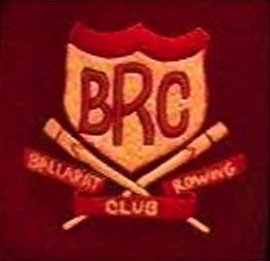
Ron’s treasured Ballarat singlet still in as new condition. This is possibly the only surviving example of a Ballarat Rowing Club singlet. Even though it is over 70 years old and worn many times “in battle”, it is perfectly preserved and still in pristine condition. When Ballarat Rowing Club amalgamated with Wendouree Rowing Club in 1973, they kept two white bars under the white star of Wendouree’s colors to signify the Ballarat white stripes. (From the Ron Douglas memorabilia collection.)
Ron joined the Ballarat Rowing Club in late 1950 as a “skinny”15-year-old as a coxswain. Many of his workmates were already members. The Ballarat Rowing Club was a great environment for young rowers. It provided a great social as well as sporting outlet. Everyone in the club contributed to the club and were proud to wear the red and white stripes of Ballarat Rowing Club. They rowed alongside their workmates and bosses and members from all different backgrounds. Public school boy or apprentice, it didn’t matter. It was very equalitarian and supportive of anyone no matter where you came from.
Other than steering some intra club races, the first “big” regatta he attended was probably the Ballarat Regatta on February 24, 1951. He was probably not experienced enough to cox at the regatta but faced his first real test a month later at the Bairnsdale Easter Regatta on March 24, 1951.

Ballarat Regatta Program, February 24, 1951. Ron Douglas memorabilia collection.
The Ballarat Regatta was a big affair for all three of the Ballarat clubs as they did not have to travel, and they got to race on their home course. It was also an opportunity for fund-raising with the clubs taking in turns to supply afternoon teas to the visiting oarsmen and spectators.
The Ballarat Regatta of 1951 was also the very first time the “new” 2000metre Olympic course was used. This meant that races finished in the south-west or Convent corner near Mary’s Mount (Loreto) and only six crews could row abreast. Previously races had started at Mary’s Mount corner and finished in front of the three rowing sheds with the capacity to race 20 crews abreast. Ballarat Rowing Club won three races at the regatta, most notably the Lightweight eights in which they fielded a crew that was one of the best in the state.


Cover and entries for Bairnsdale Regatta, March 24, 1951, with R. Douglas listed as the cox of the Ballarat No.2 Maiden eight. This was his first race for the club. From Ron Douglas memorabilia collection.
Ron must have developed quickly as reasonable coxswain, as he steered the Ballarat No 2 Maiden eight in a first and final against the Ballarat No. 1 eight and a Bairnsdale eight at Bairnsdale Regatta on March 24. The legendary Teddy Jones was also steering Ballarat City Rowing Club crews at the regatta and Ron can remember being somewhat intimidated by him. Ron was just a young lad beginning his rowing journey and Teddy had been coxing all his adult life from the mid 1920’s.
Ron enjoyed being a coxswain, and being one of the youngest club members, the cost of going to regattas was subsidised by the club. The whole club would pack up, with tents for accommodation and food to cook while they were away and head off with boats often precariously tied to the top of someone’s car! Bob Morris, who was club secretary, organised these trips away and everyone from cox to coach was allocated jobs on these rowing trips and so the cooking, cleaning, and washing up was taken care of without the responsibility being given to one person. Bairnsdale Regatta would have been his first trip away with the club which as a sixteen-year-old must have been a big adventure.
On Easter Monday, March 26, Ron steered the No.2 Maiden eight at the Sale Rowing Club, Jubilee Regatta. This was a first and final between themselves and No.1 crew with the No.1 crew taking the honours. The Sale Regatta is no longer run but it was a great opportunity for country crews to compete. Ron steered many Ballarat crews for one season 1950-51.
By the start of the next season 1951-52 he had stepped up to rowing and as his first official race was in November 1951, he would have had to earn his place in a regatta crew by having trial races, with club selectors looking on and selecting the best crews to represent the clubs.


Sale Regatta program 1951 and the listing for the First and Final of the Maiden eights with R. Douglas listed as cox of the Number 2 crew From Ron Douglas memorabilia collection.
Ron steered a few crews to victory mainly at inter club races against the two other clubs Ballarat City and Wendouree. There was also a strong intra club competition, and coxswains would be in high demand steering in pairs and fours.
Summary of 1950/51 Season from the unpublished history of Ballarat Rowing Club by Tom Cotton.
"For the second year in succession,the Club won the Light Champion Eight of Victoria and the Light Weight Premiership of Victoria. The Club also broke the previous years record in Regatta successes by registering in Open Regattas, twenty two winning crews.
The Club won also the Ballarat Rowing Association Novice Premiership and Interclub Pennant and ran second in the Victorian Junior Premiership. The Nost Successful Oarsman for the Season in Interclub races was Mr. G. Wallis of the Ballarat Club.
During this rear it was announced that Lake Wendouree had been selected as the Venue for the Rowing Section of the 1956 Olympic Games. Ballarat City Rowing Club suffered a severe loss this year when fire completely destroyed its Clubhouse and fleet.
The Light Weight Champion Eight, in registering the Club's successive win, broke the Race record established by the Ballarat Crew the previous year. The time taken was 6 mins. 48 2/5 secs being 28 1/5 secs. faster than the previous year."
The highlight of Ron’s coxing career was steering a Ballarat crew to third place in the Victorian Sprint Pair-oared Championship held on Lake Weeroona, Bendigo on March 31, 1951. Ron recalls his crew of G.Vawdrey and R. Irvine won their heat and semi-final and were happy to make the final. Eighteen crews vied for the honour with the Melbourne crew of N.Wills and M.Christie winning the event. This was only the second time the Championship had been held.
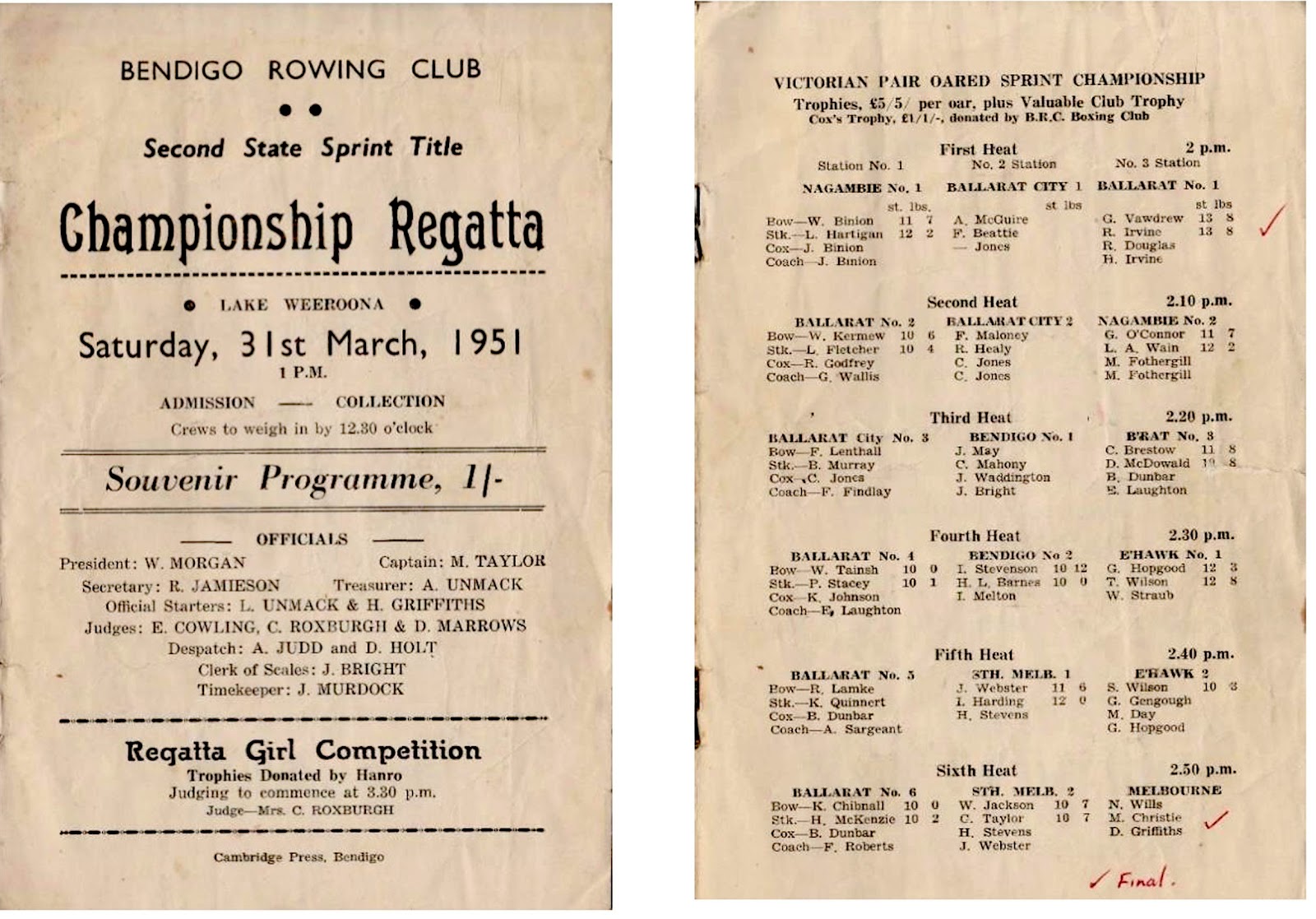
Program cover for the Bendigo Rowing, Club Championship Regatta March 31,1951, and entries for the Victorian Pair Oared Sprint Championship. Ron placed a red tick beside his crew which won their heat and beside the crew which won the final. The Ballarat Rowing Club had six crews entered with a crew in every one of the six heats. Eric Laughton coached two crews. From Ron Douglas memorabilia collection.
We travelled to regattas on a covered truck. The truck was enclosed with tarpaulins which was very cosy. This was an important consideration particularly on the longer trips to Mildura, Sale and Bairnsdale. Bob Doote owned a transport company, Doote’s Transport Co., and owned several trucks. He was also a Ballarat Rowing Club member and drove us to all the regattas.
Our boats and oars were carried on top of the truck, and we sat in the back on whatever was available for comfort on the long trips. I am sure such practices would not be permitted today, but of course this was over 50 years ago.
Melbourne, Bendigo and Geelong were all day trips with everyone leaving early and arriving home late. The Christmas and Easter Regattas required us to arrange accommodation. We did on one occasion stay at a hotel, the Leura Hotel in Camperdown, but mostly we stayed at camping grounds. The club purchased two, 12 foot by 12 foot marquee tents and everyone slept in them. We catered for ourselves, and a roster was organised for cooking, washing up etc. We became very self-reliant.
But despite all the hard work of getting to regattas, Ron said “We still found time to compete and
quaff copious ales!”

Young Ron is pictured right with two “ales” in hand and cigarette in mouth! As Ron said, this was 50 years ago and the quaffing of ales when competing, would probably not be approved of today! The tents used by the club were purchased from Bob Lemke’s father George, who ran a canvas good business. The Lemke’s were well known in Ballarat and Bob (Robert). Lemke was a very well-known baritone singer competing at Eisteddfods around Victoria.

Pictured above is the Leura Hotel, Camperdown, from an old Railways publication. The Leura was built in 1857 and this photo taken about 1950.
Ron’s first race as an oarsman, was in the Open Novice fours at the 67th Dimboola Regatta in November 1951. He rowed in the No.2 crew, in bow seat. Other members of the crew were G. Townsend, R. Giles and I. Tonkin with I. Godfrey the cox. They raced against a Mildura crew but were not successful on this occasion.
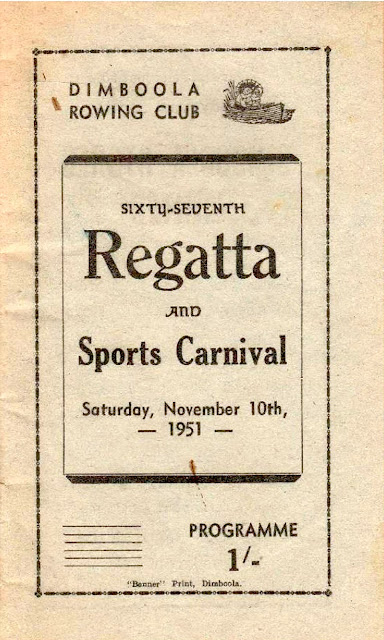

Program cover and entries for the Novice fours at the 67th Dimboola Regatta and Sports carnival. The program included running races, bike races and an Ideal Regatta Girl competition. Program from the Ron Douglas Memorabilia Collection.
The Ballarat Rowing Club only attended 5 or 6 regattas a year and the Christmas Regattas and Easter Regattas were regularly attended, with often the majority of the club competing. Dimboola regatta was held on the Wimmera River at Dimboola at the start of the season, usually in early November. The Christmas Regattas traditionally started with Warrnambool Regatta on the Hopkins River on Boxing Day, Camperdown Regatta on Lake Bullen Merri on December 27, followed by Lake Colac Rowing Club Regatta on Lake Colac on New Year’s Day. This was a “treble” and if you were good enough you could win three races in the one class of boat at the Christmas Regattas.
As Ron said, the regatta venues were many and varied and took him all over the state. Henley and Upper Yarra were a “double” held on the Yarra River again prior to Christmas. After Christmas, other “doubles” were Ballarat Regatta on Lake Wendouree and Barwon Regatta on the Barwon River usually held in late February. These were two of the oldest regattas outside of Melbourne starting in the 1860’s-70’s. After that came Bairnsdale and Sale Regattas, both held on the Mitchell River and finally Mildura and Wentworth Regatta on the Murray River. These two regattas were usually held at Easter. Albert Park Lake was also a popular venue.
Ron competed in a Novice four at the 8th Colac Regatta held on Lake Colac on January 1, 1952. The crew were Ron Douglas (bow), G.Townsend (2), Ian Mann (3), l.Spencer (stroke).

On April 12, 1952 at the Bairnsdale Easter Regatta, Ron was elevated to stroke seat when he stroked a Lightweight four of W.Elliott (bow), Ian Mann (2), and E.Dubberly (3). The crew entered in the Lightweight Four as there was no Novice four on the program.

Summary of the 1951/52 season from the unpublished history of BRC by Tom Cotton:
1951/52: By winning the Light Weight Champion Eight of Victoria this season, the Club again established a record for the race as being the first Club to win the race three time in succession.
To celebrate the victories in this race for the past three years, the Club entertained the members of the three crews at a dinner at the George Hotel.
In March 1952 the Ballarat Rowing Club won the Lightweight eight-oared Championship of Victoria on the Lower Yarra course. This was the third year in succession they had taken out the title becoming the first club to do so. Ron missed a seat in one of the eights crew on the
toss of a coin. Two rowers were vying for the one seat and Ron missed out as he lost the toss. He felt sympathy ever since for sportsmen who miss out on team selection after training and competing all year.


To celebrate the victories in the Champion Lightweight Eights for the past three years, the club entertained the members and the three crews to dinner at the George Hotel. Ron kept the program and autographs of many of the club members.
By December 1952, Ron was rowing with a new line up in the Novice four. He had been promoted from bow to two seat and K. Canny was listed in the program as the bow seat. However, for some reason, K.Canny was unable to compete and so Neville Foyster rowed in bow seat with Vic Dubberly in three and Frank Atkinson stroking the crew. The coxswain was B. Hawkes and the coach C. Beeston. The crew competed at the Warrnambool Boxing Day Regatta which was run as a treble with Camperdown Regatta on December 27 and Lake Colac Regatta on New Year’s Day, 1953.
At Warrnambool Regatta there were 12 crews competing in three heats of four. The lads of the Ballarat Rowing Club No. 1 novice four won their first race, winning their heat and then the final. At Camperdown on December 27 there were four heats of three, so the Ballarat crew faced the same crews from the previous day and again won their heat and final. Then at Colac Regatta they won their third novice four, thus taking out the coveted treble. This was the only “treble” that the Ballarat Rowing Club won in its 110-year history!
In Tom Cotton’s unpublished history of Ballarat Rowing Club, he recorded the treble :-
“For the first time in the history of the club a “Treble” was won. This “Treble” being wins by a Novice four (Ron’s four) at the Warrnambool, Camperdown and Colac regatta.”
Ron remembers, “I was fortunate enough to be a crew member in the only treble won by the Ballarat Rowing Club albeit a Novice four at Warrnambool 26/12/1952, Camperdown 27/12/1952 and Colac 1/1/1953.”

Left to right:- The treble boys Ron Douglas, Vic Dubberley, Frank Atkinson, Neville Foyster. The car they are sitting on is a 1927 Chrysler, number 252567, owned by Vic Dubberley. He was a motor mechanic and the only one of the crew old enough to have his licence.
In January 2007, when Ron first sat down to record his memories, he and his wife Dot had dinner with an old crew mate from this crew, Frank Atkinson. At this time one crew member had already passed away and one crew member was “whereabouts unknown” so there were only two of the crew left. Sadly, Frank passed away in 2010 leaving Ron the sole survivor of the “treble” four.

Ron Douglas looking very like a young “James Dean” sitting on the fender of the Chrysler. He is wearing his club blazer!
Summary of the 1952/53 season from the unpublished history of BRC by Tom Cotton, mentioning the history making treble:
During this year the Club had a slightly better year in Regatta racing than the previous season. For the first time in the history of the Club a " Treble i was woh. Thig " Treble " being wins by a Novice Four at the Warrnambool Camperdown and Colac Regattas. The Club this year very nearly won the Champion Light Weight Eight-Oared Championship of Victoria for the fourth Successive year• When holding a comnanding lead within a & Mile of the finish one of the Crew lost his seat which caused the boat to lose several lengths, a handicap which was too difficult to make up.
Ron has kept nearly all the programs from his rowing days along with competitors passes, so along with his memories of the “treble”, excerpts from the programs and photographs are pictured in the order of the three regattas.
The first leg of the treble was at Warrnambool Regatta, the second leg at Camperdown Regatta and the third leg at Colac Regatta. He is justifiably proud of winning a treble because so few oarsmen did win three consecutive races in those days. It was only when regattas were grouped together, like the “Christmas Regattas”, that the opportunity to win three races in a row was even possible.


First leg of the treble-Warrnambool Regatta, Hopkins River, Warrnambool, Boxing Day 1952. Note: K.Canny is listed in the program as bow but Ron remembers it being Neville Foyster.
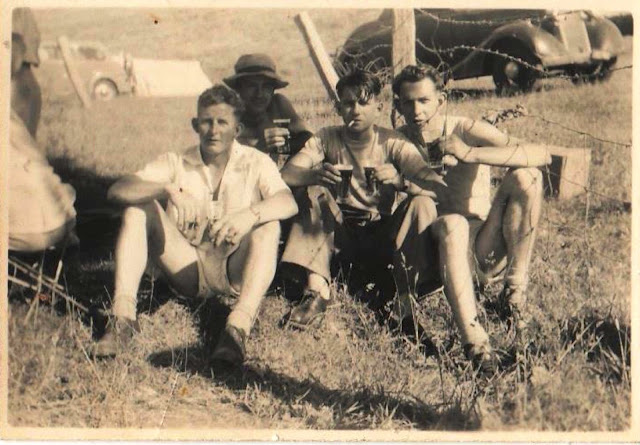
Ballarat boys enjoying a drink and a smoke at a regatta. From left to right:-Johnny Firth, Bob Morris (with hat on and club secretary), Ron Douglas and Frank Atkinson.

Second leg of the treble: Camperdown Regatta, Lake Bullen Merri, December 27, 1952.

Third leg of the treble: Colac Regatta raced on Lake Colac, New Year’s Day, 1953.
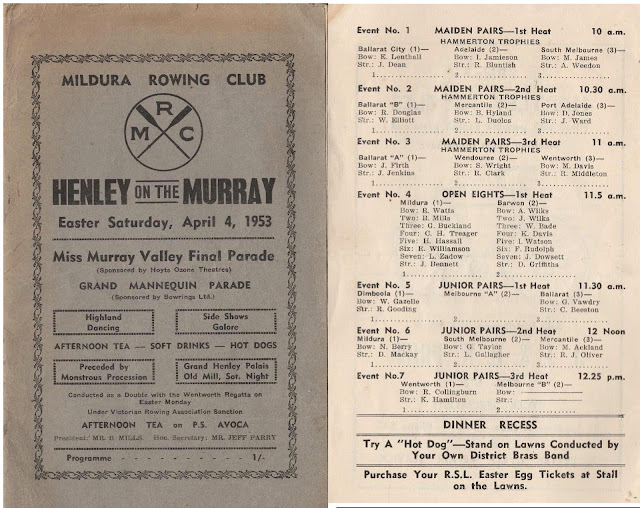
Program for Mildura’s Henley on the Murray 1953 and entries for the Maiden
pairs.
Ron raced at the Easter Regatta at Mildura in 1953 competing in a Maiden pair with W. Elliott. He was just 17, and underage for being on a licensed premises, but he obtained an Honorary membership of the Mildura Working Man’s Club so he could join his club mates for a beer. Probably quite a few underage rowers were also accorded this “privilege” over the years, as it would have been a rite of passage for many of the oarsmen attending Mildura regatta to have a beer in the legendary Working Man’s Club. Once again, the club travelled in the back of a truck with the boats on top and camped up at Mildura. They then travelled on to Wentworth Regatta on Easter Monday. This was to be the last regatta Ron competed in for six months as, like all young men at this time, was conscripted into the RAAF for his National Service.
He served from June to December 1953 at RAAF Laverton. Most men did their service with the Army, but Ron managed to spend his time at the Laverton Base Workshops working alongside the permanent RAAF tradesmen on a variety of project. Ron’s six months serving in the Nasho’s is detailed in the next section.
Ron had a very successful season and for his enthusiasm and hard work in the boat, Ron was awarded the Ballarat Rowing Club’s inaugural “Most Improved Oarsman” trophy. His crewmate from the four, Vic Dubberly, was the Most Successful Oarsman.
Summary of the 1952/53 season from the unpublished history of BRC by Tom Cotton, with Ron Douglas winner of the “Most Improved Oarsman” award:
1952/ 53 Contd. For the first time in the Clubs' history the Committee introduced competitions for the Clubs “Most Successful Oarsman" and “Most Improved Oarsman", “Most Successful 1st Year Oarsman” and "Most Attentive Coxswain”
The winners in these being :-
Most Successful Oarsman - Mr Vic DUBBERLEY.
Most Improved Oarsman - Mr Ron DOUGLAS
Most Successful 1st Year Oarsman - Mr Dan FLETCHER
Most Attentive Coxswain - Master Ian GODFREY

Photograph from the Ron Douglas memorabilia collection.
Circa 1954:- Ron Douglas with the new racing pair that Ballarat Rowing Club bought. Ron was sent down with a pocket full of cash, to pay for the boat. He remembers being handed the money and taking it home with him. He wasn’t sure what he should do with it to keep it safe. It would have been couple of hundred pounds. Imagine giving any of the 18 or 19 year old members in any club today, a pocketful of cash to take to buy a boat. After research, this would probably have been an Alan Sykes pair. Alan started building boats in Geelong in 1950 and was the only boat-builder that was “local” enough for the club to have driven down and picked up the new boat. Once again, the FX Holden did good service carrying the boat safely back to the club.
After his return from National Service in December 1953, Ron continued his rowing success winning a Maiden eight double at Colac Regatta, January 1, 1954, and then the following day at Camperdown Regatta.
The Ballarat Maiden eight was G.Wallis (bow), R.Douglas (2), R.Leigh (3), M.Haymes (4), W.Elliott (5), Ian Mann (6),Vic Dubberly (7), Frank Atkinson (stroke), I.Godfrey (cox) and Frank Roberts (coach). The eight is pictured below and it is an interesting historical photograph that shows the empty space next to Wendouree Rowing Club’s shed where the Ballarat City shed used to be. It burnt down in 1950 and was rebuilt in 1956.


Photograph, program and entries for the Maiden eights from Colac Regatta, January 1, 1954 . From the Ron Douglas Memorabilia Collection.


Program and entries for Camperdown Regatta January 2,1954. From the Ron Douglas Memorabilia Collection.
In 1954 Ron also rowed in a Lightweight four. The crew was comprised of Peter Stacey (bow), P.Montgomery (2), G.Wallis (3), Ron Douglas (stroke), J.Brayshaw (cox) and Eric Laughton, coach.
Albert Park Regatta, February 1, 1954; Ballarat Regatta, March 6, 1954; Barwon Regatta, March 27,1954. Ron reckons that this lightweight four was the best crew he ever rowed in. Unfortunately, they never won a race, but they went close. At Albert Park Regatta they were beaten by a canvas in the first and final. As they had already raced a heat of the Maiden fours an hour and a half before, they possibly would have won had they been fresher. At Ballarat Regatta they were beaten a by a quarter of a length behind the winners Yarra Yarra Rowing Club.

Officials for the Albert Park Lake, Australia Day regatta, 1954.
At Barwon Regatta they beat home all the Victorian crews but lost their heat to by a foot to a South Australian crew. This South Australian crew went on to win the final by a large margin.

Entry lists for Albert Park Regatta, February 1,1954. Interesting to note that at this Albert Park Regatta there were also two women’s races, a Maiden four and an Open four. There were entries from Albert Park Ladies, Essendon Ladies and Dimboola Rowing Club.

Albert Park Lightweight fours entries from program. Ron Douglas memorabilia collection.

Ballarat Regatta entries for the lightweight fours. Ron Douglas memorabilia collection.

Ballarat Regatta in 1954 coincided with a Royal Visit, and Queen Elizabeth attended the regatta. The faithful monarchists of Ballarat, which was nearly every man, woman and child, lined Sturt Street to catch a glimpse of her. Ron declined to go with his family to see her much to their chagrin.
“It had nought to do with my, even then, republican sentiments, but to my desire to be rested and ready for the upcoming event.”
That “upcoming event” being his race in the lightweight four. Despite being well rested and only rowing the one race, Ron’s crew came second by a quarter of a length.
Excerpt from The History of Ballarat Regatta 1862-2002, Kate Elliott:
The Ballarat Regatta coincided with the royal visit of Queen Elizabeth 11 and the Duke of Edinburgh to Ballarat. It had been over 100 years since royalty had attended a Ballarat Regatta. It also coincided with the Begonia Festival and in fact was called the Ballarat Begonia Festival Regatta. As was usual, the organizing committee sought to engage as many of the general public as possible and by aligning the regatta with other social events gained an advantage. Despite the influx of visitors for the Queen’s visit, attendances at the regatta were down. The Begonia Festival with its many other attractions around the Lake probably contributed to this as did conducting the regatta on the new 2000-meter course again. People were more spread out and their interest was taken by other things. So, the hoped for benefits did not arrive. The conditions were ideal for the regatta, fine and sunny, with the wind freshening later in the afternoon creating a headwind and choppy waves at the finish of the later races. Metropolitan clubs again dominated the finals with Mercantile winning the blue ribband Senior eights. The local clubs enjoyed their biggest number of entries since before World War II. Ballarat City and Wendouree both had five crews entered, while Ballarat had seven including three eights- a Maiden, Junior and Lightweight eight. Ballarat had had a successful early start to the season but today couldn’t finish among the winners at this regatta. Wendouree and City both scored a win apiece in the Junior fours and Lightweight pairs.”
The Ballarat Regatta coincided with the royal visit of Queen Elizabeth 11 and the Duke of Edinburgh to Ballarat. It had been over 100 years since royalty had attended a Ballarat Regatta. It also coincided with the Begonia Festival and in fact was called the Ballarat Begonia Festival Regatta. As was usual, the organizing committee sought to engage as many of the general public as possible and by aligning the regatta with other social events gained an advantage. Despite the influx of visitors for the Queen’s visit, attendances at the regatta were down. The Begonia Festival with its many other attractions around the Lake probably contributed to this as did conducting the regatta on the new 2000-meter course again. People were more spread out and their interest was taken by other things. So, the hoped for benefits did not arrive. The conditions were ideal for the regatta, fine and sunny, with the wind freshening later in the afternoon creating a headwind and choppy waves at the finish of the later races. Metropolitan clubs again dominated the finals with Mercantile winning the blue ribband Senior eights. The local clubs enjoyed their biggest number of entries since before World War II. Ballarat City and Wendouree both had five crews entered, while Ballarat had seven including three eights- a Maiden, Junior and Lightweight eight. Ballarat had had a successful early start to the season but today couldn’t finish among the winners at this regatta. Wendouree and City both scored a win apiece in the Junior fours and Lightweight pairs.”

Barwon Regatta, Barwon River, 27 February, 1954. The program cover and entries for the Lightweight fours at Barwon Regatta.

An article from the Port Adelaide Messenger, Thursday, March 4, 1954.
The Port Adelaide crew were a very good crew who had only been beaten once in their home state of South Australia. They were the first South Australian crew in 80 years to attend the Barwon Regatta.
The margin at this regatta was one foot. This is a very difficult margin to call without a photo finish and would require the relevant official to be standing right on the accurately surveyed finish line, have 20/20 vision and be very experienced at calling close races!

Summary of the 1953/54 season from the unpublished history of BRC by Tom Cotton.
Ballarat Rowing Club were very strong in lightweight rowing in the 1950’s winning multiple state championships. This lightweight pair was coached by Eric Laughton who was also Ron Douglas first coach. The stroke of the crew was W.C. Tainsh or “Billy” Tainsh. He was an outstanding lightweight for the club for over a decade.
Information from Andrew Guerin’s Australian Rowing History website:
Victorian Lightweight Pair-Oared Championship 1953 (1 mile)
Time - Not recorded. Margins: 3/4 length
1st Ballarat - Bow: R Kirsopp, Str: W C Tainsh, Cox: I Godfrey, Coach: E Laughton 2nd Banks
3rd Yarra Yarra
Other competing crews: Mercantile, South Melbourne, Ballarat City
Holders - Banks Rowing Club. Rowed on Lake Nagambie. Course one mile. 26th December, 1953. Won by Ballarat Rowing Club by three-quarters of a length from Banks, second. No time was taken.
1955 Lightweight pairs, Camperdown Regatta, January 3, 1955 T.Twite (bow), R.Douglas (stroke), V.Whykes (cox) and F.Roberts (coach).


Program cover and crews for Camperdown Annual Regatta, January 3, 1955. . Ron Douglas memorabilia collection.
At the 1954-55 season Annual Meeting Ron received the Most Improved Oarsman award for the second time, having also received it in 1952-53.

1955/56 Season. This season Ron put his hand up and was elected Captain of Ballarat Rowing Club. This was at a time when the membership was numerous, and the election of a Captain was an indication of the esteem in which his clubmates held him. Tom Cotton was elected as President for the ninth year.

Ron’s club blazer bought in 1955. It is still in pristine condition some 70 years later although Ron seems to think it is a lot smaller than it used to be as it doesn’t fit him any more! It was bought at Patterson and Powell’s Department store in Ballarat (now the Myers store.) This is probably the only surviving example of the Ballarat Rowing Club blazer and is an important piece of Ballarat’s rowing history. From Ron Douglas memorabilia collection.


One of the first regattas of the year would have been the Ballarat Regatta held on February 25, 1956. This would have been the first time that a Ballarat Regatta had no Senior events. Also for the first time on the program was a Beginners four. Ron did not race at the ’56 regatta but had lots of organising to do as Captain.
From the History of Ballarat Regatta 1962-2002, Kate Elliott:
1956 Ballarat Regatta. 1956 was, of course, the defining year for Ballarat rowing when we hosted the rowing and kayaking competition for the Melbourne Olympic Games on our beautiful Lake. Suddenly what had been our local pride and joy became famous on the world stage. For the very first time in our Nation’s sporting history, athletes and spectators travelled from all over the globe to see the very first international event of this kind ever to be held in Australia. Robinson McLaren who had first proved that the Swamp could be a Lake and those who followed him and added to the transformation would have indeed been proud to see what their efforts had achieved.
Ballarat Regatta was an ideal opportunity for the selected Australian crews to train and race on the new Olympic course. In order to allow these crews to race as a crew the Ballarat Rowing Association added Open events to the program instead of the usual Senior events. The reason they could not hold Senior events was because to race in this, all crew members had to belong to the same club. Because the Australian crews were selected from many clubs and there had not been a composite rule introduced to allow clubs to combine the Open events catered for this.
The weather was cool with a southerly breeze blowing that made the water choppy at times. But mostly the conditions were ideal for racing and ideal for testing the running of races on the course.
Local crews performed well this year with Ballarat winning three finals and Wendouree one.
The next big event was the holding of the very first Australian Rowing and Sculling Championships and King’s Cup Regatta in Ballarat in May. The many interstate rowers and their boats would have been billeted at the three rowing clubs. It would have been a very busy time at all the boatsheds. Interestingly The Head of the Lake was also held at this time in conjunction with the King’s Cup on May 4 and 5, 1956.

Cover of the Program for the first King’s Cup held in Ballarat May 4 and 5, 1956. From the Kate Elliott memorabilia collection.
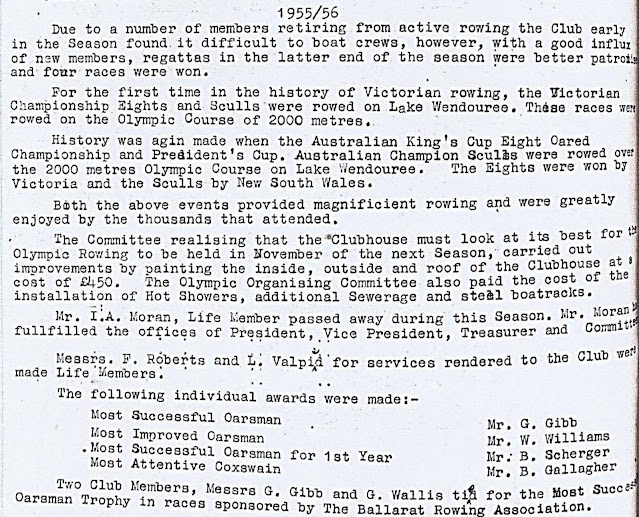

The Olympic Trial pairs was held on Lake Wendouree in October 1956, to allow selection of the Australian Olympic crews and also to trial racing on the Olympic course. Officials from the Victorian Rowing Association, Ballarat Rowing Association and Australian Amateur Rowing Council (now Rowing Australia) combined to ensure that all was in readiness for the main event. In November 1956, the biggest rowing event held in Australia to date, the Olympic Games was held in Ballarat. The Ballarat Rowing Club billeted the crews from Brazil, Canada, Denmark, France, Romania, Russia and Germany. According to Tom Cotton’s History of Ballarat Rowing Club, “The oarsmen of these nations were loud in their praise of the Lake, the clubhouse and the facilities.”
Owing to the running of the Olympic Games, the boathouse was closed to members for a period of two months. This was at the start of the 1956-57 season and impacted the training for regattas. As a result, only one win was recorded by the club this season. The annual Ballarat Rowing Association Novice Regatta was also not held.


Ballarat Rowing Club Junior eight pictured in The Courier, Monday March 2, 1953


Olympic programs from the Kate Elliott memorabilia collection.
As Ron married his wife Dot in February 1957, Ron’s rowing career came to an end, but the memories remain strong even after 70 years.
Ron’s final words on his rowing career:
I cannot emphasise the importance that I place on my involvement at the Rowing club. Membership was representative of the social strata of Ballarat Society, successful businessmen, present and former, Private School Students through to many Apprentices and Tradesmen all joined together to continue the successes of this great Club. It is sad that amalgamation was necessary, but at least the Club still survives. Badminton was also an important component of Club activities that kept Members involved and we had some very successful teams.
Friendships made during these years are still strong today, unfortunately quite a number have passed on and we may never hold another Reunion, as we did during the 70’s and 80’s, but memories are forever.”

Club members travelling to a country regatta with boat loaded on a frame attached to an FX Holden. From left to right: Frank Roberts, Ern Whykes and Peter Montgomery
Snapshots Of Rowing From The Past

FX Holden and club members on the way home from Geelong after picking up the new pair.


On the way to a regatta with a pair and a four loaded on top!!


1961 Centenary Dinner


Baseball
Back to my introduction to Rowing and Baseball! It seemed natural that I become involved in these sports as the majority of the Firm’s employees (Hollway’s) were or had been participants in one or both of these activities.
I played Baseball for several years with the Wendouree Baseball Club, mostly in B and C Grades and a few games in A Grade. I was fortunate to be a Member of Premiership Teams, although one year I nearly missed a C Grade Premiership because I had played a few games in A Grade. From memory, I believe it was permissible to play five games at a higher level and still be eligible to play Finals at the lower level. There was some doubt how many A Grade games I had played due to discrepancies with Team Sheets. However, application to the Ballarat Baseball Association resulted in permission being given for me to play in the Grand Final.
I still have a few Trophies: A Mounted Baseball inscribed with my name, presented in Season 1952 for Outstanding Batting. Another is a Miniature Bat inscribed: -
WENDOUREE: Winners Aiken Cup 1955 - R. DOUGLAS
This was the year that we won both B and C Grade Premierships and The Association Points Aggregate. I also have another, an almost full-size bat, which was a match day award.

No comments:
Post a Comment