"Lifting" Cherries at Doncaster (1908)
At the Box Hill police court on Friday, before Messrs Walker (chairman) and Ingatnells, J's.P., two boys, named respectively Herbert A. Wadham and Ernest Rohl, were charged by Constable Dent with stealing cherries from the orchard of Reinhold Dehnert, in Waldau road, East Doncaster, on December 1. Senior-constable O'Leary prosecuted, and Mr Wadham appeared for the youthful defendants. Albert Dehnert deposed that about 4 o'clock on the afternoon of Sunday, December 1, he was in his father's orchard when he saw the accused picking cherries. He chased them and they ran into the road towards two bicycles, which they mounted and rode off.
Witness followed, and Wadham fell and was caught. Wadham had some cherries in his shirt, and near where the bicycles were, two bags full of cherries were found. One was an oatmeal bag and the other a school bag. Witness took Wadham to the police station, and on the road they met Rohl, and Wadham told his mate not to come near, but clear out. Rohl would not do so, and all three went to the police station, where Constable Dent took their names and addresses. The constable weighed the cherries and found they had 21 lbs. Where they picked the cherries from were a lot of cherry boughs pulled off and thrown on the ground. The cherries were worth 2 1/2 d. per lb. Constable Dent gave corroborative evidence. Mr Wadham said his boy was evidently the worse of the two. He urged the bench not to record a conviction against the lads. They were very sorry for what they had done, and would be careful to behave themselves in future. Mr Walker administered a severe caution to the lads, and they were let off on agreeing to pay 4/- for the cherries and 11/- costs.
1908 "Lifting" Cherries at Doncaster. Reporter (Box Hill, Vic. : 1889 - 1918), 17 January, p. 4. , viewed 22 May 2017, http://nla.gov.au/nla.news-article90313162
100 YEARS AGO
On Boxing Day in 1894, Henry Fromhold was at a picnic in an adjoining paddock when he saw two youths in his orchard. They had broken some branches off cherry trees and were taking them away. John Pump and some other men, who were at the picnic, came over and helped Fromhold to detain the youths while he went and called Constable Hartshorn. At the Box Hill Court, Henry Fromhold said the cherries were worth one pound. The youths who had spent the morning drinking at the Tower Hotel were given two months gaol each.
1993 03 DTHS Newsletter
DRUNK AND DISORDERLY.
Samuel Plant was charged with being drunk and disorderly at Canter-bury on Saturday, December 22nd. Prisoner pleaded not guilty and stated that he had walked to Glenferrie and back and was resting when he was arrested on a charge of drunkenness. Fined Is. and 2s. costs, in default 24 hours; time being given to pay. John Ryan, who was charged with a similar offence, pleaded guilty, and produced a certificate that he had signed the pledge for 12 months. Fined 2s. 6d. and 2s. costs, in default seven days. DAMAGING FRUIT TREES. Two lads named George Birch and John Wilson were brought up on a charge of destroying fruit trees at Doncaster. Henry Fromhold gave evidence that while at a picnic in the adjoining paddock on December 20th he noticed several youths in his garden and upon going over noticed these two with others coming out with branches of cherry trees in their arms. He told them to put them down and they did so, but afterwards returned and were about to take them off, when he sent for the police and gave them in charge. He estimated the damage done at about £1. John Pump said he was at Don-caster on the 26th of December last, and saw prisoners in conjunction with about four others in MIr. Fromhold's garden. Did not see them break the branches off. but they were carrying the branches. All made off but these two who were detained while he went for the police. Constable Hartshorn (of Melbourne) was on duty at Doncaster on the date mentioned and the last witness came to him and said he was wanted. On going to the garden, found the prisoners, who admitted they had been in the garden, but had not broken the trees. The branches produced were similar to those broken off the trees. He had seen them in the morning at the Tower Hotel, where they were with several others from Port Melbourne and were even then the worse of drink, and had evidently come out for the express purpose of creating a disturbance. Sentenced to one month each.
BOX HILL POLICE COURT. FRIDAY DECEMBEB 28, 1894. (Before Messrs. Ellingworth (Chairman), Blackburne, and Bishop, J's.P.)
1895 'BOX HILL POLICE COURT.', Reporter (Box Hill, Vic. : 1889 - 1918), 4 January, p. 3. , viewed 26 Feb 2018, http://nla.gov.au/nla.news-article90364204
![]() |
| Stealing Apple c1877 (origin unknown) |
1908 "Lifting" Cherries at Doncaster. Reporter (Box Hill, Vic. : 1889 - 1918), 17 January, p. 4. , viewed 22 May 2017, http://nla.gov.au/nla.news-article90313162
100 YEARS AGO
On Boxing Day in 1894, Henry Fromhold was at a picnic in an adjoining paddock when he saw two youths in his orchard. They had broken some branches off cherry trees and were taking them away. John Pump and some other men, who were at the picnic, came over and helped Fromhold to detain the youths while he went and called Constable Hartshorn. At the Box Hill Court, Henry Fromhold said the cherries were worth one pound. The youths who had spent the morning drinking at the Tower Hotel were given two months gaol each.
1993 03 DTHS Newsletter
DRUNK AND DISORDERLY.
Samuel Plant was charged with being drunk and disorderly at Canter-bury on Saturday, December 22nd. Prisoner pleaded not guilty and stated that he had walked to Glenferrie and back and was resting when he was arrested on a charge of drunkenness. Fined Is. and 2s. costs, in default 24 hours; time being given to pay. John Ryan, who was charged with a similar offence, pleaded guilty, and produced a certificate that he had signed the pledge for 12 months. Fined 2s. 6d. and 2s. costs, in default seven days. DAMAGING FRUIT TREES. Two lads named George Birch and John Wilson were brought up on a charge of destroying fruit trees at Doncaster. Henry Fromhold gave evidence that while at a picnic in the adjoining paddock on December 20th he noticed several youths in his garden and upon going over noticed these two with others coming out with branches of cherry trees in their arms. He told them to put them down and they did so, but afterwards returned and were about to take them off, when he sent for the police and gave them in charge. He estimated the damage done at about £1. John Pump said he was at Don-caster on the 26th of December last, and saw prisoners in conjunction with about four others in MIr. Fromhold's garden. Did not see them break the branches off. but they were carrying the branches. All made off but these two who were detained while he went for the police. Constable Hartshorn (of Melbourne) was on duty at Doncaster on the date mentioned and the last witness came to him and said he was wanted. On going to the garden, found the prisoners, who admitted they had been in the garden, but had not broken the trees. The branches produced were similar to those broken off the trees. He had seen them in the morning at the Tower Hotel, where they were with several others from Port Melbourne and were even then the worse of drink, and had evidently come out for the express purpose of creating a disturbance. Sentenced to one month each.
BOX HILL POLICE COURT. FRIDAY DECEMBEB 28, 1894. (Before Messrs. Ellingworth (Chairman), Blackburne, and Bishop, J's.P.)
1895 'BOX HILL POLICE COURT.', Reporter (Box Hill, Vic. : 1889 - 1918), 4 January, p. 3. , viewed 26 Feb 2018, http://nla.gov.au/nla.news-article90364204
Pictures Victoria - Pictures Australia - Australia in Pictures
PictureVictoria is a Victorian Local History Project, funded from Arts Victoria, through the Statewide Public Library Development Grants. This project aims to increase the accessibility of the local history collections held by Victorian public libraries, in particular through the development of a digitisation strategy.
The primary focus of PictureVictoria is to provide a single portal for access to pictorial and photographic collections held in Victoria's public libraries. This site aims to complement existing portals, such as Picture Australia and the State Library of Victoria's Picture Collection.
Picture Victoria's limitation is that it only displays low quality thumbnails of pictures shared with it by historical societies such as ours. Internet users then have to contact the relevant historical society.
Pictures here are at high quality and downloadable at original resolution.
The primary focus of PictureVictoria is to provide a single portal for access to pictorial and photographic collections held in Victoria's public libraries. This site aims to complement existing portals, such as Picture Australia and the State Library of Victoria's Picture Collection.
Doncaster Templestowe Historical Society (DTHS) has added hundreds of photos from our collection to this catalogue with the cooperation of the Whitehorse Manningham Library.
Picture Victoria's limitation is that it only displays low quality thumbnails of pictures shared with it by historical societies such as ours. Internet users then have to contact the relevant historical society.
The system was conceived as part of a National Library of Australia (NLA) project "Picture Australia" but this project floundered.
Picture Australia has been absorbed into Trove and published on Flickr. It was originally launched in September 2000, and at that time, was a unique and ground breaking service, bringing together digitised images from cultural heritage collections around Australia for not only all Australians to see but also the world.
Contemporary images were sourced from Flickr via a series of Groups, which ensured individual contributions to Picture Australia were included in the snapshot of Australiana. We will continue with this tradition using the Trove: Australia in Pictures Group.
Picture Australia has been absorbed into Trove and published on Flickr. It was originally launched in September 2000, and at that time, was a unique and ground breaking service, bringing together digitised images from cultural heritage collections around Australia for not only all Australians to see but also the world.
Contemporary images were sourced from Flickr via a series of Groups, which ensured individual contributions to Picture Australia were included in the snapshot of Australiana. We will continue with this tradition using the Trove: Australia in Pictures Group.
Pictures here are at high quality and downloadable at original resolution.
Picture Australia's publication of free access to 346 000 high resolution photos of Flickr is part of a worldwide trend to provide free full text and full quality imagery direct to the world.
If Flickr goes bust, the library is easily moved to another service. The metadata (information about the picture) is usually embedded inside the picture to make this process extremely simple.
It is confusing, but NLA also have another Flickr account: Flickr: National Library of Australia.
Beautiful Melbourne Motor Char-a-banc Trips - Blackburn & Doncaster 1910's
Beautiful Melbourne Motor Char-a-banc Trips 1910s Withers & Sons MV482635
"BEAUTIFUL MELBOURNE" MOTOR CARS have decided to make Extended Afternoon Tours from the 1st of November till the 3oth of April, and to advance the fare from 2,6 to but are making an allowance for family parties of fid. on each fare. We beg to thank our numerous patrons for the liberal patronage extended to us in the past, and hope the new trips now introduced will meet with the success they merit. We can ask no more. All-day Runs are also now introduced, which will enable those who desire to spend a day in the Country the opportunity to do no at a moderate cost. The Evening Run to Hampton, Brighton, hc., will prove a boon to those who wish to enjoy an evening run around the beach in comfort.
Waldau Town
Christmas Eve at Waldau
Fifty children played games, laughing and shouting, during the afternoon. As evening approached, their parents called them to the meal set out on tables under the trees alongside the church. Pastor Goethe led them in a hymn and prayer before they settled down to enjoy their Christmas tea.It was Christmas Eve, 1860. The year Max von Schramm had opened his school in the Waldau church. As an end to the school year, the Lutheran congregation had agreed to hold a tea meeting and Christmas celebration. Women of the church had visited families to obtain gifts and food for the festival. English friends had been invited. There was Mr. Grant, Mr. Newman, Mr. Serpell, and Mr. Clarke. Pastor Goethe had come from Melbourne for the occasion.
At dusk, the ringing of the heel invited the gathering to the church. As the children entered, they were delighted at the magnificent sight of a Christmas tree, reaching right up to the roof, covered with decorations and Christmas gifts, and brilliantly lit by many candles.
The congregation was addressed by Pastor Goethe, Mr. Thiele, Mr. Newman, Mr. Grant and Mr. Serpell. Then the gifts were removed from the tree and handed round till every child had a present. Afterwards there were prayers and singing .
As the happy group joined in the carols a feeling of goodwill and contentment spread among them. They had left their families and homes in Germany to come to a new and strange land, driven by faith and a love of freedom. They had experienced adversity, hard work, and the homesickness of isolation from their families. Now, on this Christmas Eve, these German pioneers were gathered together in a new community, established by their own hard work. This was their new home!
Irvine Green writing in 1983 12 DTHS Newsletter
Waldau Christmas
On Tuesday evening, the 24th December, a most interesting meeting was held at Waldau, known by many as Germantown. It, was the usual gathering at a German Christmas Eve. Dr. Embling, J.P. presided. The refreshments were partaken of in the open air, the chapel being appointed for the even-ing meeting; Two very handsome Christmas trees partly filled the chapel, loaded with presents; and a table at the rear of the President's chair was covered with articles for distribution among the children of the school. Waldau occupies a highly picturesque situation amid the hills, and is chiefly cultivated by Germans. The school musters nearly 50 scholars, and everything betokens the presence of an industrious population. After the opening remarks of the Chairman, Pastor Goethe addressed the meeting. B. N. Clarke, Esq;, J.P., and other gentlemen then pressed upon the friends and children present the advantages of education, especially in a young community, where every individual mind may make itself powerful for good or evil. The presents, were then distributed, and after several hours of pleasant intercourse, the friends, whose numbers densely packed the building, adjourned, until another Christmas Eve shall call them to gather to their pleasant rendezvous - "The Chapel on the Hill."1862 'NOTES AND NEWS.', South Bourke Standard (Vic. : 1861 - 1873), 3 January, p. 2. , viewed 22 May 2017, http://nla.gov.au/nla.news-article66903280
The Dawn Service at the old Lutheran Church site, Victoria street, Doncaster, on Easter Sunday 1973. The service was held in a clearing made for Schramm's Cottage which was to be rebuilt here after having been dismantled and removed from its original site in Doncaster Road. The congregation is here surrounded by the stones of the walls layed out in preparation for the rebuilding. Some of the people in the photograph are Eric Collyer at the organ, Muriel Green (directly behind Eric), Olaf and Glenys Soderlund on the right in the second row. DP0574
Andersons Creek, Warrandyte
In 1839, the first white settler, James Anderson, established his cattle station in an area just west of the present Warrandyte township. He erected a hut and stockyard near where the creek (Anderson’s Creek) joined the Yarra.
In 1841, James Dawson established a second station to the east of the township, about 1 mile (1.6km) From the bridge. By the mid 1840’s, Anderson had sold his holding to a Major Newman, a former officer of the Indian army.
"Plassey", the Zelius Home
On the corner of Doncaster Road and Dehnert Street stands an old grey house with delicate cast iron decoration. In 1888, Martin Zelius built the house with love and care giving it the name "Plassey".
![]() | |
| A standard Italianate villa, unusually elegantly carried through with metal ridge cresting and finials, patterned slate roof, double-curved verandah roof, and stuccoed front with label moulds to the windows and statuary niches flanking the door. (VHD-B2986) |
Eastern Freeway
Run, Ride, Roll the Freeway (Freeway Opening 1997)
The greater part of the DTHS archive relates to the period 1850 to 1950. But the area is constantly changing and the events of today will also be of interest to later generations.These photographs were taken on Sunday 7 December 1997, when the new extension of the Eastern Freeway from Doncaster Road to Springvale Road was opened with the invitation to the public to run, ride, roll (or walk) the freeway prior to its being open to traffic.
![]() |
| Taken from one of the bridges over the freeway and shows cyclists travelling in both directions. 1977. DTHS-dp0859 |
Tower Hotel, Doncaster
The Tower Hotel
The Tower Hotel at Doncaster was built one hundred years ago in Doncaster Road at the corner of the present Tower Street. The Hotel was built by Alfred Hummel, a gentleman farmer, who three years before had built the Doncaster Tower.Hummel had provided refreshment rooms at the base of the Tower but, after visitors had climbed the Tower, the strenuous exercise made them feel in need of something stronger than a cup of tea. Seeing large parties ignore his facilities and go off to a hotel was too much for Hummel. He was a proud Englishman who did not like to be beaten.
The Hotel that Hummel built was bigger and better than any other in the district. There were thirty nine rooms and stables for twenty horses. He called it the Beaconsfield Hotel.
His decision to build a hotel, however, caused considerable criticism both from his family and the community. Hummel had been a supporter of the temperance movement in Doncaster. The Hotel had caused them to lose credibility and his wife Jane was one of the Lawford family who were strict teetotallers.
Hummel began to have financial problems. He had invested heavily with the Tower, the Hotel, and his many land holdings. In 1885, he sold up all his properties and moved to Tasmania where he lived for the rest of his life.
The Hotel was bought by William Meader, a man with much experience in the hotel business. Meader had come from Dorset at the age of twenty four and arrived at the time of the gold rushes. Meader became more interested in the land boom than in being a publican. He leased the Hotel, now called the Tower Hotel, to John Nicholls.
Nicholls was an auctioneer and land agent who already owned a large orchard in Reynolds Road, alongside Deep Creek. He lived at South Yarra and employed G. Edwards and his wife to run the Hotel.
A party who visited Doncaster while Nicholls was host wrote a description of the Tower Hotel:
“…. I say Doncaster Tower is the place for us all. The hills are beautiful and green, the sea breeze is fresh and cool in the town, and a wire before we start to Host Nichols will find a splendid spread waiting for us on our arrival. What better can we require.”
One hour from the start from town, our friends were seated in one of the numerous large summer houses attached to the hotel, indulging in various beverages suitable to their several tastes…..
This property has only changed hands last June (1888). It contains 13 acres of splendid land, with flower garden, picnic grounds, swings, track for foot and bicycle races. A roller skating track is about to be laid, and my intentions are to erect an extensive coffee palace, to be lit with electricity, for the accommodation of all classes of society. This tower, which has a world wide reputation, gentlemen. It runs up to a height of 219 feet, and is over 700 feet above the level of the sea. We have a splendid Assembly Hall, which will seat two hundred people, and is used by our guests for balls and parties in the season, several pianos, public dining hall, and private parlors. We cater for one or four hundred. Every delicacy that can possibly be procured at town establishments, we supply here at a very short notice, and no expense is spared to make this what it undoubtedly is - as near as poor mortals have to that desired goal - perfection.”
In 1895 the Tower Hotel was owned by C C Nisson and Passmore was the caterer and licensee. Alongside the bar was a small room where lamps were stored during the day and filled with kerosine. On January 25th, Nisson lit a lamp and returned to the bar to serve a customer. He looked back and saw the room filled with a mass of red flames. It was a hot north-wind day and soon the Hotel was blazing. Nisson tried to beat out the fire but was overcome with smoke and had to be carried out.
A bucket brigade was formed to carry water from the Hotel's large well to the fire. One of the Petty boys worked the pump. He pumped so hard that he broke the pump.
At the Box Hill Fire Station, the lookout saw the flames and rang the fire bell to call the fire crew from their homes. The men grabbed the first available horses and quickly harnessed them to the fire engine.
The Fire Brigade set off, hurrying along the tram line straight for Doncaster. It was a hard pull up the long hill to Doncaster Road and the horses were uneasy. They were accustomed to working on their own, pulling bakers' carts and farm carts, and did not like being harnessed alongside strange horses. Nearing Serpell's Corner, the horses jibbed and started to play up. By now the flames from the fire at the top of the hill were roaring up into the sky, all the brighter in the darkening light of evening, making the firemen aware of the urgency, but frustrated by unco-operative horses. The Captain, a large, portly man, struggled to control them, when from the side of the road a voice called out "Get off and walk. They'll go better without your weight!"
As the firemen once more got the team going, the engine moved forward to the scene of the fire, with a crowd running alongside. Amongst it, eight-year old Ted Galbus from the dairy.
At the fire; the hose was quickly dropped into the underground tank. The fire crew, despite the intense heat, manned the engine's pump. Two men on each side worked the rocking bar that forced water along the hoses. The building was a blazing inferno. As the hoses poured water onto the fire, part of the roof collapsed, sending sparks high into the sky.
The flames on the top of Doncaster Hill were seen by look-outs at Kew and Hawthorn.who sent their Brigades. It was too late to save the Hotel but they were able to stop the fire.
spreading to the Recreation Hall.
The Tower Hotel was re-built. An elaborately decorated brick building was erected in front of the old Recreation Hall. A curved drive led into the entrance with a light on a post to welcome visitors at night and there was a horse trough to refresh their horses.
In 1898, a local man, Edward Kent; took over the Hotel and ran it for six years till Wenke , became the licensee. In 1914, the Tower was dismantled and three years later the Hotel was delicensed. The building became Thomas' Grocery Store and a shop-front was added on one side. Later the shop was used by the Doncaster Mower Service and, in 1969 when Doncaster Road was widened, the building was demolished. The solicitor's office of Garry Glover now stands on the site of the Tower Hotel.
Irvine Green writing in 1981 02 DTHS Newsletter
c1910 Tom Wenke's Tower Hotel and the Doncaster Tower, both on the north side of Doncaster Road between Williamsons Road and Council Street. Among the signs on the cladding of the tower is an advertisement for Latham's prize ales. The sign on the picket fence behind the lamp post reads "Tower Hotel - Martin Wenke - Afternoon Teas - Good Accommodation". Another sign, on the front of the hotel, mentions "The Cyclists Rest", indicative of the time when cycling road races [such as the 'Kew Flyer' race] were in vogue. The original of this photo was a Kodak Post Card. DTHS-DP1058
| "Greeting from Doncaster Victoria. Looking towards Melbourne from the Tower Doncaster." Roof paint: Tower Hotel Doncaster M. Wenke. Doncaster Williamsons Cnr visible c Serpells building. Posted to Facebook by Belinda Smith. |
| After 1920. Jimmy Thomas' general store at the corner of Doncaster Road, Doncaster, Victoria, and Council Street. The shop was built on to the front of the Tower Hotel after it closed in the 1920s. The shop and the attached dwelling were demolished about 1970 when Doncaster Road was reconstructed. (DTHS-DP0135) |
Warrandyte School No 12 (1875) - 42 - 52 Brackenbury Street
A tent housed the first school at Warrandyte and a few planks formed the seats, but 29 years later, classes were held in a solid stone building. Opened in 1858, as a Church of England school, two years later it had the unusual experience of being moved to another town. There was a lull in mining at Andersons Creek, as Warrandyte used to be called, so many families moved across the river to the Caledonia Goldfield.
In the early 1860's Government grants were no longer available to Denominational Schools, so Andersons Creek school that had returned to the corner of Forbes Street became Common School No. 12. The low number did not mean that it was the twelfth school. At this time schools were numbered in alphabetival order, so Andersons Creek was twelfth on the list. The building now had to comply with new regulations. The roof had to be raised so that the walls could be heightened by three feet. Structurally, the building was weakened and soon became dangerous, so eventually a new building was recommended by the District Inspector.
In 1875, a new timber school was planned for Andersons Creek. A member of the School Committee, William Masterton, had been a stone mason before coming to Victoria. The Committee decided that the new school house should be built of stone. The estimated cost using local stone was £543/9/0. Masterton resigned from the School Committee, and with a fellow miner James Sloan as a partner, built the new school.
There were similarities in the life of both Masterton and Sloan. Both had come to Andersons Creek in the early days of gold mining; both had been stone masons; both men had children at the school and both were among the few early gold-miners whose descendants are still living at Warrandyte.
They built a stone schoolhouse designed on the lines of an English Village School, with simple and pleasing proportions. The steep gabled roof had a single ridge. At the east end was an entrance porch and along the side a simple row of windows.
Inside, the school was divided into two rooms. Stone for the walls came from a quarry in the hills behind the school. The stoneówork shows a high standard of craftsmanship. Rough squared stone blocks of varying sizes were laid in regular courses giving a neat finish. Bricks, the colour of which harmonised with the stone, were used around the door and window openings to give a straight edge for the joinery.
The roof was covered with wooden shingles as an iron roof would have cost £20 extra. Later when the shingles cracked and began to leak they were covered with iron. It was not till 1902 that the school bell was installed on its wooden stand where it still stands outside the porch.
During the 1920's the population of Warrandyte increased and more accommodation was needed at the school. A third room was added on the south side. The addition was designed with complete disregard for the appearance of the old stone schoolhouse. Although internally the one building, the quality of the old building sets it apart from the southern wing as though they were completely separate buildings merely pushed close together.
Perhaps at some future date the school authorities may remove the unfortunate addition. Then the old stone schoolhouse, while fulfilling a school purpose, may stand on its own as the No. 1 historic building of Warrandyte.
Source: Irvine Green writing in 1971 02 DTHS Newsletter. Drawing from 1971 02 DTHS Newsletter. Reprinted in 2000 12 DTHS Newsletter
Of local significance as the earliest school remaining in the municipality, with particular importance for the Warrandyte community, and of interest for the use of local sandstone and the demonstration of considerable stonecraft skills in its construction.
http://vhd.heritagecouncil.vic.gov.au/places/22635
Warrandyte school No 12, centenary 1875-1975 : souvenir programme ; 16th August, 1975, centenary celebrations.
http://trove.nla.gov.au/work/31401108
Place No. 14
Designer H.R. Bastow, Chief Architect,
Warrandyte's first school (c.1856) was a Church of England school, soon closed owing to a lack of pupils as Warrandyte's diggings were deserted for more promising places. Schooling re-commenced in 1863 in the court house while the first Andersons Creek School No. 12 was being built on a site in Yana Street. This school was opened in 1875. The name changed to Warrandyte Primary School in 1908 [1].
This school was completed on 20 July, 1875 under the direction of Chief Architect H.R. Bastow, by the builder William Bolger of Collingwood, at a cost of 543.9.0 pounds. The stonemasons were William Masterton and James Sloan. The stone was quarried in the valley behind the school by the builder. In 1903 the timber shingled roof [2] was covered with iron and the gable vents removed. In 1925, a rendered brick classroom with a porch was added, gable-end windows were enlarged, metal roof vents, a stove and a screen were added, the galleries removed and a timber shelter shed built.
The 1875 school has brick quoins around the windows, and stone window sills. It is constructed of ashlar sandstone with a gable roof. It is a characteristic 80-type single room school, altered by the removal of galleries and finials, the addition of a rendered brick classroom, porch and roof vents, and the enlargement of the gable-end windows. The porch has some architectural pretensions, influenced by English Baroque through Sir John Vanbrugh.
The porch has three bays, the central bay rising as a gable, a strong cornice line with the central entrance bay, decorated with ruled courses and pilaster strips. There is a timber shelter shed.
Some comparisons are Templestowe Primary School (173.07) and Doncaster East Primary School (194.23).
Creation Date 1875 Change Dates
Associations Local Themes
James Sloan and William Masterton - sto 6.03 - Schools
STATEMENT OF Of local significance as the earliest school remaining in the municipality, with particular SIGNIFICANCE importance for the Warrandyte community, and of interest for the use of local sandstone and the demonstration of considerable stonecraft skills in its construction.
Heritage Register Listings Register
Heritage Schedule External Paint Controls: On VHR: Internal Alteration Controls: Prohibited Uses:
VHR Ref No:
Manningham Heritage Study Context Pty. Ltd. page 430
Warrandyte Primary School No.12 time capsule was buried in stone August 1975.
https://www.facebook.com/warrandytehistoricalsociety/posts/1632970840248805
Anderson's Creek's earliest school was a tent school established about 1856. Classes were then taught in the Court House and later in a split slab building by Mrs Rosa Pretty. In 1863 the Board of Education declared the Anderson's Creek Common School No.12 on its alphabetical list. However by 1874 the old school building was reported as becoming increasingly dilapidated with parents reluctant to send children to a cold and draughty school. The resulting pressure and demands from parents and residents led to a new school building of local stone (quarried from nearby Whipstick Gully) and built by local miners and stonemasons William Masterton and James Sloan.
Extract from 'Wonderful Warrandyte A Portrait' by Valerie Polley. Copies available from Warrandyte Historical Society Museum.
In the early 1860's Government grants were no longer available to Denominational Schools, so Andersons Creek school that had returned to the corner of Forbes Street became Common School No. 12. The low number did not mean that it was the twelfth school. At this time schools were numbered in alphabetival order, so Andersons Creek was twelfth on the list. The building now had to comply with new regulations. The roof had to be raised so that the walls could be heightened by three feet. Structurally, the building was weakened and soon became dangerous, so eventually a new building was recommended by the District Inspector.
In 1875, a new timber school was planned for Andersons Creek. A member of the School Committee, William Masterton, had been a stone mason before coming to Victoria. The Committee decided that the new school house should be built of stone. The estimated cost using local stone was £543/9/0. Masterton resigned from the School Committee, and with a fellow miner James Sloan as a partner, built the new school.
There were similarities in the life of both Masterton and Sloan. Both had come to Andersons Creek in the early days of gold mining; both had been stone masons; both men had children at the school and both were among the few early gold-miners whose descendants are still living at Warrandyte.
They built a stone schoolhouse designed on the lines of an English Village School, with simple and pleasing proportions. The steep gabled roof had a single ridge. At the east end was an entrance porch and along the side a simple row of windows.
Inside, the school was divided into two rooms. Stone for the walls came from a quarry in the hills behind the school. The stoneówork shows a high standard of craftsmanship. Rough squared stone blocks of varying sizes were laid in regular courses giving a neat finish. Bricks, the colour of which harmonised with the stone, were used around the door and window openings to give a straight edge for the joinery.
The roof was covered with wooden shingles as an iron roof would have cost £20 extra. Later when the shingles cracked and began to leak they were covered with iron. It was not till 1902 that the school bell was installed on its wooden stand where it still stands outside the porch.
Warrandyte Primary School, Brackenbury Street, 1970 showing the original stone-built school with the cement-rendered brick entrance that was added in 1925. The original building was built in 1875. DP0243
Perhaps at some future date the school authorities may remove the unfortunate addition. Then the old stone schoolhouse, while fulfilling a school purpose, may stand on its own as the No. 1 historic building of Warrandyte.
Source: Irvine Green writing in 1971 02 DTHS Newsletter. Drawing from 1971 02 DTHS Newsletter. Reprinted in 2000 12 DTHS Newsletter
WARRANDYTE PRIMARY SCHOOL (SCHOOL NO. 12)
42-52 Brackenbury Street WARRANDYTE, Manningham CityOf local significance as the earliest school remaining in the municipality, with particular importance for the Warrandyte community, and of interest for the use of local sandstone and the demonstration of considerable stonecraft skills in its construction.
http://vhd.heritagecouncil.vic.gov.au/places/22635
Warrandyte school No 12, centenary 1875-1975 : souvenir programme ; 16th August, 1975, centenary celebrations.
http://trove.nla.gov.au/work/31401108
WARRANDYTE PRIMARY SCHOOL (SCHOOL NO. 12)
42 - 52 Brackenbury Street, WarrandytePlace No. 14
Designer H.R. Bastow, Chief Architect,
Warrandyte's first school (c.1856) was a Church of England school, soon closed owing to a lack of pupils as Warrandyte's diggings were deserted for more promising places. Schooling re-commenced in 1863 in the court house while the first Andersons Creek School No. 12 was being built on a site in Yana Street. This school was opened in 1875. The name changed to Warrandyte Primary School in 1908 [1].
This school was completed on 20 July, 1875 under the direction of Chief Architect H.R. Bastow, by the builder William Bolger of Collingwood, at a cost of 543.9.0 pounds. The stonemasons were William Masterton and James Sloan. The stone was quarried in the valley behind the school by the builder. In 1903 the timber shingled roof [2] was covered with iron and the gable vents removed. In 1925, a rendered brick classroom with a porch was added, gable-end windows were enlarged, metal roof vents, a stove and a screen were added, the galleries removed and a timber shelter shed built.
The 1875 school has brick quoins around the windows, and stone window sills. It is constructed of ashlar sandstone with a gable roof. It is a characteristic 80-type single room school, altered by the removal of galleries and finials, the addition of a rendered brick classroom, porch and roof vents, and the enlargement of the gable-end windows. The porch has some architectural pretensions, influenced by English Baroque through Sir John Vanbrugh.
The porch has three bays, the central bay rising as a gable, a strong cornice line with the central entrance bay, decorated with ruled courses and pilaster strips. There is a timber shelter shed.
Some comparisons are Templestowe Primary School (173.07) and Doncaster East Primary School (194.23).
Creation Date 1875 Change Dates
Associations Local Themes
James Sloan and William Masterton - sto 6.03 - Schools
STATEMENT OF Of local significance as the earliest school remaining in the municipality, with particular SIGNIFICANCE importance for the Warrandyte community, and of interest for the use of local sandstone and the demonstration of considerable stonecraft skills in its construction.
Heritage Register Listings Register
Heritage Schedule External Paint Controls: On VHR: Internal Alteration Controls: Prohibited Uses:
VHR Ref No:
Manningham Heritage Study Context Pty. Ltd. page 430
Warrandyte Primary School No.12 time capsule was buried in stone August 1975.
https://www.facebook.com/warrandytehistoricalsociety/posts/1632970840248805
![]() |
| Warrandyte School c Stone building 2017 (School Website) |
| Warrandyte PS 1975 SLV |
| Warrandyte PS 1975 SLV |
Anderson's Creek's earliest school was a tent school established about 1856. Classes were then taught in the Court House and later in a split slab building by Mrs Rosa Pretty. In 1863 the Board of Education declared the Anderson's Creek Common School No.12 on its alphabetical list. However by 1874 the old school building was reported as becoming increasingly dilapidated with parents reluctant to send children to a cold and draughty school. The resulting pressure and demands from parents and residents led to a new school building of local stone (quarried from nearby Whipstick Gully) and built by local miners and stonemasons William Masterton and James Sloan.
Extract from 'Wonderful Warrandyte A Portrait' by Valerie Polley. Copies available from Warrandyte Historical Society Museum.
Anderson and James Streets, Templestowe
On the SW corner of Anderson and James Streets, Templestowe you will now find Carlucci's Restaurant. For many years this was the site of a general store. Later a Caltex Service Station was located there.
![]() |
| Keep's store, Early 1960: Keep's store, corner of Anderson and James Streets, Templestowe. Built in 1917 by Mr Hunter, it was bought in 1924 by Mr Jack Keep. (dp0516) |
Dehnert Family
Dehnert House in George Street, East Doncaster c1890s built by Rheinhold Dehnert in 1897. DP0214
Dehnert house, George Street East Doncaster | Brief Description: Pen and ink drawing by Dorothy Fletcher of the house in Waldau Lane [now George Street] built for Rheinhold Dehnert in the 1880s. This house still stands, but the drawing may have been done from an old photo. Fletcher, Dorothy [artist] DP1211
Timber Packing Shed, Templestowe
A timber packing shed, relatively intact.
It was erected in 1928 by William Hawthorn who owned property between Watties Lane and Monckton Road
20 Monckton Road's house stands and still traversed by the drive to Monckton. It is of historical significance locally with other elements of surviving physical evidence as a representative embodiment of the orcharding way of life in Templestowe in the early twentieth century. The former drive to Monckton is also significant for its association with that early homestead built in 1859 by district first settler, Major Charles Newman. It is of architectural significance as a surviving 1920s packing shed, now rare in Templestowe.
http://vhd.heritagecouncil.vic.gov.au/places/22597
Doncaster History (from Victorian Places)
Doncaster, formerly an orchard area and now residential suburb is 11.5 km north-east of central Melbourne.
Settlement a little to the west of Doncaster began with Unwin's Special Survey in Bulleen in 1841. The Special Survey of 5120 acres was bounded by the Yarra River (west and north), Foote Street (north), Church Street (east) and the Koonung Creek (south). Further settlement occurred along the Koonung Creek and other streams in the Doncaster area in the 1850s. Several of them were German, and a Lutheran church was the first one in Doncaster in 1858. A Lutheran school opened in 1860 and a denominational school in 1861.
Name
The German community was named Waldau, but the name Doncaster gradually became commonly accepted. In 1854 John Robert Wilson, from Doncaster in Yorkshire, England, built the Doncaster Arms Inn on the track through the stringybark forest to the Warrandyte gold diggings. The track was later named Doncaster Road. An alternative derivation may be from William Burnley, a Richmond land developer, who sold land in Doncaster in the 1850s. He also was from Doncaster, England.
Early settlers earned income from timber and firewood. The land proved suitable for cereals, vegetables and orchards. In the long term fruit was more profitable, and orchards predominated, growing citrus, pome and stone fruits. In 1875 the Australian handbook described Doncaster:
Settlement a little to the west of Doncaster began with Unwin's Special Survey in Bulleen in 1841. The Special Survey of 5120 acres was bounded by the Yarra River (west and north), Foote Street (north), Church Street (east) and the Koonung Creek (south). Further settlement occurred along the Koonung Creek and other streams in the Doncaster area in the 1850s. Several of them were German, and a Lutheran church was the first one in Doncaster in 1858. A Lutheran school opened in 1860 and a denominational school in 1861.
Name
The German community was named Waldau, but the name Doncaster gradually became commonly accepted. In 1854 John Robert Wilson, from Doncaster in Yorkshire, England, built the Doncaster Arms Inn on the track through the stringybark forest to the Warrandyte gold diggings. The track was later named Doncaster Road. An alternative derivation may be from William Burnley, a Richmond land developer, who sold land in Doncaster in the 1850s. He also was from Doncaster, England.
Early settlers earned income from timber and firewood. The land proved suitable for cereals, vegetables and orchards. In the long term fruit was more profitable, and orchards predominated, growing citrus, pome and stone fruits. In 1875 the Australian handbook described Doncaster:
DONCASTER, a post town in the county of South Bourke, and Bulleen electoral district, 10 miles NE. of Melbourne, lying between the Yarra river and the Koornung creek. It has a State school, an Athenaeum, an Episcopal church, and a Disciples' meeting-house.
Alfred Hummel
Doncaster Templestowe Historical Society holds a number of items relating to Alfred Hummel, the Tower Hotel and the Tower in its collection.
Doncaster Tower and the Tower Hotel. The Wenke's hotel was built in 1895 to replace the original hotel building that was destroyed by fire. A car is parked in front of the hotel. The 285 feet high tower was built in 1879 and demolished in 1914. DTHS dp0170
Atkins Cottage, Newmans Road
Atkins Orchard Cottage
Members will have enjoyed visiting this attraction which visitors find very interesting with its large variety of items from our collections.
Ben Atkins built the house during the 1860’s at 72 Newmans Road, Templestowe using second-hand materials. The floors and weatherboards are of teak that had been used as dunnage on a vessel on the India run. The walls are lined on the inside with wide Oregon boards used to make fruit cases, covered with newspapers dated 1878 and then overlaid with wallpaper. Originally the home consisted of three rooms and to cater for their expanding family another three rooms and the iron roof were added to the rear of the building in the 1880’s. After Ben’s death in 1928 Frank Aumann purchased the property which remained in the family until it was saved by the City of Manningham and Templestowe and the three original rooms moved to Currawong Bush Park in Reynolds Road. In 1988 it was moved to the present site at Schramm’s Cottage Complex. Atkins Orchard Cottage was officially opened by the mayor of Doncaster and Templestowe, Cr John Bridge on 23rd February 1991.
Source: 2021-12 DTHS Newsletter
Avenue of Honour, Blackburn
The Avenue of Honour commemorating the fallen soldiers of the First World War was planted along Blackburn Road East Doncaster in 1921.
Planting the Avenue of Honour, July 1921: Children from East Doncaster Primary School with Mr August Zerbe, planting the Avenue of Honour commemorating the soldiers who died in the 1914-18 War. Zerbe, August; Beavis, Beatty; Burroughs, Doris|; Burroughs, Jack; Burroughs, Ron; Zerbe, Rupert; Crouch, Vic; Crouch, Victor; Daws, Emmy; Forest, Cliff; Sell, Ida. DTHS DP0605
Pupils of East Doncaster School planted a row of Mahogany Gums to honour past pupils, relatives and friends who served in the 1914-18 War. The trees were set out in Blackburn Road from near May Street past the school to as far as the present Saxonwood Drive. Each tree was planted by a-pupil in honour of a member of the services. A sturdy tree guard, five feet high, was placed over each gum and the name of the soldier inscribed on a narrow brass plate attached to the guard. Mr. Daws built these, using pickets to match the school fence. The trees were placed out in the road.
In the 1920's there was ample room for traffic in Blackburn Road, but by the 1970's, when traffic became heavy, an extra lane was needed at that side of the road. It was decided that the trees would have to be removed. To replace the avenue Gums, this time Queensland Box were planted in Zerbe's Reserve in Saxonwood Drive.
In 1975, a plaque was unveiled, it read: "This Plantation of Trees Replaces the Avenue of Honour Which Was Planted in 1920 by The Pupils of the East Blackburn State School in Honour of Past Pupils, Relatives and Friends who served in the Great War 1914-18," Lest We Forget 1975.
After the planting was finished there were several trees over. These were given to families of children who took part.
One went to Eva Buck and was planted on their land, now Carbine Street, another went to the Aumann family in Smith's Road, Templestowe. When the Aumann's land was subdivided, the gum stood in a block No. 5 Bebs Court. The tree was preserved by Mr. & Mrs. Cilmi building their home to fit around it. Mrs. Cilmi now plans to place a plaque on her tree.
Among the children who took part in the ceremony in 1920 were Beatty Beavis, Doris, Jack & Ron Burrows, Rupert Zerbe, Vic Crouch, Emmy Daws, Cliff Forest and Ida Sell. Beatty Beavis planted a tree for Henry McKinley and the name on tree guard in the picture is Malcolm S. Kennedy.
1986 09 DTHS Newsletter
Planting the Avenue of Honour, July 1921: Children from East Doncaster Primary School with Mr August Zerbe, planting the Avenue of Honour commemorating the soldiers who died in the 1914-18 War. Zerbe, August; Beavis, Beatty; Burroughs, Doris|; Burroughs, Jack; Burroughs, Ron; Zerbe, Rupert; Crouch, Vic; Crouch, Victor; Daws, Emmy; Forest, Cliff; Sell, Ida. DTHS DP0605
The Avenue of Honour
In 1920 right through the suburbs of Melbourne, War Memorials were being built. Honour Rolls being erected and Avenues of Honour planted.Pupils of East Doncaster School planted a row of Mahogany Gums to honour past pupils, relatives and friends who served in the 1914-18 War. The trees were set out in Blackburn Road from near May Street past the school to as far as the present Saxonwood Drive. Each tree was planted by a-pupil in honour of a member of the services. A sturdy tree guard, five feet high, was placed over each gum and the name of the soldier inscribed on a narrow brass plate attached to the guard. Mr. Daws built these, using pickets to match the school fence. The trees were placed out in the road.
In the 1920's there was ample room for traffic in Blackburn Road, but by the 1970's, when traffic became heavy, an extra lane was needed at that side of the road. It was decided that the trees would have to be removed. To replace the avenue Gums, this time Queensland Box were planted in Zerbe's Reserve in Saxonwood Drive.
In 1975, a plaque was unveiled, it read: "This Plantation of Trees Replaces the Avenue of Honour Which Was Planted in 1920 by The Pupils of the East Blackburn State School in Honour of Past Pupils, Relatives and Friends who served in the Great War 1914-18," Lest We Forget 1975.
After the planting was finished there were several trees over. These were given to families of children who took part.
One went to Eva Buck and was planted on their land, now Carbine Street, another went to the Aumann family in Smith's Road, Templestowe. When the Aumann's land was subdivided, the gum stood in a block No. 5 Bebs Court. The tree was preserved by Mr. & Mrs. Cilmi building their home to fit around it. Mrs. Cilmi now plans to place a plaque on her tree.
Among the children who took part in the ceremony in 1920 were Beatty Beavis, Doris, Jack & Ron Burrows, Rupert Zerbe, Vic Crouch, Emmy Daws, Cliff Forest and Ida Sell. Beatty Beavis planted a tree for Henry McKinley and the name on tree guard in the picture is Malcolm S. Kennedy.
1986 09 DTHS Newsletter
Zerbes Reserve. VHD-22471 Blackburn Road Doncaster East, Manningham City - Of regional botanical significance for its remnant stand of Eucalyptus cf. nortonii. The conifers form a local landmark. http://vhd.heritagecouncil.vic.gov.au/places/22471 Plaque Inscription: Avenue of Honour: This plantation of trees replaces the Avenue of Honour which was planted in 1920 on Blackburn Road by the Pupils of the East Doncaster State School in Honour of Ppast students relatives and friends who served in the Great War 1914-1918. "Lest We Forget". unveiled by the Hon Sir Raymond Garrett AFC AIA MLC on Sunday 10th Ap 1978.
Zerbes Reserve. VHD-22471 Blackburn Road Doncaster East, Manningham City - Of regional botanical significance for its remnant stand of Eucalyptus cf. nortonii. The conifers form a local landmark. http://vhd.heritagecouncil.vic.gov.au/places/22471
The Leader Cup
This Leader Cup was presented to W. S. Williams, Doncaster, for the best fruit garden in the Melbourne district on March 26, 1885. William Sydney Williams was the first person to win this cup, awarded by the Leader newspaper. The winning orchard had to be without weeds, with all trees in perfect condition.
Inscription: "The Leader Cup. Awarded to W.S. Williams Doncaster for the best fruit garden in the Melbourne District. March 26, 1885". This photo by Audrey Killey was used as an illustration in the revised edition of the publication The Orchards of Doncaster and Templestowe by Irvine Green 1985 revised by Eric Collyer 2016. 64p. (Copies from Schramm's Cottage for $10).
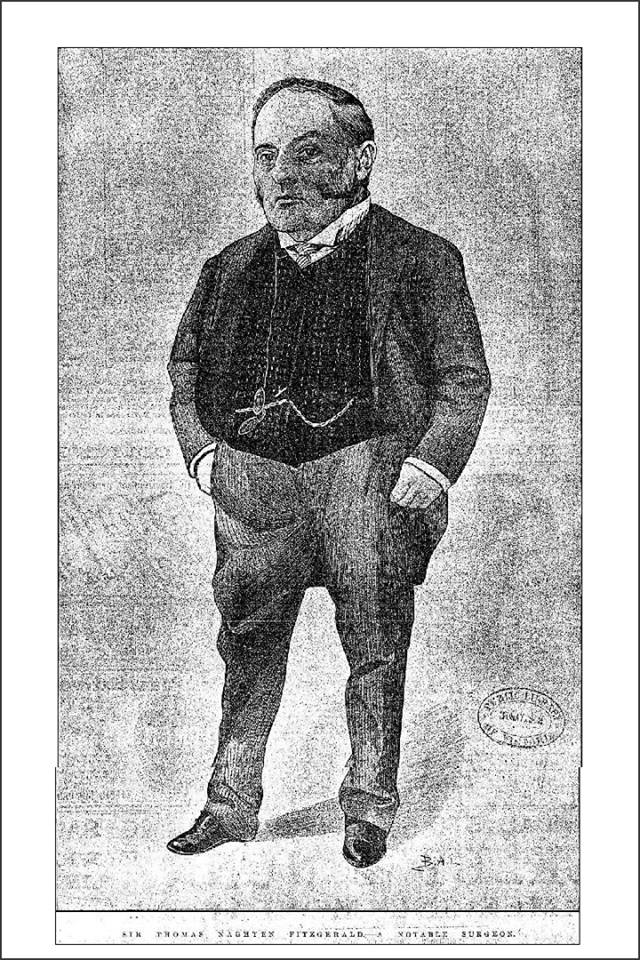
Sir Thomas Naghton Fitzgerald

Illustration of Sir Thomas Naghton Fitzgerald from the Leader 31 May 1902.
Miss Selina Serpell's history (1930) - Extracts
In 1930 the Doncaster Literary Society asked Miss Selina Serpell to prepare a talk on the history of Doncaster. At that time there were many old residents, with memories of the early days, for Miss Serpell to interview.
Even then there were evidently many who were interested in local history, for that night the meeting room of the Athenaeum. Hall was crowded. Miss Serpell was highly complimented on her talk.
Some Interesting Dates for Doncaster and Templestowe
Log Hut Road
Log Hut Road (Now Log School Road), Doncaster, is so called because an early school was held
there 1m a log hut. It was conducted by the Misses Ann and Robina Wilson, probably the daughters of R. Wilson, of Doncaster Hotel, after whom nearby Wilson's Road is named.
From 1967 09 DTHS Newsletter
See on our annotated map
there 1m a log hut. It was conducted by the Misses Ann and Robina Wilson, probably the daughters of R. Wilson, of Doncaster Hotel, after whom nearby Wilson's Road is named.
From 1967 09 DTHS Newsletter
See on our annotated map
Richard & Jane Serpell
Richard Serpell
Richard Serpell. One-time owner and long-standing supporter of the tramway. Studio portrait. He arrived in Victoria with his parents and brothers and sister about 1851. About 1856 his family purchased land in King Street East Doncaster and about 1869 Richard selected about 80 acres of crown land at the south-west corner of Blackburn and Reynolds Roads. In the early 1880s he sold the 80 acres and purchased a property at the north-east corner of Doncaster and Williamsons Roads, part of which is now occupied by Westfield Doncaster Shoppingtown and Doncaster Primary School. Richard Serpell was an entrenpreneur and among his endeavours was the building of the well remembered red brick emporium at the intersection of the last mentioned roads, a major shareholding in the Box Hill and Doncaster Tramway Company, a fruit canning operation, in addition to being an astute property owner and fruitgrower. He died in 1918. Photographer, The Glen Studios, Glenferrie. Written beneath the photo are the words "Richard Serpell our father". DP0307
Jane Serpell (nee Moon) 1812-1901
Jane Serpell established one of the first orchards in Doncaster while living in a rough bush tent, caring for five children.
Jane Moon was born in 1812 and grew up in a small village in Cornwall. She married Richard Serpell when she was 21. They had five children and in 1851 moved to Australia, following Jane’s sister Selina. They settled briefly in Glenferrie. But then Richard was killed.

Mrs Richard Serpell Senior, nee Jane Moon, born 1812. Married 1833. Died 1901
As her two eldest sons, Thomas and Alfred, were old enough to work, Jane moved her family to the place that is now Doncaster where they purchased land. They lived in a tent while they cleared the land and, within three years, had built a house.
Jane worked alongside her sons; they were one of the first families to plant fruit trees in the district. In a single day they planted nearly 350 trees and vines. When Selina was also widowed she joined them with her young daughter.
The farm flourished and life became more comfortable. The boys soon established their own thriving businesses.
Jane died in her sleep in 1901 at the age of 90.
Source: Kay Mack writing on DTHS Facebook page, April 2017
Glenfern: 10 Amberley Court, Bulleen
When the first settlers came to Australia, they built homes similar to those they had known in the old country. The Australian climate influenced two major changes in the appearance of houses. Instead of having bedrooms upstairs to be away from the damp ground, houses here were mostly built on ground level; also because of the hot sun, verandahs were built around the houses. Doncaster has an excellent example of this distinctive style with "Glenfern" in Amberley Court, Bulleen.
Alfred Caldicott, a Senior Government official, built the house in 1856. Unlike the pioneer homes in the district, "Glenfern" was built for gracious living. Caldicott actually commuted to Melbourne every day, walking 6 miles to catch the steam train at Hawthorn.
The house stands on a rise. At the front, steps lead up to a broad verandah surrounding the house. The verandah has interesting corners, and sections creating a "courtyard" atmosphere. At the front, large windows opened onto the verandah, looking across a sweeping lawn to a summer house in the garden.
Sympathetic restoration by its present owners Mr. and Mrs. J. D. Campbell, has retained the original charm while making the home liveable. No longer does it sit in the midst of a large estate, but shrubs and trees surround "Glenfern", thus creating a secluded atmosphere.
"Glenfern" has been classified "C" by the National Trust of Australia (Victoria).
Source: Irvine Green writing in 1969-08 DTHS Newsletter
Glenfern was the homestead of Alfred Millwater Caldecott, and was built in 1858 on his farm which had a long frontage to Ayr Street.
(Sometimes confused with National Trust Property Glenfern East St Kilda).
Subscribe to:
Posts (Atom)