World War Two Rationing

 In June, we had Anne Miller back to remind us of the rationing most of us experienced in World War Two. 

To ensure an equitable distribution of essential items, foodstuff and clothing to all people the Commonwealth Government set up a system of rationing, during the War, beginning in 194 2. As most the thrust was on the war effort many items were in short supply, so a Rationing Commission was instituted in each state of Australia. Coupons in small booklets for one year were provided for each person. The shops cut out the appropriate number of coupons, these were sent to suppliers and then on to the growers or producers. 

The first commodity addressed was clothing on 15/6/1942. 112 coupons were provided for each person. Samples of basic items were 6 coupons for industrial a man's three-piece suit used 38 coupons, socks were 4 coupons, and a lady's outfit of frock, gloves, hat, and shoes was 60 coupons. 

Expectant mothers received a special allocation. Variations were introduced later. 

Food rationing was introduced gradually from July 1942. Malaya had fallen into enemy hands and it was difficult to obtain tea from India and Ceylon so a rationing quota of 1 oz per week was begun or 1/2 pound for 5 weeks. This rationing was in place until 1950. 

Sugar rationing began in September 1942. Greater amounts were allowed during the summer season for jam making and fruit preserving. 

Butter was also rationed from 1943. Most of Australia's and New Zealand's butter was sent to Britain as essential supplies. Australians received coupons for 1 lb per person per week. This was later reduced to 6 ozs per week. 

Rationing of meat caused much controversy. The trade was hostile to the rationing of meat products. Mutton was popular and people made do with rabbits, canned meat and offal. 

Feeding of dogs was difficult and a problem with feeding their lions was experienced by zoo and circuses, due to the lack of meat on the market. 

Transport was greatly affected by the scarcity and the rationing of petrol. Many taxis were forced off the road, and some people put their cars on blocks in garages for the duration of the war. 

People reverted to horse drawn vehicles, the Melbourne "Herald" in particular used these for their deliveries. Gas producers, although dirty and dangerous, were mounted on the rear of many cars, to help alleviate the shortage of petrol problem. 

A black market in silk stockings, liquor, coupons and other goods flourished everywhere. 

People became used to queuing for almost everything they bought. 

However, these privations brought out the best in many people. Australians, always noted for their innovative nature, came up with ingenious ways to make the most what they had. 

Weekly magazines were full of hints of how to make cakes with no butter and no sugar. Meatless meals were tried and clothing was unpicked and remade with scraps of fabric and little touches to make a fashion statement. Brides used pieces of silk parachutes for wedding gowns, and many curtains were sacrificed to make bridesmaids' dresses, for the big event. 

Even long after the war had ended, rationing continued, some items until the 1950's. It had been a difficult time, but the people had survived, and had the satisfaction of knowing that many of our products had been sent to Europe to assist people who suffered far greater hardships than we in Australia.

Source: 2011-12 DTHS Newsletter

From Horseshoes to High Heels - Ringwood Shopping Centre 1858-2008

Richard Carter, Estate Agent and member of Ringwood Historical Society, spoke to our Society in March of the development of the Ringwood Shopping Centre from its early days in Whitehorse Road (Maroondah Highway) to the modern Eastland as it is today. 

The Carter family have been Estate Agents in Ringwood since 1923 when Richard's grandfather established the business. £3.00 an acre was the price paid to Browns for the site of Eastland in 1858. 

Initially Ringwood began its life near the antimony mines near the present Mines Road, about one and half kilometres from the present site. The building of the Railway Station in 1882 caused development of the town to centre nearby and the first shops were erected in Maroondah Highway near the corner of Ringwood Street. 

By 1880 the land was sold for £100.00 an acre and the Grant family purchased some acres. The Grants could be said to be the founders of Ringwood as a commercial centre. In the 1889 land boom, land reached £400.00 an acre, but during the crash in the 18901s could not be sold. 

The Grants ended up with 34 acres which was subdivided into 20 allotments facing Maroondah Highway and 124 allotments at the rear, (later Eastland). The Mechanics Institute and the Methodist Church were built near the front shops. Most shops were built by 1925 and in the next few years little changed in the Ringwood central district from 1929-47 due to the Great Depression and later World War 2. Materials and money were unavailable at this time for major commercial and residential development. 

The Chamber of Commerce in the 1960's decided to purchase the football ground at the rear and lease it for commercial development. The Council were in favour too, and overcame the objections of the owners of the older shops. 

In 1966 Council signed a lease with Eastland Shopping Centre Pty Ltd, of which the Myer Emporium was the largest lessee. Eastland was born and opened on October 31st 1967. 

In the middle 1990's a large redevelopment of Eastland took place with the addition of K-Mart, Big W, a large Food Court, and a Cinema complex with restaurants and a rooftop car park. 

The area had come a long way in the 150 years since the original sale of land and in 2008, the sesquicentennial (1858-2008) took place. Eastland can proudly take its place as one of the foremost regional shopping centres in Victoria serving the needs of the people in the Outer East of Melbourne.

Source: 2011-09 DTHS Newsletter 

Sloyd Room

Sloyd Room


In this issue we feature “The Sloyd Room” which has a long and interesting history and is another of the buildings which started life at another location, the Doncaster East Primary School on the corner of Blackburn Road and George Street. 


Built in 1921 we understand it started life as a shelter shed and with the introduction of Sloyd into the school curriculum; it was converted into a classroom to accom- modate the program. Sloyd was a system of woodwork training, to develop manual skills of boys, that originated in Sweden and was introduced into Victoria in 1900. By the 1960’s Sloyd ceased to be taught and the room was then used as an additional classroom. Doncaster East Primary School was closed in 1997. Prior to that time the building was temporarily relocated and in 1993 was, along with the school bell, relocated to Schramm’s Cottage complex. The accompanying photo- graphs show the building at the complex and the lifting of the building over the fence line during the relocation. The Society’s large display of woodworking tools and models of Finns Hotel, an old mill and others provide an interesting exhibit for our visitors.

Source: 2022-03 DTHS Newsletter

The McCormick Deering Orchard Sprayer

By way of introduction, my interest in vintage orchard sprayers, goes back to my early childhood years. Living on an orchard property in Doncaster, I was always fascinated watching these machines at work in the orchard, and in my later years, this interest translated into the acquisition of six such outfits by different makers in varying states of repair. Three of these have been restored to working order, the most recent being the McCormick Deering illustrated here. 

The McCormick Deering Orchard Sprayer circa 1925 and fully restored in 2009.

Doncaster Hill

Doncaster Hill - Preserving the Hill’s Heritage


"Many who came to Manningham … believed they had found a place to live that embodied the best of both worlds - a country environment close to the city. Doncaster is one of Manningham's gateway suburbs on the municipality's southern boundary, "a cluster of suburban housing crowned by Shoppingtown, a landmark development perched high on a hill" (known today as Doncaster Hill)".
'Manningham from Country to City' 2001, Barbara Pertzel and Fiona Walters

The history of Manningham dates back thousands of years to the Wurundjeri tribe whose way of life was closely linked to the natural environment in which they lived and identified with specific tracts of land in both a physical and spiritual sense.

Orchard Spraying


DP0424  Bave-U spray pump outside John Russell's Spray Machinery Works at Box Hill, together with members of Russell's staff.


DP0820 George ('Beatty') Beavis restoring one of the first motorised orchard spray pumps. 


DP0485  Spraying fruit trees with a Bave-U motorized spray pump. This horse-drawn Bave-U was made at the Russell implements works at Box Hill. Two hoses meant that two men could spray at the same time.


Bave-U Power Sprayer

With the season for spraying the orchard practically at hand, anything in the form of spraying machinery naturally attracted attention. In this connection, Messrs Russell and Co., of Box Hill, had on view the Bave-u Power Sprayer. The single acting model, which is sold for £70, has a three-horse power engine water cooled, fitted with a pulley for general use and easily disconnected. The pump is of the single solid plunger type; and the engine and pump are bolted to the same iron bed.The Bave-u duplex sprayer has two pumps working side by side, and it is said to give a perfectly steady spray. The plungers and all working parts are made of a special metal designed to withstand wear and corrosion Patent ball-jointed eccentric rods are used. The Bave-u 4 h.p. sprayer was also on view.

1914 'BAVE-U POWER SPRAYER', Weekly Times (Melbourne, Vic. : 1869 - 1954), 3 October, p. 40. , viewed 22 Feb 2018, http://nla.gov.au/nla.news-article121114322


Bave-U Motor Sprayer


In 1907 Messrs Russell and Co introduced the "Bave-U" which was the first power sprayer to be used in the southern hemisphere Many orchardists at that times were very much averse to using such a machine the prevailing opinion being that the benzine would blow up when exposed to the sun. Mr Tom Petty of Doncaster, who had 300 acres of trees in one patch was convinced that something better than the hand pump was necessary, and he it was who ordered the first power sprayer to be used in Australia. This he put on his "Bay View" estate at Doncaster, and Messrs Russell and Co's spray pump has ever since been called the "Bave-U" Almost every important orchard in Australia has a "Bave-U" machine, which Messrs Russell and Co claim to be the lightest most powerful, and durable on the market. In support of this they state the first machines they built are still in use and going as well as ever. Their factory, at Box Hill Melbourne is the largest in Australia devoted to the manufacture of spray pumps.

THE "BAVE-U" MOTOR SPRAYER (1916, September 26). Huon Times (Franklin, Tas. : 1910 - 1933), p. 2. Retrieved December 14, 2017, from http://nla.gov.au/nla.news-article135819360


Hand spraying at Schramm's orchard:  Three men spraying fruit trees on Schramm's orchard, using a hand operated pump. One man is pumping the spray with the handle, while two men are applying the spray to the trees. c1890  DTHS-dp0426


The Bave U Orchard Sprayer

The invention of the first motorised orchard sprayer in the early 1900’s did much to revolutionise the control of fungal diseases and insect pests on orchards.
Previously, fruit growers had to rely on hand operated spray pumps, which were heavy and tiring to operate.

So it was that one of Doncaster’s well-known orchardists Tom Petty, asked his son-in-law, Jack Russell, an enterprising engineer, if he could invent some form of motorised outfit that would take the drudgery out of spraying with manually operated pumps. Jack Russell, bom in England, spent the greater part of his life in Australia. He obtained a first class certificate as a steam engineer, but later turned his attention to the application of latent motor power. He first opened a small engineering business in Camberwell under the name of Russell and Duncan, but soon established himself in premises at Whitehorse Road, Box Hill, known as Russell and Co.

In 1908, he produced the first Bave U orchard sprayer, named after Tom Petty’s house “Bay View.” So successful was his invention, that by 1911, there were 108 Bave U sprayers in use in various parts of Australia. Russell employed nine men, and his workshop was well organised. In addition to lathes, drilling and milling machines, there were eight workbenches for specialised tasks, each equipped with its own set of up to date-fools. One complete outfit would be assembled in a day.


Russell and Co’s workshop in Whitehorse Road, Box Hill, circa 1920. Jack Russell in dark suit.  need Image


Most of Russell’s engines for spraying orchards were built to run on two-stroke fuel and were economical to run. One grower stated that it was possible to spray 80 gallons for one shilling and sixpence (150). However these engines could be temperamental and were prone to flooding, if the mixture was too rich (insufficient air with the mixture) which would also carbon up the spark plug. The 3-horse power motor was fast running and maintained a beautifully even pressure in the pump, which was designed to operate effectively at around 300 psi (pounds to the inch). It had a bursting pressure of500 psi. Russell did not use the conventional belt on chain drive to drive the pump, but instead used a system of direct gearing (intermeshing cogs). He also designed and patented a strainer to prevent any sediment from the spray tank entering the pump and ultimately clogging up the spray nozzles. The wooden spray vat mounted on the deck was available in two sizes 80 or 100 gallons, and depending on the size and number of spray rods and nozzles used, it was possible to put out ten loads of spray in a day.

The engine was built so that it would be used for other purposes. By unscrewing a nut, the engine could be disconnected from the pump. One Doncaster grower wrote that he cut 250 tons of chaff with the power of the Bave U engine, that he had ordered a bigger one for chaff cutting and would keep the small engine for his Spray pump.

The Bave U sprayer became very popular* and in time was distributed widely throughout Australia and New Zealand, Russell refined his motors and pumps in later years to make them even more efficient. He designed his outfits with the hilly terrain of Doncaster's orchards in mind. Suspension springs and four-inch diameter steel wheels ensured that they would be transported over the roughest and steepest ground with only one horse needed to pull them, Bave U pumps were used on orchards in this district until the 1950's when they were superseded by more powerful and labour saving air blast mist sprayers that are used in orchards today.
Nevertheless, the Bave U sprayer was the most popular outfit used on orchards in this district for many .years. Most orchardists referred to it as the Russell Spray Pump,
Russell and Go's workshop in Box Hill later became known as Russell Burrows an agency for the marketing of Holden cars.

Source: Eric Collyer writing in 2010-09 DTHS Newsletter


The Ronaldson-Tippett Spray Pump

One of the great engineering icons of bygone days was the firm of Ronaldson Bros &
Tippett Pty Ltd, designers and manufacturers of an extensive range of stationary engines and agricultural machinery.
In this district, they were best known for their orchard spray pumps. I remember these spray pumps being used on the family orchard in the 1940’s.
In 1903, brothers David and Adam Ronaldson built a small workshop on the Creswick Road at Ballarat, and produced their first engine the following year. They registered the name AUSTRAL as a trademark. John Tippett joined the firm in 1905, which then became known as Ronaldson Bros and Tippett Pty Ltd.
Their company soon established a wide reputation as manufacturers of efficient and reliable products including kerosene, petrol and oil engines, chaff-cutters, saw benches, pumps, milking machinery, portable shearing machines and house electric lighting plants. They also made tractors and trucks. The post World War 2, period was a time of great expansion of the company in practically all facets of manufacturing.
The first Ronaldson-Tippett orchard sprayer was designed in the late 1920s in response to demands by orchardists throughout Australia, for a unit that was suited to Australian conditions. Engineers worked in close consultation with leading orchardists in many of the major fruitgrowing areas of Australia in order to design and manufacture the best possible product.


An early Ronaldson-Tippett Sprayer Need image


After the company had assembled their first spray plant at Ballarat, orchardists were invited to inspect, criticise and suggest. Further refinements were made, and the final product was an outfit of outstanding design which gained immediate popularity throughout the Commonwealth.
The Ronalds on- Tippett sprays embodied features of design and construction, not previously seen in other like products. The goal of the company was to produce a sprayer of the highest standard in design, quality of materials and workmanship, well suited to local needs, and capable of maintaining the highest efficiency for a lifetime at the lowest possible cost.
Features of the Ronaldson-Tippett Spray Pump:
  • Totally enclosed engine with automatic lubrication. Other sprayers were generally fitted with manually operated grease cups and oil drippers to lubricate the engine.
  • Engine protected by combined moisture trap and dust cleaner (filter) against spray and dirt.
  • Totally enclosed pump with all working parts running in an oil bath.
  • Propeller type agitator in spray vat to ensure thorough mixed and consistent spray.
  • Travelling wheels independently supported by a double frame and axle to relieve the vat of any strain or vibration.
  • Strong reliable, long life expectation and satisfaction with low upkeep and minimal maintenance requirements.
One of the crowning achievements in the life of the company was the opening in 1951, of a new state of the art foundry, not far from the original site, established in
1903.
Sadly, operations came to an end in the early 1970s for various reasons, and this marked the end of an important era in the manufacture of some of Australia’s most popular and reliable farm machinery products.


Source: Eric Collyer writing in 2010-12 DTHS Newsletter. Eric wishes to acknowledge information supplied by Alan Shepherd in compiling this article.


T

Yarra Riverkeepers

 The Yarra Riverkeepers are a band of enthusiastic people who work together to protect and enjoy the Yarra River. The Association is a community organisation that tries to give the Yarra a "voice”.

Ian took us for a journey via a digital presentation down the Yarra from its source at Mt Gregory, 240 kms from the sea. It begins as a small river which was central to aboriginal life in pre-European days - a source of drinking water and fishing grounds at Yarra Falls a deep gully in the catchment area upstream from Warburton. Lower down, there are rapids at Warrandyte where the rare Powerful Owl can sometimes be found, as well as the . also rare Rosella spider orchid. Lovely views in a very diverse thick vegetation region are found near Fitzsimons Lane in Nillumbik. As we drift down the Yarra, we pass scenes in Heidelberg beloved of the artists of the Heidelberg School, Streeton, and David Davies. The lovely Studley Park boatshed with its restaurant and popular hire canoes is next and Yarra Bend only 4 kms from the Melbourne CBD is home to the indigenous shortfinned eel. Eastern water dragons live in the river at Abbotsford. All the news of the Yarra, though is not good. The native Australian grayling, a food source for the native people in the past is no longer found in the river. The health of the Yarra is suffering from pollution and overuse due to residential expansion.

The riverkeepers have a small boat which takes groups for cruises on the Yarra, testing the water and often just enjoying the ambience of the river the Aboriginals called Birrarung "place of mists and shadows."

Ian Penrose described the general health of the river in the following ways.

First it must be clean and litter pollution, industrial pollution and noxious run-off must be avoided. The banks should be in a healthy state. Animals and excess clearing can erode the banks and cause collapse. A healthy flow is needed to keep the river in tip-top condition.

Ian suggested we can help by becoming sponsors and supporters of the Yarra Riverkeepers.

We can also lobby our local Members of Parliament for better management of the river which flows through the City of Manningham. And most importantly, we can enjoy the river in our district, by walking the paths along its banks, appreciating its unique beauty.

Source: Ian Penrose as reported in 2010-06 DTHS Newsletter


See also: Home - Yarra Riverkeeper Association

Ed Cameron - Truck and trucking legend in Doncaster

Truck and trucking legend Ed Cameron passes on

The man who imported the first fully assembled S-model Kenworths to Australia back in October 1962 has passed away.   Industry icon Ed Cameron passed away on July 16. Australia is mourning one of its most respected trucking pioneers, Ed Cameron, 93, of Doncaster, Victoria.  Cameron passed away at Broadbeach, Queensland, on July 16. Paccar and Kenworth Australia released a statement, saying they were saddened by the death of Cameron, extending their condolences to his family.

While his greatest legacy is undoubtedly bringing the Kenworth brand to Australia, Cameron is also remembered for operating interstate transport company, D&E Cameron Transport, from 1946 to 1970.  His contribution to the industry continued after retirement. Cameron was a generous supporter of the National Road Transport Hall of Fame.  He was inducted to the Wall of Fame in 2002 and became an Icon of the Industry recipient in 2015.   Hall of Fame CEO Liz Martin describes Cameron as ‘one of the nicest, most humble men’ she ever met.   "He really was just a genuine down-to-earth, salt-of-the-earth type bloke. I was really lucky to have him as a friend.  "One of the things that he did was highlight to us that we didn’t necessarily have to have what we were given from Britain – trucks that overheated in the heat and weren’t quite able to handle the heavy loads we needed to cope with our rough roads.  "Ed worked with Kenworth to make sure the specifications were what he thought would suit Australia."

After WWII Cameron and his brother Don bought their father’s 1935 Dodge to cart produce from Doncaster orchards to the Melbourne market. (Their brother Les later joined them at D&E Cameron.)  By the end of 1946 they were regularly carting produce up the Hume Highway to Sydney.  The fleet grew in response to demand, but throughout the 1950s Cameron considered British and European trucks unsuitable for the Hume Highway’s steep climbs and deteriorating road surfaces.  After lengthy negotiations he imported several S Model Kenworths from the USA for the D&E Cameron fleet.

In 1962 long-term employee Peter Cerveri drove one of the company’s first Kenworths.   "Ed Cameron was a lovely man to work for and he listened to you," Cerveri says.  "You could talk to him anytime you wanted if you had a bit of a problem.  "He had a lot of faith in people. That’s why everybody stayed there for so long. We respected him but he respected us as well."  Cameron Kenworth Importers brought more than 100 Kenworths into Australia during the 1960s.  Cameron also operated Australian Kenworth Truck Sales which handled sales and parts.

He sold both businesses to Kenworth’s American parent company in the late 1960s.  D&E Cameron was sold to Mitchell Cotts in 1970.  Since then Cameron’s son Glen has established his own transport company, Glen Cameron Group.

A service to celebrate the life of Ed Cameron will be held at Doncaster Church of Christ, Doncaster, Victoria on Friday, July 22 at 1.30pm. A private cremation will be held earlier.


D&E Cameron Transport operated from 1946 to 1970 at 650 Doncaster Road Doncaster.

Cameron Transport DE Depot Esso service station - 650 DoncasterRd c1964 (From Glen Cameron via Facebook)


650 Doncaster Rd.  Site of Clays House  and later Cameron's Garage. GoogleStreetView 2016


Edwin (Ed) Cameron - National Road transport Hall of Fame

Edwin (Ed) Cameron is one of the true pioneers of the modern generation of road transport. After army service during WW11 he joined the family transport business in Doncaster Vic., which principally transported fruit from growers to the Melbourne markets.

Under the name of D. & E. Cameron involving his brothers Les and Don, they began a regular service to the Sydney wholesale markets initially moving brussel sprouts and then other fresh fruit products and perishables back loading with general freight to Melbourne.

Ed Cameron was always frustrated by the primitive road conditions and the unsuitability of the trucks, principally the British or European brands, which were then on offer. In the late 1950s Ed visited the USA searching for more suitable long distance highway trucks. Finally in 1961 he was appointed the first Australian importer of Kenworth trucks and quickly had them adopted by his own business and major freight operators including Ansett and Kwikasair as well as many logging, heavy haulage and general freight business. Ed imported and sold more than 100 prime-movers before the USA parent company acquired his business in the late 1960s and established their Australian manufacturing and assembly base at Bayswater Vic.

Ed Cameron was also actively involved in transport politics being a founder of the Victorian Road Transport Development Association and served as its president. The Association played a lead role in what led to the Privy Council victory in London upsetting the state road tax charges and severe restrictions on transport operators. Ed has recently published his life's journey and Kenworth experience in a book "First Custom Built Trucks for Australia" - subtitled The Kenworth and Ed Cameron Story. It documents a formative period of road and highway transport as it is known today.

Ed's son Glen, also a Wall of Famer, maintains the family traditions with a substantial presence in transport through the very successful Melbourne based Glen Cameron Transport Group.


On the Road 1: Road scenes and trucks of the 50’s and 60’s

Prince’s Pier, Melbourne sometime in the 1960’s with an R model International behind a line of earlier model Internationals. All of these trucks are loaded with apples or pears from various cool stores in the Goulburn Valley area. The loads are all double tarped and as neat as a pin (an art fast disappearing). I had just started work for D. & E. Cameron from Doncaster around this time and we carried fruit from Petty’s or Tully’s cool stores in Doncaster to this same wharf amongst others.


SourcePeter Morrow. Images from the Peter Morrow Collection


Cameron's Trucking - The beginning

Ed Cameron, a member of one of Doncaster’s early families, spoke to us of his experiences in the district and of his later career in trucking.
As a boy Ed was always interested in deliveries and the movement of goods around the area. He hitched rides with the driver of the milk cart from the Callus dairy and loved to help out at White’s corner store in Doncaster. Chopping wood and delivering oats, wheat, butter and other products to local farms were his favourite pursuits. After a stint in the army in World War II, he returned to the family orchard to assist with sales of fruit.
He identified as a major problem the difficulties of transporting fruit to interstate markets. Railway transport was slow and the rolling stock at the time was aging, so in 1946 started with one truck, a 1934 model, on an interstate trip to Sydney. The primitive state of the road was a problem, and the trip with two drivers took 24 hours. Ed told us of his experience of running off the road into a ditch. There were no service stations and at the time towns were not identified (because of the war). The conditions of the roads meant many punctures and changes of tyres along the way. Ed also initiated the method of carrying fruit in cases with no packaging which was new to the Sydney market. To prevent a return trip with the truck empty they carried rotary hoes back to Melbourne.
The business expanded and Ed and his partner decided to travel to USA to see if they could find a truck with a bigger motor and transmission. To begin with they had no luck in Detroit, but eventually they contacted Kenworth who felt there could be a market for them in Australia. In 1962 Camerons ordered seven Kenworth trucks. Since 1970’s, the Cameron company employed 1,000 people on a permanent basis and many others in subsidiary groups. The three Cameron brothers worked in the business in various roles and later all retired from the company.
We thank Ed for a fascinating insight into the early days of Doncaster, and we admire his tenacity in running a trucking business under sometimes very difficult circumstances on primitive roads and minimal infrastructure.

Source: Ed Cameron as reported in 2010-06 DTHS Newsletter

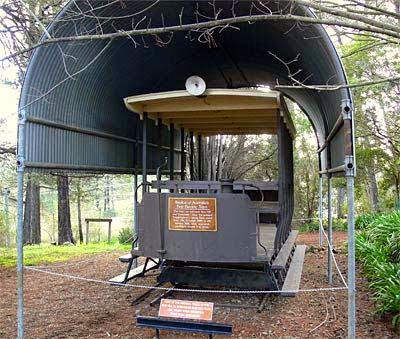
Box Hill - Doncaster Electric Tram

Doncaster Tram

The expansion of metropolitan train services bypassed Doncaster. Attempts were made to get train services, but unsuccessfully. A homemade tourist attraction was the building of a lookout tower in 1877 on a hill beside Doncaster Road. It attracted visitors from the International Exhibition in Melbourne in 1888. The exhibition also featured an electric tram, which became a prototype for a service from Box Hill to Doncaster in 1889. The service lasted until 1896, and tram trips to the lookout tower were a popular recreation.

Source: Extract from http://www.victorianplaces.com.au/doncaster May2017

The Royal Exhibition Building

0n 1 October 1880, the Melbourne Exhibition Buildings were opened. It was a great day for the people of Melbourne who saw it as proclaiming the maturity of the colony. They celebrated, for here was proof of having made it as a nation. Melbourne, a town of only 200 000 had built a magnificent building and invited the world to come and show its wares. Victoria proudly displayed its manufactures and produce. The many halls and temporary buildings housed machinery, manufactures, horticulture displays, clothing, mining, agriculture, farm produce, fruit and dairy produce.


Royal Exhibition Buildings Melbourne 1880 - c Lake (SLV)

George Smith of Bulleen entered a sample of cheese from his farm in Thompsons Road and won first prize.

On 1 October 1980, the centenary of this exhibition was celebrated with Princess Alexandra declaring the one remaining section of the building as 'The Royal Exhibition Building'.

In 1888, the exhibition was repeated, again on a massive scale. Row after row of temporary buildings filled the area north of the main hall right up to Carlton Street.
At the extreme north, running from Nicholson Street to Rathdown Street, an electric tram ran on a demonstration track. When the exhibition closed, the tram with all its equipment was purchased by a newly formed company and became the Box Hill to Doncaster Tram.

Source: 1980 11 DTHS Newsletter


The tram you will see on your visit is a replica of the Box Hill - Doncaster Tram that ran from 1889 to 1896 along the line of Tram Road.


Daniel Harvey and Family

The DTHS Archive includes a number of photographs and documents relating to Daniel Harvey, implement maker.
Documents include Day Book for repairs done by Daniel Harvey at his blacksmith's shop in 1906-1910.
Daniel Harvey's ledger of his blacksmith shop in Lower Templestowe repairing plough shares, horse shoes etc. from 1906 - 1910. The ledger includes the price of the work and the name of the customer.
DTHS Archive dd5JF9
and a photocopy of a document containing advertisements, testimonials and photographs of the Petty two-furrow disc orchard stripping plough. The document is produced by D Harvey, Box Hill, and carries his name, although it does not mention Herb and Frank Petty who originally developed the plough.
DTHS Archive dd5AF2D1 c1934

Waldau Cemetery - Original Death Records

 Access Original Files

Death Records held by DTHS that need to be located and scanned:
  • John Thiele 15th January 1868
  • William Snell 3rd February 1868
  • Joseph Pickering 12th May 1870
  • William August Zander 16th September 1870
  • Eliza Jane Piggott 20th September 1870
  • Carl August Froebel 29th November 1884

Deat records that need transcription

Note: These records are not usually referred to as "certificates".

Doncaster Templestowe Proclamation 1967

PROCLAMATION OF CITY AND NOTICE OF FIRST MEETING OF THE COUNCIL OF THE CITY OF

DONCASTER TEMPLESTOWE

FEBRUARY 28th, 1967

Municipal History

  • 1856 Proclaimed a District (Templestowe Roads Board)
  • 1875 Constituted as Shire of Bulleen
  • 1890 The Doncaster Riding severed and created Shire of Doncaster.
  • 1892 The remainder of Shire of Bulleen renamed Shire of Templestowe.
  • 1915 The Shire of Templestowe was reunited with Shire of Doncaster as the Shire of Doncaster.
  • 1926 The Shire was re-named Shire of Doncaster and Templestowe.
  • 1967 Proclaimed a City.

Massey Harris Pacemaker Tractor - 1934 Model


Michael Thiele driving the Pacemaker Tractor at the Thiele Property in Doncaster. Circa 1950s

The Massey Harris Pacemaker Orchard Model was built in 1934.
It was assembled at H V McKay, Sunshine, and purchased by Alfred Thiele. It was driven from there to Alfred Thiele’s property “Friedensruh” in Doncaster.

The cleats, or spikes, were removed from the rear wheels to prevent damage to the roads, and bolted back on arrival at the “Friedensruh”property.

The Massey Harris Pacemaker Tractor, 1934 Model was one of the first tractors in Doncaster.


Peter & Michael Thiele servicing the 1934 Pacemaker Tractor at the Thiele Orchard in Doncaster, Circa 1950s


Massey Harris 44K, 2nd Tractor purchased by the Thiele family for the orchard at Doncaster


It was in 1965/66 when the orchards of Doncaster were subdivided and the tractors and equipment were moved down to the Thiele Orchard at Main Ridge on the Mornington Peninsula.


2021 Restored 1934 Massey Harris Pacemaker at Main Ridge


2021 Michael Thiele aged 93 and Lawrence Thiele with Restored 1934 Massey Harris Pacemaker at Main Ridge


Fig. 6 2021 Gathering of family at Jonathon Thiele’s property at Main Ridge


2021 A great moment. The restarting of the restored 1934 Massey Harris Pacemaker tractor.  Michael Thiele at the wheel.


Source: Elizabeth Seward (nee Thiele) and Chris Thiele, 2025


Massey Ferguson


Massey Ferguson is an agricultural machinery manufacturer, established in 1953 through the merger of farm equipment makers Massey-Harris of Canada and the Ferguson Company of Ireland. It was based in Coventry then moved to Beauvais in 2003 when the Coventry factory was shut down.

The company's early tractor models included the 20 horsepower Massey-Harris GP 15/22 (1930–36),[11] 25 horsepower 'Massey-Harris Pacemaker' (1936–1939),[12] 35 horsepower Model 101 (1938–1942),[13] Massey-Harris Pony, Model 20, Model 81, and Model 744.

Source: Extracts from Wikipedia as at Oct2025


Massey-Harris Pacemaker

Massey-Harris Pacemaker
1936 - 1939
Standard-tread tractor

Manufacturer Massey-Harris
Standard-tread tractor
Built in Racine, Wisconsin, USA

The Massey-Harris Pacemaker replaced the Wallis 12/20 in Massey's line. The Twin Power feature increased engine rpms to provide additional horsepower for belt work. The Pacemaker was a standard (wide) front tractor, while the Challenger was the row-crop version.

Mafeking Day at Doncaster - June 1, 1900 - Enthusiastic Celebrations

The celebrations here took the form of a monster procession from the Athenaeum to the Recreation Reserve and back to the hall. The Street was lined with onlookers; every person either carried a flag or wore colours suitable to the occasion. Arriving at the Reserve the President (Cr E Lawford) delivered an excellent address bearing on “the now famous siege”. The wife of the President planted two commemorative trees in the Reserve. A gigantic feast was partaken of in the Athenaeum Hall and from 5 o’clock until half past 7 an impromptu concert was held, followed by free Patriotic Entertainments arranged by the committee. The hall had to accommodate over 500, packed in like sardines but without complaint. A social hop till midnight followed. All the arrangements were in the hands of a committee. Cr Lawford, Crs Zerbe, Crouch, Pickering Finger and Stutt. Mr F.H. Thomas (Shire Secretary) and the local head Teachers Messrs Goodson and Craig.

 Source: Camberwell and Hawthorn Advertiser quoted in 2004-03 DTHS Newsletter


DONCASTER. (FROM A CORRESPONDENT.) Mr. H. S. Hollow, B.A., now reader-in-charge of the Ringwood district, was, on his leaving Wallan Wallan, presented with a travelling bag and prayer book by the Merriang Church; with a tennis racquet by the Wallan Railway Tennis Club; with a pair of gold links by the Bible Class in the State School of Wandong, each present being suitably inscribed; and with a Master of Arts hood and gown by the congregation of St. John's, Wandong. On the holiday of Wednesday, 23rd (Mafeking Day), a procession in keep-ing with the day left the Athenæum for the Recreation Reserve. Heading the procession were the characters " Britannia" (Miss A. Sykes), "Old King Neptune" (Mr. V. S. Hollow), his Queen " Amphitrite" (Miss Irene Plumb), with their bodyguard of horse-men. Then come the members of the three Lodges, the two brass bands, and the two State schools, all in regalia. After the picnic the evening was en-livened by a patriotic concert. A collection being made in aid of the Melbourne Hospital amounting to £15.

Source: 1900 'DONCASTER.', Evelyn Observer, and South and East Bourke Record (Vic. : 1882 - 1902), 1 June, p. 2. (MORNING.), viewed 05 Oct 2025, http://nla.gov.au/nla.news-article60688099


DONCASTER SHIRE COUNCIL.
Needs ProofReading

This council's adjourned monthly meeting was held at the shire ? bail, Doncaster on Thursday evening, November 21. Present : — Crs. MciNamara (president), H. C.ay, Duxson, ' 'fully, Mitchell, and P. C. (Jlay. Allied Victory. Prior to business being proceeded with, the president referred to the

termination of hostilities tic the war, and moved the following resolution : — 'That this council place 011 record an expression of its heartfelt gracitude and joy at the signing ol the armistice, which practicahy means the reesuiljlishment of peace.' — The inocion was seconded by Or. H. Clay, supported by Crs. P. Clay, Tully, Mitchell, and Duxsou, and carried by acclamation. Corresnondence. From state recruiting committee, stating that in view ol' the cessation ui recruiting, it desired to express its unqualified and sincere thanks to the loyal committee for the unfailing, loyal and effective help rendered to the recruiting movement. — Received. From shire of Melton, requesting ..xiinnil f.r* nnnncn cf'liorl 11 lo nf

of - widths ot tyres act. — Cr. H. Clay moved that the council support the movement. He maintained it was not the time for experimental legis.ation of- any sort in connection with the producers of this country. Recently, he had had to pay 35/- for one tyre, and if some of those in the shire had to alter all the vehicles' in their yard it would mean a big cost. At present it was absolutely ridiculous, and he contended that the motor traffic did much more damage to the roads than horse drawn vehicles. — In seconding, Cr. Mitchell agreed that it would place another burden on the producers, who should not be harassed at the present time. — The motion was supported by

Cr. Tully, and the president, and approved of.From From G. T. Knee, East Doncaster, applying for hire of load grader for few days to form up _some tracks. — Granted, and left in hands of preside ug to fix the charge, on motion of Crs.

A Uil.y (IUU JL . VyllfcJ . From Jas. Cashen, Jemplestowe, olfering to again lease reserve at Lower Tempiestowe for next six months at 3/7 pel week. — Cr. Duxson, in moving that the lease be renewed, thought it a good idea to keep the grass down, and thus obviate the danger of lire. — The president seconded. — Carried. From postal department, notifying intention to erect telegraph poles in Williamson's and Mauningham roads. — At the instance of Crs. Xully and H. Clay, engineer to have power to deal with similar notices in the -future. From Automobile club of Victoria, with reference to request to provide warning notices for Doncaster East Methodist chuich, advising that their stock of church signs had run out, and it is not intended to order a further supply, in the circumstances the club regretted being unable to comply with the request.— Cr. H. Clay moved that the club be again written to, making a further request for the notices to be supplied, as the motor traffic was very annoying to those attending church services. — Seconded by the president, and agreed to. From town of Kew, requesting coun

cil s support to re-election ot Cr. Jxellett-as representative on hie brigades board; also from borough of Sandriugliami soliciting support for Cr. Ferdiiiando. — The president moved that Cr. Kellett's candidature be supported. — Cr. H. Clay seconded.- — Carried. From Doncaster Junior football club, thanking council for use of recreation ground for past season. — Received. From Royal Life Saving society, asking if council is agreeable to attend, a demonstration of joiethods of resuscitation taught by the' socioiy. — Reply to be sent suggesting that demonstration be given at a public meeting or entertainment in Doncaster in lieu of to councillors only. From department of lands and survey, forwarding proposals for amalgamation of matter of destruction of noxious w'eeds with the vermin destruction branch. — Secretary Simmous stated that the act was not enforced in this shire. Council's allocation of cost under the new proposal would be about £90 a year. — To lie on the table till

uuau moo lij 1 1^. From T. Hodgson, Lower Tempiestowe, ilia wing attention to furze aud briars on road and property adjoining him, which were a menace owing to fire. — Several members considered that the sooner the thistle act was made to apply to the shire the better. — Left in hands of Tempiestowe members. From city of St. Kilda, enclosing resolution relative to the retention of the German Pacific colonies. — Action to be supported, on the motion of Crs. Tully and H. Clay. From Dayman H. E. March, Warrandyte, applying for an increase in wages to 9/- per day. — Request to be considered with the estimates. From public health department, forwarding leaflets on influenza, and requesting that council have posters and leaflets drawn up on advice of officer of health and distributed within the municipality. — Referred to health officer. Reports. The secretary (Mr. R. A. Simmons) reported collection of rates, etc., totaling £80/16/6; and electric lighting fees £21/17/6. A list of outstanding rates had been prepared. Cost of spreading metal and gravel on Heidelberg- Warrandyte road this season was £11/11/8. Quantity of material put out was 684i yards metal, 250 yards blinding gravel, 315 yards coarse gravel, in addition to what was left over from previous year. Above cost includes rolling. Last year, £119 a/7 ? '

Treasurer J. G. Robinson reported receipts for month £81/5/2, leaving an overdraft of £742/13/9. Electric light account — Receipts, £21/17/6; overdraft, £641/9/3; country roads board fund — Overdraft, £207/5/8. — Received. Engineer R. A. Simmons reported : — Doncaster riding. — Since last meeting very little work haB been completed, Foreman Geraghtar not being, able to work full time, Hardidgo being laid up with influenza for a couple of weeks, and Bloom leaving the employ of the council last month. Repairs to Park hill were completed ; Evans'' hill job taken in hand, and will bo completed next week. Footpath on main road from Pettv's lane to Mr. Geo. Petty' s crossing has been cleaned up. Ruts on Whitten's lane and Frederick street have been attended to. Tempiestowe riding. — Repairs have been effected to Bulleen road, Thompson's road, High street, Serpell's road, and Jumping Creek road; furze, etc., cut in reserve. The men ar© now repairing Webb street, Warrandyte. Ra fnnf,hrir?orA rmnr WarratifTTrfrv

creation ground. — Recommended that this be reconstructed as a suspension bridge on wire cables. Necessary cables can be purchased for about £1 from Mr. Kruse, of Warrandyte. By doing this, span of . new bridge can be' considerably increased, and no trouble will' be caused by future erosion of the banks of the creek, which show signs of further carrying away. It would also! be a cheaper construction than timber. --Mr. Webb had offered to pay half the .cost of cartage of any soil ploughed from sideB of main and Blackburn roads adjoining his property. If this does : not I meet with council's approval, ma-, terial might well be used to make up a 1 footpath on south side of main road along Mr. Webb's property. This would be a short lead, and the two purposes of improving the roadwnv and constructing the path would bp effected. _ Country roads board. — Doncaster riding: There has. been no work on the /.

main road since last meeting. Tem- 11 plestowe riding: Maintenance metal 11 lias been spread and blinded on the If Warrandyte-Riiigwood road. On War- B randyce side of Xortice's hi l some B metalling was done in addition to that jj provided lor by contracts last let. m Spalls obtained from cutting near by g being brokeu down. Same material fs' was also used for metalling in places p

011 the deviation. Arrangements are g| bting made for a joint inspection of If Warrandyte-Kiugwood road re culverts B and drainage of road through War- p randyte township by one of the coun- te try roads board engineers and himself, fc alter which a report will be submitted. —Adopted. H Cr. Tully reported that the electric P lighting committee had agreed to the p tightening of wires, and t-lic securing fe of a double set of fuses for the trans- p termers. This would help to make the «§ light more loiiable, aud would only |§; cost about £7 or £8. He moved that p the council adopt the action of the || committee in having the work attended p to. — Seconded by Cr. H. Clay, and ap- tgj proved of. H The valuer I Mr. J. R. Hunter) re- H ported having completed a supplement- li ary valuation of the Tempiestowe rid- .? ing, and the increases made would 011 I a i/6 rate bring in an additional £45. — |§ the report was received. B General. B Referring to the recent war loan ffi campaign, Cr. 'l'ully said that a good IS deal ot its success was attributable to || Mr. Grover, a returned soldier, who R had canvassed the Doncaster riding. B The committee had agreed to ask the H council to give him a letter of appre- p ciation, which would be useful to him, fi as he had lost an arm in the war. He p

had carried out his duties in a courteous, industrious and satisfactory uiauuer. Messrs. Lawford and Reynolds had acted on the committee with him lUr. Tully), and had also ? worked hard to bring about the success of the loan. He moved that a letter, under council's seal, be presented to Mr. UrTlver. — The president, in seconding, said that it was pleasing to him that the loan had been so successful. He had also to thank the committee which had acted with him in the Temp^stowe ridiug. Cr. Mitchell iiad put forth good elforts in Warrandyte; whilst Cr. Duxson had canvassed the lower portion of the riding at his own expense. Thanks were also due to Messrs. Albert i'etuy and Alt'. Chivers, both of whom canvassed the eastern portion ol the district, and handed the commission over to the local Red Cross. — Cr. Duxsou said he was only too pleased to do a.l he could, as the money was needed. — Cr. H. Clay supported the resolution. The Doncaster committee could not have got a better uiau tliau All-. Glover. — Cr. Mitchell thought that the shire secretary was also instrumental in getting a lot of money in. — Cr. if. Clay said it was due to Mr. Grovel's hard work that they had succeeded in raising such a large amount 01 money in the shire, and he should be congratulated ou the result. The council could uot do anything better than present him with an appreciation ol his services. — Motion carried. Cr. 'i'uliy stated that the shire hatl won the honor flag in the war loan, but they had no place to liy it from. The shire hall building required some reno

vations, aud renewal in iront to provide for a flagpole. — it was agreed to it-ave the carrying out ol' the necessary improvements in the hands of the secretary. A coat of metal was ordered to be spread in front of Mr. Smith's engineering establishment, on the motion of Crs. H. Clay and Tully. Cr. P. Clay said he had been informed the Park bridge was in a bad state of repair. He moved that the engineer inspect to ascertain -,whai is required, and report to uext meeting. — Cr. Tully seconded. — Carried. A11 application by J. Hardidge for an increase in wages from 8/- to 9/per day was granted on the motion 01 Crs. P. Clay and Tully. . The president moved that the increase asked ' for by H. March be granted. — Seconded by Cr. Mitchell, and agreed to. At the instance of Cr. Mitchell, the secretary is to again interview Mr. Flood in connection with Mr. Atkins' outlet at Warrandyte. Cr. Duxson said that in High street, Tempiestowe, about 10 chains of road should be gravelled. It was the main

road from iemplestowe to Done-aster, which was almost impassable in winter time, and really wanted forming. — Work to be done. The president mentioned that in several shires they were having a sports day to celebrate the signing of the armistice. He asked for the opinion of the oouncil regarding the holding of a similar gathering to impress on the minds of the children the significance of the gathering. - He questioned whether it was advisable to wait until peace is declared, and the government proclaimed a holiday. — Cr. Tully said that Doncaster as a shire had three different centres, and it would be difficult to hold a combined demonstration. After the relief of Mafeking, Doncaster held a picnic on the recreation ground, in which the two schools took part, with an entertainment at night. He favored waiting a little while till the government declared a national day. — Cr. P. Clay supported that course, and the holding of a picnic. — The president thought they should make it a whole shire effort, aud form a committee in each centre. — After further discussion, it was decided to leave the matter in the handB of the president and secretary, to call the council together if necessary.

Source: 1918 'DONCASTER SHIRE COUNCIL.', Camberwell and Hawthorn Advertiser (Vic. : 1914 - 1918), 29 November, p. 2. , viewed 05 Oct 2025, http://nla.gov.au/nla.news-article153117494


Independent Order of Rechabites

The Independent Order of Rechabites (IOR), also known as the Sons and Daughters of Rechab,[1] is a fraternal organisation and friendly society founded in England in 1835 as part of the wider temperance movement to promote total abstinence from alcoholic beverages.[2] The Order has been active in Australia from 1843, promoting temperance and as a benefit society. A branch was established in the United States in 1842, and also flourished for a time. In the United Kingdom, the Order trades under the name of Healthy Investment, being well connected in upper society and involved in financial matters; there it gradually transformed into a financial institution which promotes teetotalism.

History

A 1908 Independent Order of Rechabites certificate for the instatement of a member as Deputy High Tent Chief Ruler

The Independent Order of Rechabites was founded on 25 August 1835 as the Salford Unity of Rechabites, in the city of Salford, Lancashire, England.[3] Their first lodge was "Tent Ebenezer #1" and soon "tents" were founded for adult females (over the age of 12), boys (aged 12–16), and for children of both sexes (age 5-12), as well as other adult males (age 16 and up.)[1] In describing the heritage of the Independent Order of Rechabites, a circa 1892 newspaper in Leeds said:[4]

If any order in the world has a claim to call itself an Ancient Order it is that of the Rechabites. As we learn from the Scriptures, a command was laid over 2,700 years ago upon the sons of Jonadab, the son of Rechab, that they should drink no wine, neither they nor their sons forever; and the injunction has been obeyed to this day. At various periods in modern history have travelers come upon the lineal descendants of these Rechabites of old, in Spain, in the districts visited by Dr. Wolff, and in the neighborhood of the Dead Sea, still adhering faithfully to their total abstinence principles. Other orders may claim the questionable honor of being founded by extremely mythical personages, but the Independent Order of Rechabites, if it cannot prove an uninterrupted kind of apostolic succession from Rechab, can show that it has at least a continuity and similarity of aim that effectually connect it with the Rechabites of old. The promise of Jeremiah that for their faithfulness in adhering to the command of their forefathers they should not want a man of the house of Rechab to stand before the Lord forever has literally been fulfilled. There is no break in the chain, and for nearly 3,000 years a living testimony of total abstienence has been upheld on the earth.[4]

The rituals and ceremonies of the Rechabites vary from place to place but the order promoted three degrees, Knight of Temperance, Knight of Fortitude, and Covenanted Knight of Justice. Lodges are called tents because Jehonadab (or Jonadab) commanded the Biblical sons of Rechab to live in tents[3] (Jeremiah 35:6-7) and the governing body, in England at least, was called the Movable Committee, meeting in a different city every two years. Membership remains open to all who would sign a pledge to completely abstain from alcohol except for religious or medical purposes. There were also death and sickness benefits.[1]

From the late 18th century a number of Friendly Societies had been set up to help working-class people with such things as health insurance and death benefits. Generally these societies held their meetings in pubs. In the 1830s a group of Manchester Methodists became concerned that by encouraging working men to attend public houses to pay their friendly society dues, then the societies were harming the men's health and financial situation and threatening their moral welfare, rather than helping them. To counter this they set up a new Friendly Society called the Independent Order of Rechabites, named after the nomadic, abstaining Rechabites of the Old Testament. The IOR were an offshoot of the Calathumpians, then a diverse collection of social reformers of independent religious views.[citation needed] The organization was still active in the middle 20th century; Sir David Cannadine (British historian, born in Birmingham in 1950) described in 2019 attending a Rechabite meeting with his grandparents who were members.[5]

A branch may be known as a "Tent", since the biblical Rechabites lived exclusively in tents. Each Tent is ruled by a High Chief Ruler, assisted by a High Deputy Ruler, Corresponding Secretary, Sick and Tent Stewards, Inside and Outside Guardians, a Levite of the Tent and a number of Elders. Before one could join the Rechabites and benefit from their insurance and saving scheme a document has to be signed swearing that the proposed member and his family would not drink any alcoholic beverages. This document is known as The Pledge and represents a solemn promise. The initials "IOR" on a tombstone may indicate that the deceased was a member of the organisation.[citation needed]

The Victoria District of the Independent Order of Rechabites currently has 17 Tents and 5 Regions, while the Queensland District of The Independent Order of Rechabites currently has four Tents and two social committees.[6][7]

Australia

In Australia the IOR was first established in Tasmania in 1843, soon spreading to other states. Members of the IOR were provided with assistance during times of sickness, death and hardship.

IOR was active in Victoria and in 1876 it established 'Tent' 138 in Bung Bong rural Victoria.[10][11] The Building was also used for community purposes including meetings of the 'Farmers Club'[12] and as a Church of England.[13]

In 1991, IOR Victoria combined with the IOR in other states to form a national private health fund. Members wishing to join IOR's health fund were no longer required to sign a pledge of abstinence from alcohol.[14] In 2005 the IOR health fund was sold to HCF Health Insurance, and the rest of the organisation continued as a temperance promoting organisation. In 2008, 38.5 million dollars of its funds management was transferred to the Foresters Friendly Society.[15] As of 2024, the Independent Order of Rechabites retains a state branch in Victoria, with a number of affiliated tents.

Source: Wikipedia as at 4Oct2025


Victoria Rechabites

The Victoria District No. 82 was established in the 28th January 1861 with the transfer of Star of Australia Felix Tent No. 4 of the Tasmania District  and Mount Alexander Tent No. 9 of the Tasmania District. 

The Victoria District of Rechabites (District No. 82) was established in the 28th January 1861 with the transfer of Star of Australia Felix Tent No. 4 of the Tasmania District (which was established in Melbourne on the 25th January 1847) and Mount Alexander Tent No. 9 of the Tasmania District (began in Castlemaine on the 26th January 1860).

These two Rechabite Tents went on to become the first Tents of the new Victorian District with the Star of Australia Felix becoming Tent No. 1 and Mount Alexander Tent being Tent No. 2. It is interesting to note that Star of Felix Tent No.1 still meets today and is the oldest surviving Rechabite Tent of any Friendly Society in Australasia.

It is also interesting to note that from Victorian District, the South Australian District, known as Albert District No. 83 was formed on the 17th February 1865, and New South Wales District No. 85 was formed but the foundation collapsed and was reformed six years later on 24th September 1884. Also from Victoria District, Western Australia District No. 88 was established on the 29th January 1872 and the Queensland District No. 87 was established on the 18th May 1872.

In its heyday the Victoria Rechabites’ membership numbers grew and grew to the extent that there were at one stage in excess of 36,000 members associated with the Victorian Rechabites in the late 1800’s to early 1900’s covering approximately 250 operating Tents.

Sadly this is not the case today as with age and infirmity, membership has declined to the level that there are now only 700 registered members here in Victoria who endeavour to keep the Rechabite ideals and traditions alive by attending the regular quarterly Tent and Region meetings held. Certainly we have had some new members sign a “Pledge” agreeing to abstain from drinking alcohol, but not enough to make an impact on membership numbers.

As of now there are 17 tents and 5 Regions of the Victorian Rechabites still actively operating today upholding the ideals of an alcohol free lifestyle.

In 1920 the decision was made to purchase a building to house the Victorian Rechabite operation. This building still stands today and is directly diagonally opposite the Victorian Markets in Elizabeth Street Melbourne.

Even though each State had its own benefit funds, in April 1991 the States merged their health funds and under the National Health Act registered its own health fund known as IOR Australia Pty Ltd and this operated successfully until 2005 when it was taken over by the Hospital Contribution Fund, more commonly known as HCF.

In 1986 / 87 the Victorian State Board made the decision to purchase 25 acres of land in Wantirna to create a retirement village for Rechabite members with accommodation in 2 bed room units as well as 120 bed hostel and 30 bed nursing home accommodation. This village was somewhat of a first here in Victoria, where all three levels of accommodation were available on the one site.

However as the years progressed, in 2001 all State based organisations merged into one National body based in Melbourne when the IOR Friendly Society Ltd was formed, and when further Government legislation was pressed upon us in August 2007, the decision was made to demutualise, and a new organisation known as IOR Group Ltd was formed. The new organisation however had no provision for fraternal activities and it was necessary for those States who wished to continue in their own right could do so with a financial grant as part of the demutualisation process, and from this the Independent Order of Rechabites Fraternity (Victoria) Inc. was formed.

During 2011 the Victoria Rechabites helped celebrate the 150th anniversary of the Rechabite Fraternity with celebrations being held around the State at Tent and Region meetings and as mentioned above that the membership has declined, there are still 17 Tents and 5 Regions still actively operating today.

The Victorian Fraternity also have and maintain connections with the Dalgarno Institute (Coalition of Alcohol & Drug Educators), Melbourne Total Abstinence Society, Women’s Christian Temperance Union and more recently the National Alliance for Action on Alcohol.


Independent Order of Rachabites Salford Unity Victoria District No82 Tent No129 1905 James Sell Signatories: FW Kruger; HJ Gunner; W. Bell; John Tully; R Toogood; LH Smith


Park Orchards - A Short History - Green & Beavis (1983 Reprinted and reformatted 2008)


The POLCI or Park Orchards Learning Centre Inc recently held the launching of their new history "Park Orchards, The History." This attractive little booklet is a combination of material gathered by Irvine Green and Beattie Beavis, both now deceased. It was published in 1983. More recently Judy Haley, manager of the Centre, felt that the original booklet, needed bringing up to date, and contacted our Society, with a view to collaborating to form a new booklet. Judith Leaney met Judy Haley, early in 2008 and they worked together to formulate the latest booklet. With a Community· Development Grant from Manningham City, the volume was produced. Groups in Park Orchards were approached by Judy Haley to contribute material on their activities to form part of the booklet. Many did, and with attractive colour photographs, the result is a series of cameo sketches of interesting people in Park Orchards who have added colour to the area. Also churches, sporting groups and service clubs which have played a large part in forming the vibrant community of Park Orchards contribution to the booklet. We are pleased at the republication of our booklet which is now out of print in its original form, and are very happy to add it to our list of publications, available for sale at Schramm's Cottage. 

Source: 2009-06 DTHS Newsletter


The Beginnings 


For many years only occasional herds of grazing cattle moved through the virgin bushland that was to become Park Orchards.  It was poor grazing country as the hills were heavily timbered with wattle, stringy-bark, box, messmate and peppermint gums. Open areas held patches of grass in which wild flowers and native orchids grew. Kangaroos and wallabies wore tracks through the bush. Echidna and wombats hid in the undergrowth, silver possums swung among the trees and bandicoots were seen by keen eyed bushmen. This was beautiful country and in the 1870's came to be called The Park.

In the 1840's, the district around Warrandyte contained many large grazing runs. In 1838 James Anderson established a sheep station on the Yarra in Warrandyte. His grazing run included the area that is now Park Orchards. On the east James Dawson took up a run of ten square miles for his cattle and on the west Rossiter had a licence for eight square miles. James Anderson left the district so, in 1852, Major Charles Newman leased a large area that included The Park. The Major was the largest landholder in the district. His homestead "Pontville" was by the Yarra at the junction of Deep Creek. During these early years many settlers were thankful to work for Major Newman while waiting for their farms to produce.

During the 1850's, land in Warrandyte was sold in sections of one square mile for one pound an acre. Thomas Stinton, Francis McDonnell, Charles Heape, Mark Marks and Euphemie Falconer purchased the land that become Park Orchards. Many land buyers were only interested in a speculation but Stinton and Falconer had come to Australia to settle on the land.

Stinton came from an agricultural village in Suffolk, England, arriving in Australia with his wife and family in 1847. He was an assisted migrant, and on arrival was assigned to work for Major Newman at £ 35 per annum plus rations. After buying his 640 acres, he sold the northern part to William Harris, and farmed part of the southern area till his death fifteen years later. After his death his family lived on in their mud hut and worked the land for ten more years, then they sold out to Thomas Dowd.

Bush Tracks in the Park 1856


In the 1850's, there were two lonely huts in the Park Orchards area and a stock yard on the site of the present Park Orchards Primary School. Bush tracks wound through the trees. One track led up to the Andersons Creek gold fields and the other travelled east to the old settlement of Brushy Creek and Lilydale. In 1860, a constable chased a gold bandit along one of the tracks. The bandit was later arrested in the bar of the Doncaster Arms Hotel.

Much of South Warrandyte was sub-divided in 1856. It was taken up by settlers and within a few years a community of ten farmers were living on the Ringwood Road. Settlers with names like Tortice, Falconer, Spiers and Dickson. They soon found that the land was ideal for fruit growing and eventually the eastern area was covered with fruit trees. Russell, Colman, Stewart and Kendal settled there.

Henry Crocker bought 718 acres, the main section of Park Orchards, and called his estate "The Park", but the land remained virgin bush. During the land boom of the 1880's, one of Melbournes most notorious "land boomers", J.B. Davies of the Mercantile Bank, bought up Park Orchard land. By 1889, he owned over 2,500 acres, the whole area of the present Park Orchards postal district.
At the time land prices were soaring. Speculators were buying land and selling it within a few months, often at more than double the price. Some, such as Davies, bought recklessly on borrowed money. When the crash came in 1892, J.B. Davies became bankrupt. After the turn of the century, Melbourne recovered from the depression and gradually the Park Orchards land was sold once more.

Tom Petty's Orchard 


At the beginning of the new century a large orchard was planted at the Park by Tom Petty of Doncaster. The Petty family had been one of the early settlers in Doncaster. Tom had come out as a thirteen year old boy in 1858. He grew into a capable, energetic man becoming the most successful orchardist in the district.

Park Orchards was Tom Petty's most ambitious project.  In 1902, he obtained a loan of £8000 from the bank and he and his wife Eliza purchased 559 acres at The Park. The land was covered with trees and scrub, which had to be cleared before fruit trees could be planted. Petty hired men, supplied them with tools and a jack, and paid them £2 - 10 - 0 an acre to clear the trees.

Tom Petty inspired confidence. He worked with determination and enthusiasm. On monday mornings, he would load a cart with men and tools and set out for a week's work, camping in the bush. Four years later, Petty's fruit trees had been planted. It was a large scheme with eighty orchard blocks on the slopes of the Park. Rows of pine trees were planted and some areas of bush land left as windbreaks. Ten dams were scooped out to supply water for the young fruit trees during the hot summer weather and, near the group of houses, a bore was sunk and a windmill erected. In the north east corner, a fifteen acre paddock was fenced off for the many horses required to work the orchards.

Park Road was continued through the Park with pine trees planted either side. The road became a beautiful avenue winding through fields of trees that were covered with blossom in the Spring, and glowing with coloured leaves in the Autumn,

Park Road in 1920

On the west side of Mullum Mullum Creek, the road leading to Mitcham, went straight up a very steep hill. Horses found it difficult to pull a cart load of fruit up the hill. Tom Petty bought a strip of land to widen the road so horses could zig-zag up the hill. The first road on the Park side of the creek was washed away by heavy rains. Another road was cut further to the side, leaving a wide strip of land unused. This is now Alan Morton Reserve.

One of the men who worked for Tom Petty was his nephew, Jim Mitchell. Mitchell bought a one hundred acre block on the north of Petty's land where he built a house and cleared a road from the orchards into his land. This road was the start of what is now Knees Road. In the late 70's, this land became officially known as "The 100 Acres". Tom Petty's son, Frank also worked on the orchards and lived in the house later owned by William Domeney alongside the service station in Park Road.

Tom Petty purchased four weatherboard houses in Richmond and moved them to the Park for the men who worked on his estate. The first house was erected for Harry Brown on the corner of the present Alva Avenue and Park Road. Harry had come from Doncaster where his father lived in Church Road.

The families of The Park a small community, Their children were fortunate that a school was built at South Warrandyte, but thick bushland separated them from the school.  Harry Brown cleared a way to the school by blazing a trail of axe marks on the trees for the children to follow.  The South Warrandyte School started in 1902 using two rooms in the Colman's house. Five years later, a school building was erected in Hall Road. During the first years the children came from the Milne, Zoch, Tortice, Brown, Mitchell, Colman Johansen and Porter families. In 1923, another school started
to serve the Park Orchards area. A one room school was built in Oban Road on land given by W. S. Williams Jnr.

Tom Petty lived an active, successful life. By the time he was 68, he had bought and developed orchards on nineteen different properties in Doncaster, Templestowe and Park Orchards, he had become a leader of the community and contributed much to orcharding in the district. Tom Petty died at his home in Doncaster in 1922.

Bush Tracks in 100 Acres

In the 1890's the northern section of the Park had been sub-divided into blocks that varied in size from twenty to one hundred acres. The land was sold for three to five pounds an acre. James Kent bought five lots on the Tindals Road side and J. Smith, McIntyre, Berger and Robert Petty chose land around McIntyres Road. Further east, Bromley had a small block in Stintons Estate and, north of Mitchells 100 acres, Henry Stiggants purchased 213 acres.

By 1920 patches of this northern land had been cleared when trees were cut for firewood and some orchards had been planted. Mitchell cleared a small area of his 100 acres to grow berries and a small orchard. An orchard of plum trees grew on the land that became Domeney Reserve and across the road Julius Grant planted an orchard.

Grant was a director of the Kings Theatre in Russell Street.  When the play “Dad and Dave" was performed with Bert Bailey, saplings and gum leaves from Park Orchards were used to decorate the stage.  For a few years in the 1920's, he rented the “100 Acres" but later the land was left to revert to bushland and the farmhouse deteriorated.

The Country Club


Park Orchards was bought by WiIlian Sell in partnership with Eva and Minnie Gibb. Sell was an estate agent in Doncaster. He was a keen businessman who had arrived in East Doncaster at the time of the “land boom”, and was one of the partners in the Box Hill to Doncaster electric tram. His family became well known orchardists. The Gibb and Sell partnership ran the orchards for another twelve years.

In 1925 Mr. Australis Sharp and Jonn Taylor, timber merchants of South Melbourne, purchased 559 acres of Park Orchards. Sharp and Taylor had many land holdings around Melbourne including the Ranelagh Country Club at Mt. Eliza. The next year, they launched the "Park Orchards Country Club Estate”. The scheme was imaginative and ambitious; 650 half acre blocks were to be sold to form the club. Purchasers of allotments were to become members of the country club and enjoy open air sporting facilities.  The idea was to create a family playground, where life would be healthy, pleasurable and worth living. To make the estate exclusive, gates were placed at the entrance to the Park. To ensure that it remained a residential area a covenant was placed on the land.

The estate was designed by Tuxon and Miller the surveyors who had worked with Walter Burley Griffin at Ranelagh and Heidelberg. Griffin frequently used curved roads following the contours of the land to give an interesting, picturesque landscape and also to avoid intersections with traffic problems. Tuxen copied Griffins landscape ideas but overlooked the traffic aspect.

The estate did not attract buyers. Only about thirty lots were sold and a few houses built. During the Depression of 1930, over twenty unpaid for lots reverted to the estate. The first year some of the facilities promised for the country club were built. A football ground, a croquet lawn and two tennis courts were laid out in the area around Pine Avenue, and the club house was built.

The Chalet

The club house was a large high building in Spanish mission style, with white stucco walls and tall arches on the verandahs and main windows. It was completed in 1928 at a cost of two thousand pounds. A ballroom was in the centre with a tall celling supported by timber trusses. The interior had a rich quality with its blackwood panelling. Along each side were glass doors, with delicate blackwood glazing bars. A platform was provided for a band and on the far wall was a large stone fireplace. The ballroom stood higher than the side wings with clerestory windows above the lower roof. Along the Park Road side was a billiard room and two smaller rooms for cards and a library. Each room had its own fireplace. On the other side were verandahs opening on to a courtyard. A short wing contained a bathroom and toilets which opened onto the verandah. At the rear was a residence.

The club house was leased by Mrs. Martin, who with her two daughters served afternoon teas and catered for weddings and functions. After two years they left and it was leased by others. It remained a dining room and dance hall.

In 1931, the promised 9 hole golf course was laid out. With its hills and steep slopes the course was interesting to play but lacked the finish of the metropolitan courses. Golfers dressed in the fashion of the time, with a golf cap. Fair Isle jumper and plus-fours, carrying a golf bag over the shoulder, walked up to the club house for afternoon tea or a shower and change in the bathroom.

Park Orchards Golf Course

By 1931, with Australia still in the grip of the Depression, it became apparent that the country club was not a success. To make some gain from their investment. Sharp and Taylor cleared unused bushland and established pine plantations to provide future timber for their timber yard. Pine trees were planted over the following eight years. By 1947 nearly two hundred acres were covered with plantations and self-seeded pine trees.

At the commencement of the Second World War. The Australian Army was looking for an isolated secure area suitable for radio reception. Park Orchards was reported to be a suitable place. It was sufficiently remote from settled areas and had good natural protection, but the club house was reported to be in a state of disrepair. The Army requisitioned the area and four hundred personnel moved in. The men lived in tents on the football ground between Park Road and Arundel Road. Octagonal huts were built as service buildings. Later, the club house, known as the Chalet, with six acres on the east and north, was purchased and repaired. The Army paid for electric power and water mains to be extended to Park Orchards. Previously, a windmill had pumped water from a well and kerosene lamps had been used.

The unit was to run a wireless interception and signals communications station. The interception station was not installed, but the unit carried out communication to the Pacific area. The Chalet itself was used for recreation, and often concerts were held in the ballroom.

Park Orchards 1947

When the Army moved out the sports grounds were again used. In 1946, the golf course earned £377 in green fees. Australis Sharp died in 1943. Taylor and John Sharp handled the affairs of the estate and in 1947 sold their land in Park Orchards to Edments, the variety store in Bourke Street, Melbourne. The Army sold the Chalet and six acres to W. R. Jones for £3150.

Two of Sharp's employees stayed on in the area. Joe Titotto, who had been greenkeeper and William Domeney, who had looked after the orchard. Domeney purchased the house that was alongside the shopping area including the land behind it. Joe Titotto purchased the house at the corner of Alva Avenue and Park Road.

William Domeney

Mr. and Mrs. Jones opened the Chalet as a cabaret. At that time a liquor license could not be granted to such premises.  It was an isolated area, where the patrons felt safe to bring their own drink. Bottles were kept under the table. The cabaret was successful and for many years was filled on Saturday nights.

Edments had bought the land for their Staff Provident Fund as a rest and recreation hostel. The sports ground and golf course were already there but post war building restrictions prevented them from erecting buildings for accommodation. For a few years the trustees continued to run the orchards and the golf course.

From Orchards to Rural Suburb


In 1950 Park Orchards showed little change. The orchards were being maintained, the pines bordering Park Road hadgrown tail, the golf links were still in use, and twenty five families lived in the Park.
As wages increased, the cost of running the orchards and the golf course became expensive and land prices were rising so the trustees of Edments Provident Fund decided to sell their section of the Park. The football ground, croquet green and tennis courts were subdivided with Pine Avenue running through the centre. The golf course was abandoned and soon became overgrown. In 1951 the estate was put up for sale.

On Warrandyte Road, the Pentacostal Church had purchased land for a holiday camp. War surplus army huts were erected on the site and in 1953 the first camp was held. It was called Beulah Heights, Three hundred campers were catered for in four camps per year until 1981 when Beulah Heights closed for repairs.

In 1956, the Edwards family purchased the club house, now called the "Chalet". It became a restaurant and was hired for functions. The restaurant, with its French chef, soon gained a reputation for excellent cuisine. During the 70's, improvements were made to the Chalet. Some walls were removed to enlarge rooms and new toilet facilities were built. A smorgasbord was installed in the ballroom and additions were made around the courtyard.

By 1959 the Park Orchards population had grown. A milk bar and general store was built and in November the Park Orchards Post Office was opened. Seventy school children were living in the Park. To cater for them, on 14th March 1981, a primary school was opened.  In the same year, the Anglican Church held its first services in the school, and five years later built St. Emmanuels.

The Roman Catholic Church held services in the Chalet until June 1970 when a Catholic Church was moved to Knees Road. This building had a history of moves. During the war it had been an army chapel at Camp Pell and, on being moved to Templestowe after the war, was named St. Kevin's. Finally the building came to rest at Park Orchards and was re-named St Anne's. Later a Catholic School was opened on the site.

Facilities such as water and electricity did not extend beyond Park Road. Most houses were built close to this road. Those people who built further away had to lay their own pipes up to the main and pay for electricity to be carried to their homes. Many streets had deep ruts and were under water in winter and dusty in summer.

In 1966 a private street construction scheme was introduced. The streets were to be cleared of trees from fence to fence and gutters, kerbs and footpaths built. Many residents, not wanting the picturesque character of the district to be lost, formed the Park Orchards Ratepayers Association. They proposed that narrow paved roads should wind between existing trees and straight kerbs be omitted, also only one footpath on the high side of the road was suggested. Three years later, after protracted hearings, straight roads were built with width of cut reduced and footpaths were eliminated.

The sports grounds and parks that John Sharp had provided for the country club had all gone. New facilities were wanted. This need brought residents together, welding them with strong community spirit. As a result of community action, the council purchased Domeney Reserve in 1965 and built a pavilion. Over the next eight years, additions were made to the building, also netball courts and a shelter were built. A score board was erected by Park Orchards Lions Club. Domeney Reserve became a great asset to the youth of the district. The junior football club played on the ground, cubs, brownies, a boys club and ballet classes used the ball.

A group of tennis players visited every home in Park Orchards to investigate the interest in tennis among the residents. A tennis club was formed and, in 1967, four courts were opened on land provided by the council. Five years later a club house was built and more courts opened.


Community action in the 1960's was focused through the local Progress Association. After a few years this group disbanded but resident action in the late 60's led to the formation of the Park Orchards Ratepayers Association. The Association acted as a catalyst for Improvements and a watchdog for unwanted developments. Many changes that would have spoilt the character of the village, such as freeway proposals and high density re-zoning, were opposed, and improvements, often in small ways, gave the opportunity for life in Park Orchards to be more enjoyable.

Through the Park Orchards Ratepayers Association, community action led to the council, with State and Federal funding,-purchasing the area now called "The 100 Acres". This block of natural bush land was set aside for passive recreation and appreciation of the natural habitat. The 100 acres contains flora and fauna that was native to the area before the intrusion of settlers. This was the land that Jim Mitchell owned at the turn of the century. Relics of his house and orchard can still be seen.


The growth of population took place In the 1960's and 70's when transport facilities were inadequate. This led to a community of two car families.  There had been a bus from Ringwood In the late 50's but only to the eastern end of the Park. For over ten years requests for a direct bus service to Melbourne were unsuccessful. Local students from Norwood High School, with the assistance of the Park Orchards Ratepayers Association, were successful in obtaining a bus service in 1983. One bus morning and evening connected Park Orchards directly with the City.

Three roads lead into Park Orchards. On the east, the road from Ringwood passes through a semi-rural area. On the north, the land at Stintons Road is zoned for conservation and landscape interest. Park Road is surrounded by trees as it descends to Mullum-Mullum Creek. Coming into Park Orchards through the bush and rural areas, one has the feeling of entering a country village isolated from the crowded commercial inner suburbs of Melbourne.

The history of the area has influenced this affluent modern suburb. The estate with its winding roads was subdivided into blocks of half an acre and larger, giving room for houses to be set in gardens of trees and shrubs. In these newly planted gardens, many of Tom Petty's fruit trees still grow, and there are pine trees in abundance.

When Australis Sharp planned his Park Orchards Estate in 1926, he said: "To owners of motor cars and vehicles. Park Orchards opens up a new vista In life where the work-a-day world can be most speedily changed to an environment of healthy and pleasurable associations".

The country club planned by Sharp did not eventuate, but the quality of life he envisaged can be enjoyed in Park Orchards today.

Source: Part of School Project Series. Written by Irvine Green and Beatty Beavis. Illustrated by Irvine Green.  Published by Doncaster Templestowe Historical Society (1983) 81 McGowans Road, Donvale, Vic. 3111.  19 p. : ill., maps ; 21 cm.
ISBN: 0950092045.  Dewey Number:  994.5/​1.  Libraries Australia ID:  2813090.  https://trove.nla.gov.au/version/45490016.   See: Scan of Park Orchards - A Short History (Green, Beavis 1983) ;  Scan of Park Orchards The History - Central Park Orchards (DTHS Manningham 2008)
DTHS Book: DB0327